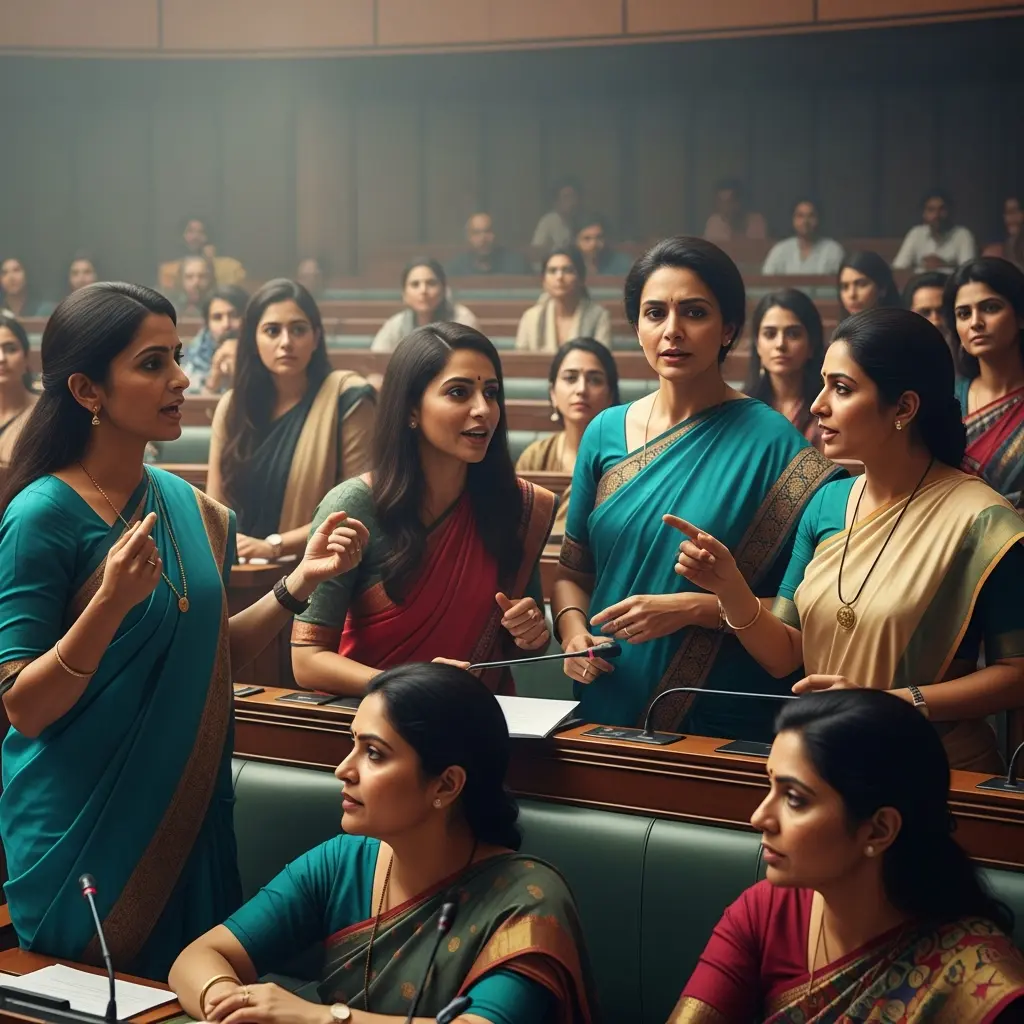
Passed with fanfare in 2023, the women’s reservation bill remains unimplemented. As 2029 approaches, so does the reckoning over whether Indian democracy will finally make room for half its population.
There is a particular kind of political frustration that comes not from being ignored, but from being acknowledged and then made to wait. For the millions of women who watched the 128th Constitutional Amendment sail through both houses of Parliament in September 2023—greeted with thumping desks and proud speeches—the current debate over actual implementation carries exactly that sting. The law exists. The will, apparently, is still being located.
The women’s reservation bill, which mandates that one-third of seats in the Lok Sabha and state assemblies be reserved for women, was celebrated as a historic moment in Indian governance reform. And in one sense it was: getting a constitutional amendment through a fractious Parliament is never trivial. But the legislation came with a condition that critics immediately flagged as a quiet escape hatch—implementation was tied to the completion of a delimitation exercise, which itself awaits a fresh census. With no firm census date and delimitation following behind it, the promised deadline of 2029 has begun to feel less like a commitment and more like a horizon that recedes as you approach it.
The government’s recent posture has been to go on the offensive, framing the debate as one of accountability and warning opposition parties against obstructing reform. It is a deft rhetorical move: position yourself as the champion of gender equality and dare your critics to look like they are blocking women’s political participation. But opposition groups have not taken the bait entirely, pointing out—with some justification—that the same government controls the census timeline and the delimitation process. If implementation is delayed, the delay is not opposition-made.
“The issue has sparked nationwide discussions on gender equality and political participation, with civil society groups urging swift implementation.”
What makes the Lok Sabha debate particularly charged right now is that it is no longer a conversation happening only in Parliament or on news channels. Civil society groups—many of them organizations that have spent decades working on women’s rights at the grassroots level—have grown visibly impatient. Their argument is straightforward: India has known for generations that women are underrepresented in its legislatures. The numbers are not disputed. What has always been disputed is whose turn it is to act, and when, and under what conditions. They are tired of that conversation. They want implementation.
The pushback from within political parties—including some that voted for the bill—adds another layer of complexity. The reservation is for women as a category, but it does not address caste. Parties that represent Other Backward Classes and Scheduled Castes worry that the reserved seats will disproportionately benefit upper-caste women, essentially trading one form of underrepresentation for another. This is not an unreasonable concern. India’s experience with reservation policy across other domains suggests that without careful design, the benefits of such measures can concentrate among those who are already relatively privileged within a marginalised group. The demand for sub-categorization—reserved seats for women from OBC and SC communities specifically—has real merit, and refusing to engage with it seriously does not make it disappear.
There is also the question of what reservation alone can accomplish. Countries that have achieved high levels of women’s political representation—Rwanda, Iceland, New Zealand—did so through a combination of quota policies and broader cultural and institutional change. Quotas get women in the door; what matters is whether the room they enter has been genuinely restructured to let them lead. India’s Parliament and state assemblies are still, in many respects, environments designed by and for men. The hours are punishing, security concerns are real, and the informal networks through which political power actually flows remain largely male. Reservation is a necessary condition for change. It is not a sufficient one.
None of this is an argument against moving forward. The imperfect is often the enemy of action in Indian policy debates, and the women’s reservation bill—whatever its design limitations—represents a meaningful structural shift. Countries that have crossed the threshold of thirty percent women in their legislatures consistently report different legislative outcomes: more attention to social welfare, health, education, and child policy. These are not stereotypes; they are findings that hold across diverse political contexts. India has every reason to want those outcomes.
The intensity of the current debate is, in a strange way, a sign of democratic health. A question that was shelved, deferred, and deprioritized for nearly three decades is now impossible to dismiss. Civil society is organized. Women voters—who turn out in large numbers in Indian elections—are paying attention. The political cost of continued delay is rising. Whether that rising cost is enough to move the census, accelerate delimitation, and make 2029 a real date rather than a symbolic one is the question that will define this chapter of Indian governance reform. The women who have waited this long deserve an answer that is more than another promise.
A Promise Deferred: Why India’s Women’s Reservation Debate Refuses to Go Away.