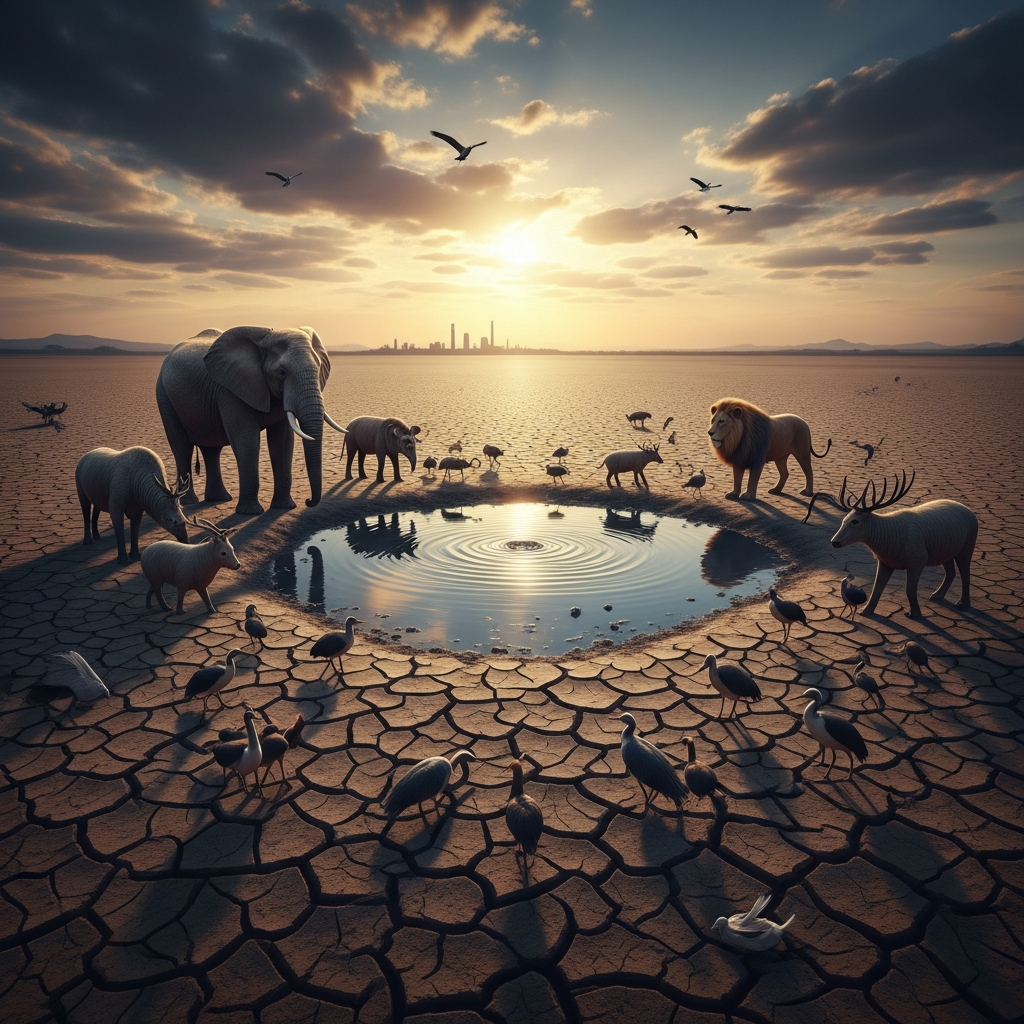
As Earth Day 2026 turns its attention to the global water crisis, a quiet crisis is unfolding across rivers, lakes and aquifers around the world – one that impacts every ecosystem, every species and every human life on earth.
Every year, Earth Day arrives with a theme. Some years it feels urgent. Some years it feels like a calendar obligation — a day of reusable bags and social media banners that fades by the weekend. But Earth Day 2026, with its laser focus on the global water crisis, comes at a time when the issue it raises is not a distant warning. It is a present day reality, playing out right now in dried-up river beds, depleted aquifers, collapsing fisheries and the daily lives of billions of people already spending more time, money and energy just finding enough clean water to survive.
Water is so fundamental to life that we have spent most of human history assuming it would always be there. It falls from the sky. It fills rivers and lakes. It runs from taps. The idea that it could become scarce — genuinely, dangerously scarce — is one that the human mind resists almost instinctively. And yet that resistance is becoming harder to sustain as the evidence accumulates, season by season, drought by drought, species by disappearing species.
A crisis with a familiar culprit
The water crisis does not exist in isolation. It is, at its roots, a climate change story — and understanding that connection is essential to understanding both the scale of the problem and the shape of any real solution. As global temperatures rise, the water cycle accelerates and destabilises. Evaporation increases. Precipitation becomes more erratic — heavier in some places, lighter in others, and less predictable almost everywhere. Glaciers that have fed rivers for millennia are retreating. Snowpacks that historically released water slowly through spring and summer are diminishing, shifting the timing of freshwater availability in ways that agriculture and human settlement were not designed to accommodate.
The result is a world where droughts and floods are no longer opposites but frequent neighbours — where a region can suffer years of crippling water scarcity and then be overwhelmed by rainfall so intense that parched soil cannot absorb it, triggering floods that kill people and destroy crops before the water vanishes into the sea. Climate change is not simply making the world hotter. It is making water — the most basic resource on which all life depends — fundamentally less reliable.
What the animals are trying to tell us
Wildlife conservation, the second major theme of this year’s Earth Day, is more tightly connected to the water crisis than it might initially appear. Ecosystems are not collections of species living independently alongside water — they are built around it, shaped by it, dependent on it in ways that ramify through entire food chains and habitat structures.
Low rivers mean the fish that require specific water temperatures and flow rates vanish. Dried-up wetlands mean the birds that feed and breed there lose their homes. Drought-stressed forests mean the insects, mammals and plants that constitute their living fabric start to disintegrate. So wildlife conservation in the age of climate change is inextricable from water conservation—saving one without saving the other is like trying to save a building while removing its foundations.
The loss of biodiversity that results from water stress is not just an ecological tragedy, though it is certainly that. It is also a practical catastrophe for human livelihoods. Freshwater fisheries feed hundreds of millions of people. Wetlands filter water, buffer floods, store carbon Forests regulate rainfall patterns at regional scales When these systems collapse, human communities—especially the poorest and most rural—bear the consequences most directly and most severely. Sustainability, in this context, is not an abstract value. It is a survival strategy.
The human face of scarcity
It is easy, when discussing the water crisis in global terms, to lose sight of what it actually looks like in individual human lives. It looks like a woman in sub-Saharan Africa walking three hours each way to reach a water source that may or may not be clean. It looks like a farmer in South Asia watching a well that has never run dry in living memory slowly, inexplicably dropping. It looks like a child in a city on the edge of a water-stressed region drinking from a tap and not knowing whether what comes out is safe.
These are not edge cases. They are the present experience of a significant portion of humanity — and on current trajectories, the portion of people affected by water insecurity will grow, not shrink, as the century unfolds. The experts who gather around Earth Day 2026 to stress urgent action are not being alarmist. They are being honest about a timeline that is no longer measured in generations but in years.
What urgent action actually looks like
Urgency without direction is just anxiety. What the water crisis actually demands — across governments, industries, and communities — is a combination of measures that are well understood but consistently under-resourced and under-prioritised.
It means investing seriously in water infrastructure, both to reduce the staggering losses from leaky distribution systems and to build the storage and recycling capacity that a less predictable water cycle will require. It means reforming agricultural water use, which accounts for roughly seventy percent of global freshwater consumption and which, in many places, is dramatically inefficient by any reasonable standard. It means protecting and restoring the natural ecosystems — wetlands, forests, river systems — that regulate water availability far more effectively than any engineering solution. And it means treating climate change itself as the root cause it is, rather than addressing only its symptoms while the underlying crisis deepens.
Earth Day comes once a year. The water crisis does not take a day off. Acknowledging that gap — between the rhythm of our attention and the relentlessness of environmental change — is perhaps the most important thing this year’s Earth Day can ask of us. The other important thing it can ask is simpler, and harder: do something about it, and do not stop.
We’re Running Out of the One Thing We Can’t Live Without.