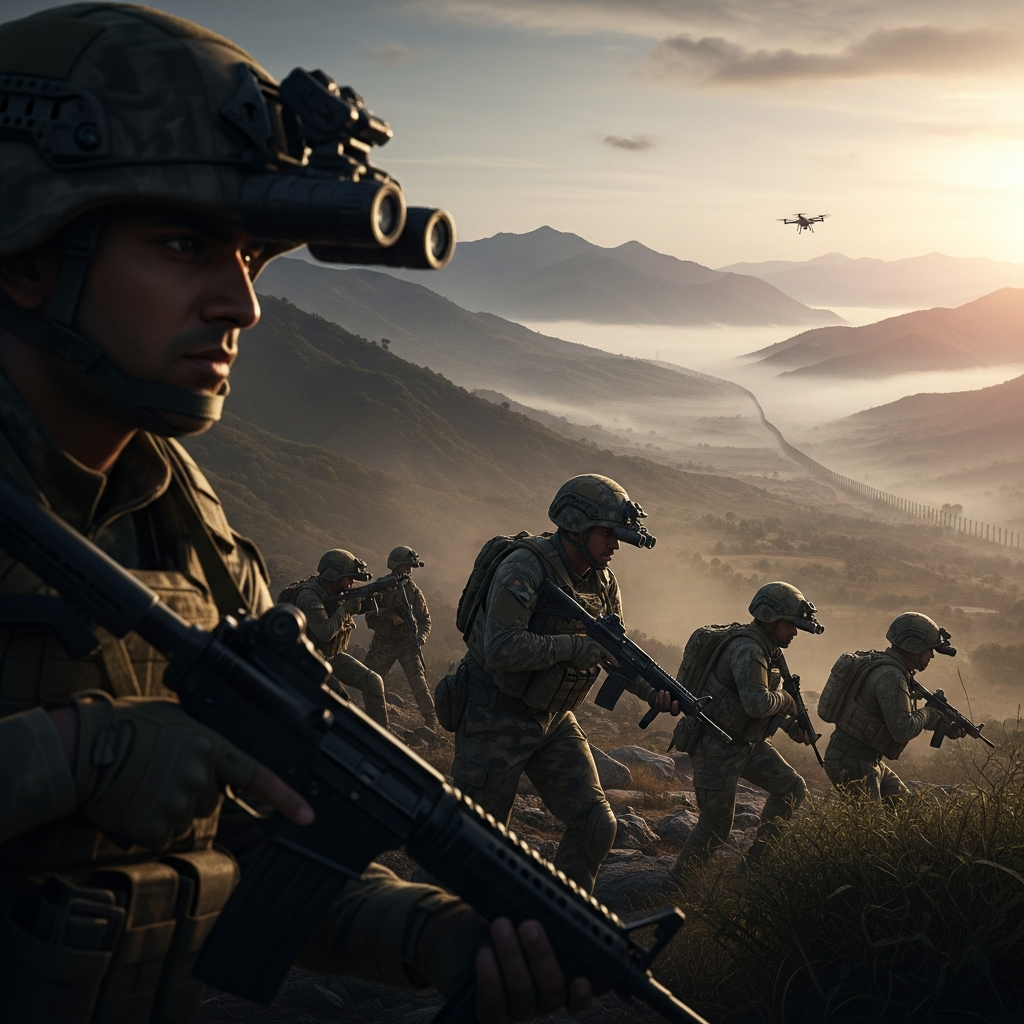
One year after a massacre in a meadow shook the nation’s conscience, India chose precision over patience — and in doing so, redrew the lines of its national security doctrine.
There are places that stay with you long after you leave them — meadows ringed by pine trees, the kind where the air tastes faintly of dew and distance. Baisaran Valley, nestled about seven kilometres from the quiet town of Pahalgam in Jammu and Kashmir, was one of those places. On the afternoon of April 22, 2025, that changed forever. Armed attackers moved through the surrounding forests and entered the meadow, where families and tourists had gathered, asking people to identify their religion before opening fire. Twenty-six civilians were killed. It was the deadliest attack on Indian soil since the 2008 Mumbai attacks — and it was designed, experts would later note, to be more than a massacre. It was meant to shatter the idea that Kashmir was returning to normal.
The Attack
The intent behind the Pahalgam attack went beyond the immediate loss of life. Tourism in the Kashmir Valley had, in recent years, become a quiet symbol of stability — of markets reopening, of families returning, of fear slowly retreating. Targeting tourists in a beloved meadow, and doing so along religious lines, was a calculated act of psychological warfare. Its goal was to break that nascent normalcy and bring fear back into the daily fabric of life in the region. The Resistance Front, widely understood to be a proxy of the Pakistan-based Lashkar-e-Taiba, initially claimed responsibility before retracting the claim — a pattern security analysts say is consistent with groups seeking to avoid retribution after attacks that kill civilians generate intense public backlash.
“Attacking tourists and doing so in a way that emphasised religious identity was intended to fracture that perception and reintroduce fear into everyday life.”
“Security analyst, quoted in post-operation review, 2025 Operation Sindoor When India’s response came, it was neither hasty nor measured. In the days after the attack, diplomatic channels were opened, international pressure applied behind closed doors, and military planners fine-tuned what would be one of the most consequential Indian military operations in recent memory. On the night of 6–7 May 2025, the Indian Armed Forces commenced Operation Sindoor — a name chosen with deliberate symbolism, evoking directly the personal grief of the families whose lives were ripped apart that day in Pahalgam. The Army, Navy, and Air Force acted in full coordination, striking nine terror camps across Pakistan and Pakistan-Occupied Kashmir, neutralising over a hundred terrorists including senior handlers and trainers linked to Jaish-e-Mohammed, Lashkar-e-Taiba, and Hizbul Mujahideen.
What distinguished Operation Sindoor from India’s earlier cross-border responses — the surgical strikes after Uri in 2016, the air strikes after Pulwama in 2019 — was both its depth and its deliberateness. This was not a single targeted strike. It was a coordinated, multi-service military operation that combined kinetic action with a broader set of non-military pressures, including India’s decision to suspend key provisions of the Indus Waters Treaty with Pakistan. New Delhi was signalling something new: that the old distinctions between a terrorist group and the state that shelters it were no longer operative. The message was unambiguous — future attacks would be treated as acts of war.
Precision and Restraint
Throughout the operation, Indian officials were careful to emphasize what was not targeted. Pakistani military establishments, they noted at the first press briefing on May 7, had been deliberately spared. The strikes were focused and measured — aimed at terror infrastructure, not at widening the conflict. This restraint was not weakness; it was strategy. By calibrating its response precisely, India preserved its moral authority internationally while still delivering a message that could not be misread. Global reaction bore this out — unlike earlier episodes, where India faced calls for de-escalation from major powers, this time several world leaders openly backed India’s right to defend its citizens. The Kashmir narrative, for perhaps the first time, was being read purely through the lens of counter-terrorism.
Pakistan responded with drone incursions and cross-border shelling, targeting, provocatively, religious sites — the Shambhu Temple in Jammu, a Gurdwara in Poonch, Christian convents. The intent appeared to be communal inflaming. A brief four-day conflict followed before a ceasefire, brokered through the Directors General of Military Operations of both countries, took hold on May 10.
The Hunt Continues
The military operation was one part of the story. In parallel, a 93-day counter-terrorism manhunt — Operation Mahadev — was launched to bring the direct perpetrators of the Pahalgam attack to justice. A multi-agency effort involving the Army, intelligence services, Jammu and Kashmir Police, and Central Armed Police Forces, it culminated in July 2025 with the elimination of all three terrorists who had carried out the massacre. Officials called it one of the most extensive operations in recent years, underscoring the improved intelligence-sharing and real-time coordination that made it possible.
A year on, India’s security environment remains vigilant. Senior defence officials continue to stress that Operation Sindoor was a beginning, not a conclusion. Terror networks, as they acknowledge themselves, are adaptive; they absorb losses, reconstitute, and continue. Even after the strikes, security forces uncovered explosive devices along infiltration routes and disrupted several planned attacks. The challenge of South Asia conflict has never lent itself to clean endings. What has changed, perhaps irrevocably, is India’s threshold — and the world’s understanding of where that threshold now lies.
A Nation Remembers
Along the Lidder River in Pahalgam, a black marble memorial now bears the names of all twenty-six who were killed in Baisaran Valley. Adil Shah, the local pony ride operator who died alongside the tourists he was guiding, is there too. On April 22, 2026, Prime Minister Narendra Modi led the nation in tribute, writing that the victims “will never be forgotten” and that India stands “united in grief and resolve.” These are not just words of consolation. They are, after Operation Sindoor, the outline of a doctrine — one that holds, firmly, that India’s security is not a matter for negotiation, and that those who mistake its patience for passivity do so at their own peril. The valley that once bled has not forgotten. Neither has the nation.
When the Valley Bled: India’s Answer to Pahalgam.