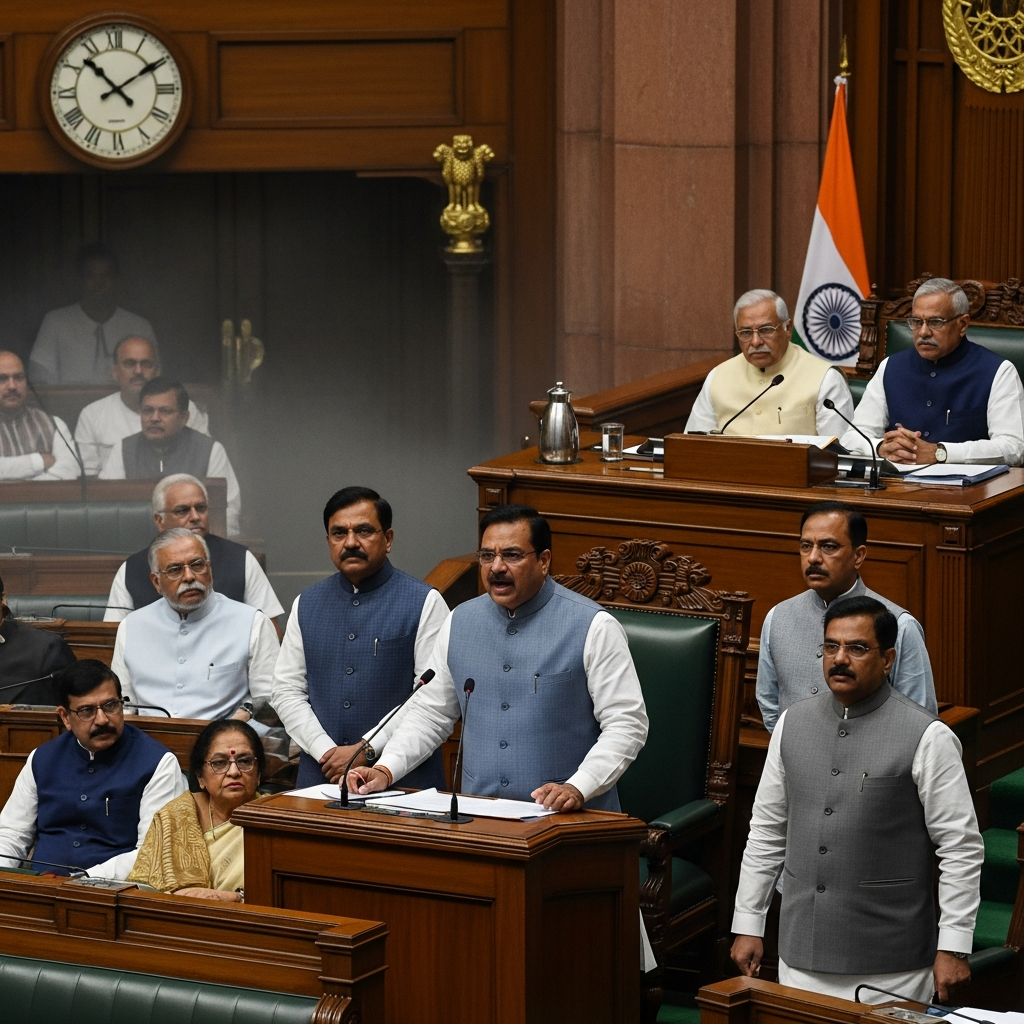
When Congress moved a privilege motion against PM Modi over his televised address after the defeat of a landmark women’s reservation bill, it did more than file a legal notice — it raised a question the country can no longer avoid.
There is a long tradition in Indian democracy of loud, bruising, often theatrical confrontation between the government and the opposition — but every now and then, a moment arrives that feels less like political theatre and more like a genuine reckoning. The privilege motion filed by Congress MP K.C. Venugopal against Prime Minister Narendra Modi on April 21, 2026, may well be one of those moments. What began as a procedural notice submitted under Rule 222 of Lok Sabha’s Rules of Procedure has quickly grown into something larger: a pointed argument about the boundaries of executive power, the dignity of elected representatives, and what it means to govern in a democracy that is increasingly mediated by television cameras.
What Triggered It The immediate trigger was a 29-minute address by PM Modi to the nation on April 18, 2026 – a day after the Constitution (131st Amendment) Bill, 2026 was defeated in the Lok Sabha. The bill, which sought to implement women’s reservation in parliament and increase the strength of the Lok Sabha to 816 seats, could not get the requisite two-thirds majority required under Article 368. The defeat was, by any measure, a significant legislative setback for the government. What followed, however, is what set off the political storm. In his nationally televised address, the Prime Minister directly referenced the voting pattern of opposition members and, according to the privilege notice, compared the bill’s defeat to the “foeticide” of the women’s quota — a charged analogy that opposition parties called both misleading and deeply unfair.
What is a privilege motion? Background A parliamentary privilege is a right or immunity that applies to members of parliament in the exercise of their duties. A privilege notice or privilege motion is a formal complaint that these rights have been breached – in this case that the Prime Minister’s remarks impugned the exercise of their constitutional duties by MPs and impeded the free functioning of the House.
The Congress Argument
Venugopal’s notice to Lok Sabha Speaker Om Birla was blunt in its language. It described the Prime Minister’s remarks as “unprecedented,” “unethical,” and amounting to a “blatant misuse of power.” The core of the grievance was this: that it is a long-established parliamentary convention that no person — not even the Prime Minister — may publicly reflect upon, or impute motives to, the conduct or voting of any member of the House. By doing so on national television, the Congress argued, Modi had not merely crossed a political line, but a constitutional one. Congress President Mallikarjun Kharge added fuel to the fire at a press conference, accusing the Prime Minister of misleading the public over the nature of the bill and of using central agencies to intimidate opposition parties. The notice also contended that opposition lawmakers had, just days before the vote, publicly stated their unanimous support for women’s reservation — making the Prime Minister’s framing of their opposition as betrayal particularly difficult to defend.
“Any such reflection or imputation directly undermines the dignity and authority of the House and interferes with the free and independent discharge of parliamentary duties.”
— K.C. Venugopal, Privilege Notice to Lok Sabha Speaker, April 21, 2026 The Larger Stakes Strip away the legal scaffolding and what you are left with is a question about democratic norms — and how they bend under pressure. A Prime Minister’s address to the nation is not routine. It carries the weight of office, the reach of state television, and an audience of hundreds of millions. When that platform is used to publicly blame elected representatives for a legislative defeat, it does something that a parliamentary speech cannot: it takes the argument outside the chamber, beyond the rules that govern debate, and into a space where the other side has no guaranteed right of reply. That asymmetry is precisely what the opposition finds intolerable. Congress, along with CPI(M) and CPI, also petitioned the Election Commission over the address, claiming it violated the Model Code of Conduct in force due to the ongoing state assembly elections – a move that indicates the privilege motion is part of a larger, coordinated political and legal strategy. The Government’s Stand The ruling dispensation has pushed back hard, arguing that the Prime Minister has every right to communicate directly with citizens on matters of national importance, and that explaining the fate of a major constitutional amendment to the public is not only appropriate but expected. The government’s supporters contend that the opposition’s decision to vote against — or abstain on — a bill it claimed to support is itself worthy of public scrutiny, and that the Prime Minister was simply holding up a mirror to a contradiction. The Bharatiya Janata Party has also characterised the privilege motion as a reflexive opposition tactic, pointing out that such notices rarely result in formal proceedings and often serve more as political messaging than as genuine parliamentary remedies. How Speaker Om Birla chooses to respond to the notice will be closely watched — not because the procedural outcome is certain, but because the manner of disposal will itself send a signal.
Symptom of a Deeper Problem This episode, after all, is symptomatic of the increasing fragility of the political common ground in the Indian Parliament. The debates on governance, accountability and public communication have become sharper, more personal and more difficult to contain within institutional channels. When a government and its opposition can no longer agree on what counts as fair comment, when a nationally televised speech by the most powerful office-holder in the country becomes a matter of formal legal dispute, something fundamental has shifted. The privilege motion may or may not proceed to any substantive conclusion. But its significance lies not in what it achieves procedurally — it lies in what it reveals about the condition of India’s parliamentary democracy today: stretched, contested, and very much alive. The battle for the soul of India’s parliament is rarely fought with swords or slogans alone. Sometimes, it is fought with a two-page notice to the Speaker.
A Notice, a Speech, and the Battle for Parliament’s Soul.