When platforms began speaking louder than performance, athletes stopped being just competitors — they became brands, broadcasters, and cultural phenomena. That shift is now complete, and the rules of the game have changed forever.
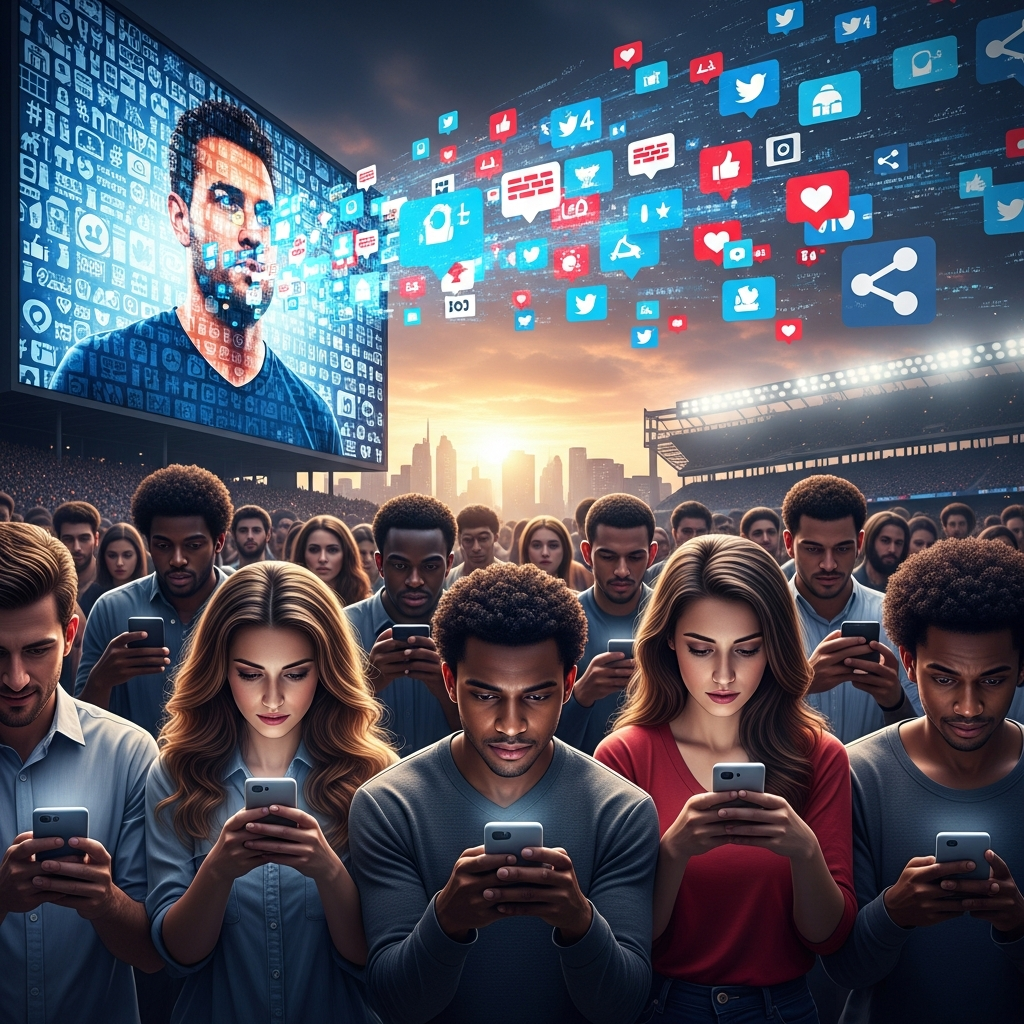
Think about the last sports moment that truly stopped you in your tracks. There is a decent chance it did not happen inside a stadium, or during a broadcast, or even on a highlights reel. It happened on your phone — a video that blew up overnight, a post that sparked a thousand conversations, a clip shared so many times it felt like the entire world had seen it within hours. That is the world that digital culture has built around sport, and there is no going back. Social media has not merely changed how we follow sport. It has fundamentally altered who gets to tell the story, whose version of events gains traction, and — perhaps most importantly — how we decide what, and who, matters.
The New Power Dynamic
For most of the 20th century, the story of sport was told by a relatively small group of gatekeepers — broadcasters, newspaper editors, magazine journalists, and television producers who shaped what audiences saw and believed. An athlete who impressed on the pitch but kept a quiet life off it could be heroic and anonymous at once. An athlete who stumbled publicly could be defined by a single damning headline for years. The audience received the narrative; they did not create it. Social media dismantled that architecture almost entirely. Platforms like Instagram, TikTok, and X gave athletes something previously inconceivable: a direct line to their audience, bypassing every traditional filter. They could now showcase their personality, address rumors, share their daily lives, and above all, craft their own identity in their own words and images. The gatekeeper era did not end slowly. It ended with a feed refresh.
$60B+
Global sports media rights value in 2024
76%
Active athletes on social media who endorse at least one brand
72%
Of a brand’s social value drivers attributed to athletes
Branding Over Performance
Here is where things get genuinely complicated. The freedom that social media gave athletes came bundled with a commercial logic that now shapes sports media in ways that are difficult to fully untangle. Research now shows that social media engagement metrics have become central in determining an athlete’s endorsement potential — in some cases carrying as much weight as what they actually achieve on the field. Consider what that means in practice. An athlete who has cultivated a million loyal followers, who posts thoughtfully, who understands the visual grammar of Instagram and the algorithmic pulse of TikTok, is — commercially speaking — often worth more to a brand than a slightly more decorated rival who simply plays and says little. The sport itself has not changed, but the ecosystem around it rewards a new kind of skill: the ability to perform not just in competition, but in front of a lens, daily, indefinitely.
“Social media engagement metrics now reign supreme in endorsement potential, often weighing as heavily as on-field performance.
— Platform Power, Athlete Branding & Sport Governance, PMC Research Review, 2025
Athletes as Architects
The most sophisticated athletes in sport media today are not just responding to this new digital culture; they are also actively shaping it. LeBron James built an entertainment empire that extends from the basketball court into film, media ownership, and philanthropy, using digital platforms as the connective tissue throughout. Cristiano Ronaldo commands an estimated $2.3 million per sponsored Instagram post — numbers that have less to do with football and everything to do with a global personal brand built post by post over more than a decade. Skier and cultural figure Eileen Gu has been able to strategically balance Western and Chinese platforms simultaneously — Instagram, TikTok and Weibo — to create a dual identity that extends beyond any single athletic accomplishment. These athletes are not outliers. They are the template. They have shown the generation coming up behind them that the story you tell about yourself, online, every day, is as important as anything you do in competition.
The implications run deeper than individual celebrity. Social media has also reshaped how entire sports are perceived and consumed. During major events like the Olympics or the World Cup, athletes now routinely use their personal platforms to craft narratives that run independently of team or federation messaging — controlling how their sport is understood by audiences who may never buy a ticket or watch a broadcast.
Research suggests that challenges such as privacy breaches, online harassment and reputational harm remain. Incidents like Kyrie Irving’s controversies show how one ill-considered post can undo years of careful brand building, and damage commercial relationships overnight. Studies also warn that the NIL economy, and the relentless pressure to maintain an online presence, can cause athletes — especially younger athletes — to focus more on their digital persona than on performance, creating a tension at the very core of what sport is meant to be about.
What This Means for the Audience
For fans, the transformation has been exciting and, at times, disorienting. Social media, on one hand, has democratized access to sport in ways that were unthinkable twenty years ago. A teenager in Lagos can follow an athlete in São Paulo in real time, feel the intimacy of behind-the-scenes content, participate in global conversations, and encounter sports figures as fully-formed, complex human beings rather than distant icons. The emotional connection between athlete and fan has never been richer or more immediate. But that same immediacy also drives the rapid construction of narratives — some fair, some not. Social media accelerates the pace at which collective judgments are made. Stories unfold quickly, and audiences shape perceptions in real time, often before all the facts are in place. The line between reporting and rumor, between analysis and opinion, between truth and trending, has never been thinner.
A New Chapter, Still Being Written
What digital culture has created is not simply a new distribution channel for sports media. It has created a new economy, a new set of values, and a new kind of celebrity — one that rewards consistency, personality, and platform fluency alongside (and sometimes above) raw athletic achievement. Whether that is a wonderful thing or a troubling one probably depends on where you are standing. For the athlete who parlayed a mid-table career into a thriving personal brand, it is liberation. For the purist who believes that sport should be decided entirely on the field, it may feel like the whole game has been quietly moved to a different arena. Perhaps both of those things are true at once. The scoreboard has not gone anywhere. But the story being told around it has never been louder, more contested, or more consequential than it is right now.
Beyond the Game: How Social Media Rewrote the Sports Story.