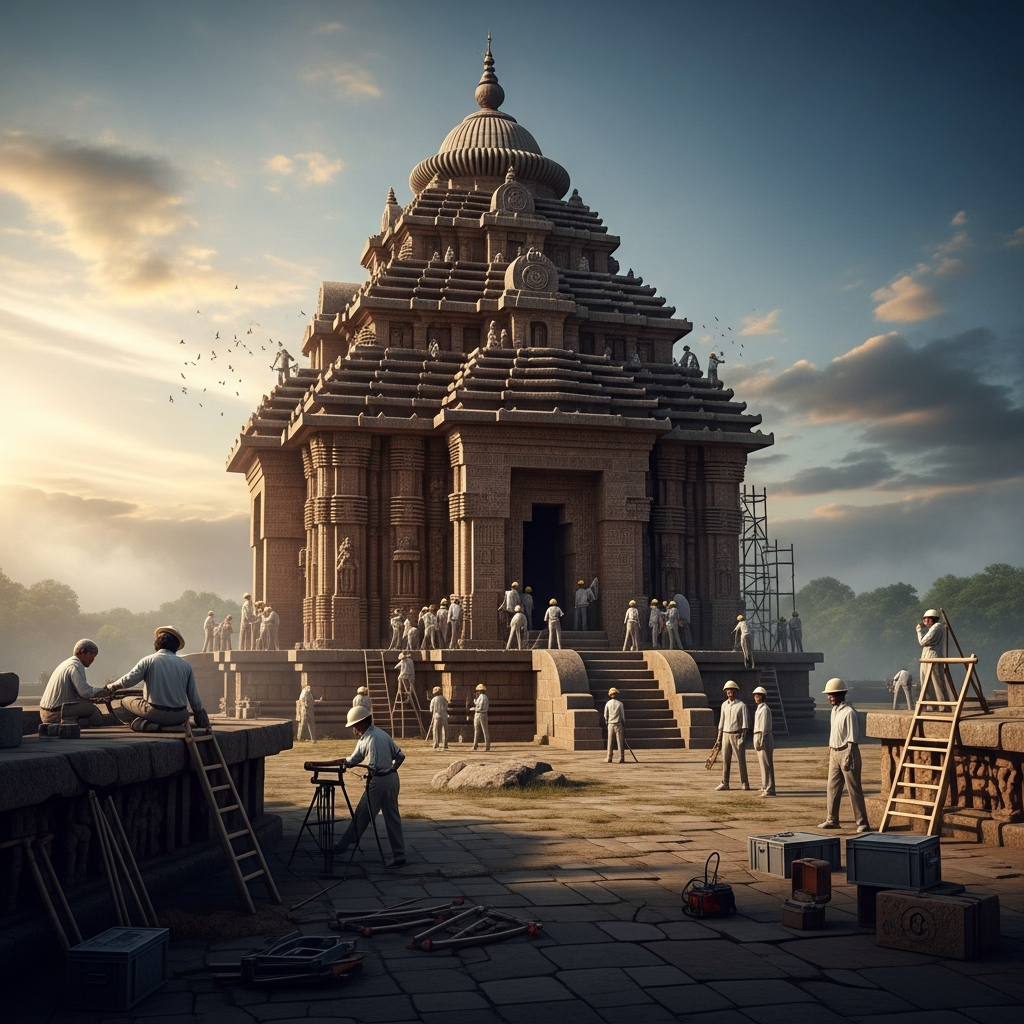
There is a particular kind of silence that settles over ancient places — a weight that has nothing to do with noise and everything to do with time. Stand before the Konark Sun Temple on a quiet morning, and you feel it immediately. In the morning sun, the sandstone shines amber, as if the building itself remembers what it was built to celebrate. Carved in the 13th century as a giant chariot for the sun god Surya, the temple is not simply a monument. It is a statement — of devotion, of artistic ambition, of a civilization’s desire to reach toward something eternal.
That statement, however, has been weathering for eight centuries. And now, the Archaeological Survey of India has stepped in with a renewed commitment to make sure it endures for eight more.
The Restoration Begins The Archaeological Survey of India has formally begun a massive restoration project at the Konark Sun Temple in Odisha, one of the most structurally complicated and symbolically important UNESCO World Heritage sites in the country. The focus, conservation experts say, is two-fold: address the immediate concerns around structural stability, and institute long-term conservation measures that respect the integrity of the original craftsmanship.
This is not a simple paint-and-polish exercise. The Konark Sun Temple restoration involves careful scientific assessment of the stone, monitoring of load-bearing sections, treatment of salt crystallization damage, and the painstaking documentation of carvings that have suffered centuries of wind, rain, and biological growth. Every intervention must be measured against one overriding principle: do no further harm.
For historians, conservationists, and the millions of visitors who make their way to this corner of Odisha each year, the news has been welcomed with genuine relief. The temple has needed this level of sustained attention for a long time.
Why Konark Needs Saving — and Why It’s So Difficult
The Konark Sun Temple is not just old. It is intricately, almost impossibly old — and the very features that make it extraordinary are what make its conservation so challenging.
The temple was conceived as a chariot with twelve pairs of elaborately carved wheels, pulled by seven horses, carrying the sun god across the sky. Every surface is covered in sculpture — celestial musicians, erotic carvings, mythological figures, geometric patterns — each one a masterpiece of medieval Indian craftsmanship. The sheer density of carved stone means that structural movement anywhere in the complex has cascading consequences for the artwork it supports.
The main shikhara, or tower, collapsed centuries ago under circumstances that historians still debate. What remains — primarily the Jagamohana, or audience hall — has been propped and reinforced through various interventions over the decades, including a controversial decision in the colonial era to fill the interior with sand to prevent collapse. That decision has had lasting consequences for the structure’s internal environment, contributing to moisture retention and accelerated deterioration in some sections.
ASI’s current restoration initiative builds on years of technical study, and the approach this time is more holistic than anything attempted before. Today, non-invasive diagnostic tools such as ground-penetrating radar and 3D laser scanning are being used to map the interior condition of the structure without disturbing the stone. It is conservation science meeting ancient architecture – a meeting long overdue.
Implications for Odisha Tourism Not only for historical and conservation reasons but also for the economy and cultural identity of the region, the restoration of the Konark Sun Temple has implications. Odisha tourism has long promoted the temple as its crown jewel, and rightly so. The Konark Dance Festival, held every year with the temple as the backdrop, draws performers and spectators from all over the country and the world. The monument attracts hundreds of thousands of domestic and international tourists annually, underscoring that its preservation is as much an economic imperative as it is a cultural one.
Odisha’s tourism stakeholders have received the ASI announcement with cautious optimism. The concern, as always with major restoration projects, is disruption during the work period — restricted access, scaffolding that obscures the temple’s visual splendor, extended timelines. But there is broad understanding that the short-term inconvenience of conservation work is a far better outcome than the long-term tragedy of irreversible deterioration.
State tourism authorities said visitor management plans were being worked out along with the restoration schedule to ensure minimum impact on the site’s accessibility. “We want to ensure that Odisha tourism continues to flourish even as the work goes on,” said an official.
The Larger Stakes: Cultural Heritage India Cannot Afford to Lose The Konark project is part of a larger national conversation about India’s relationship to its UNESCO sites, and its cultural heritage more broadly. India is home to forty-three UNESCO World Heritage sites — a number that reflects the extraordinary depth and diversity of its history. But recognition alone does not equal preservation. These sites require sustained investment, scientific expertise, and institutional commitment that goes beyond periodic emergency interventions.
Cultural heritage India carries is not merely a tourism asset or a point of national pride. It is a living record of civilizations that shaped the subcontinent — their art, their faith, their understanding of the cosmos. The Konark Sun Temple was built by a king who wanted to capture the movement of the sun in stone. That ambition deserves to be honored with the seriousness and resources it demands.
ASI India news around Konark is, in this sense, more than an administrative update. It is a signal that the country is choosing — actively and deliberately — to prioritize what it inherits over what it might otherwise spend that attention on.
The Sun Still Rises
There is a reason the Konark Sun Temple has endured in the imagination of every person who has ever seen it, in photograph or in person. It does not merely depict the sun. In the quality of its stone, the intricacy of its carving, and the audacity of its conception, it seems to contain something of the sun’s own energy — warm, ancient, and stubbornly persistent.
The ASI’s restoration work is, at its heart, an act of faith. Faith that what was built with such extraordinary care eight hundred years ago is worth protecting with equal care today. Faith that the people who come to stand before it in the decades ahead deserve to feel what visitors feel now — that particular silence, that amber light, that sense of time held briefly, beautifully still.
The sun, as ever, keeps rising. The task is simply to make sure the temple is still there to greet it.
Saving a Sun: ASI Races Against Time to Restore Konark’s Ancient Marvel.