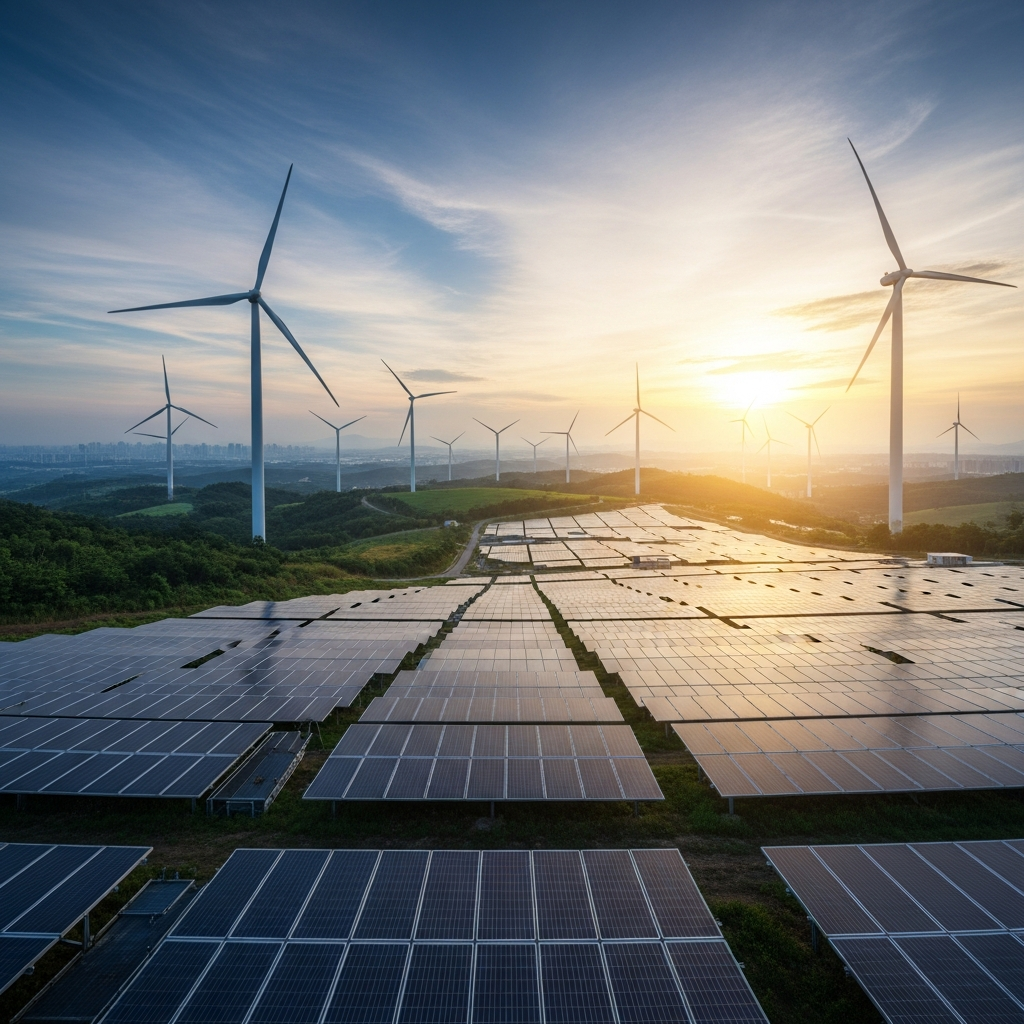
For decades, renewable energy lived in the realm of the aspirational. It was the subject of climate summits and policy white papers, of passionate speeches and cautious pilot projects. It was always the future — promising, necessary, perpetually just around the corner. Something shifted. Quietly at first, then unmistakably, the economics caught up with the idealism. And now, the transition to green energy is no longer a question of whether. It is a question of how fast.
The answer, increasingly, is: faster than almost anyone predicted.
The Economics Changed Everything
The most important thing that happened to renewable energy in the last decade wasn’t a policy breakthrough or a climate agreement, as significant as those were. It was a price collapse. The cost of solar power has fallen by more than 90 percent over the past decade. Wind energy has followed a similar trajectory. What was once financially viable only with heavy government subsidy is now, in many parts of the world, the cheapest form of new electricity generation available — full stop.
This is not a talking point from an environmental advocacy group. It is the conclusion of financial analysts, energy economists, and the investment arms of some of the world’s largest banks. When the numbers work, capital follows. And capital has been flowing into renewable energy at a pace that would have seemed extraordinary even five years ago.
Global investment in clean energy crossed the $1 trillion threshold in recent years — a milestone that represents not just ambition but genuine market confidence. Investors are not funding solar and wind projects out of altruism. They are funding them because the returns are real, the risks are understood, and the long-term demand outlook is essentially guaranteed by the trajectory of global energy consumption.
Solar Power Growth: The Standout Story
If one technology has defined this era of the energy transition, it is solar. Solar power growth has been relentless and, in many ways, revolutionary. From rooftop panels on suburban homes in Germany to utility-scale installations sprawling across the deserts of the Middle East and the plains of India, photovoltaic technology has moved from niche to mainstream with remarkable speed.
India’s solar story alone is instructive. The country has set targets that once seemed wildly optimistic — hundreds of gigawatts of installed solar capacity by the end of the decade — and has been making credible progress toward them. The combination of abundant sunshine, falling panel costs, and government commitment has made India one of the most active solar markets in the world. State-level auctions regularly attract international bidders, and the pipeline of projects under development continues to grow.
China, the United States, and the European Union are scaling solar in ways that are reshaping global electricity systems. Grid operators who once worried that solar’s intermittency made it unsuitable as a primary power source are now grappling with a different problem: managing an abundance of cheap solar power during peak generation hours while building the storage and transmission infrastructure to spread it more evenly.
That is a good problem to have. It is the problem of success.
Wind Energy: The Offshore Frontier
While solar has grabbed headlines, wind energy has been doing its own quiet work — and the next chapter of that story is being written offshore. Offshore wind projects, once prohibitively expensive and technically challenging, have matured rapidly. European nations — the UK, Denmark, the Netherlands, Germany — have led the way, installing massive turbines in the North Sea that generate power at scales previously associated only with large thermal plants.
The United States has entered the offshore wind market with significant federal backing, and Asian nations including South Korea, Japan, and Taiwan are developing their own offshore pipelines. The appeal is straightforward: offshore winds are stronger, more consistent, and further from the population density concerns that sometimes complicate onshore projects.
The costs remain higher than onshore wind or solar, but they are falling — and the scale of energy generation possible in offshore environments makes the investment case increasingly compelling for countries with long coastlines and high energy demand.
Climate Solutions Demand More Than Energy Generation
Honest accounting of the energy transition requires acknowledging that generation is only part of the challenge. Climate solutions that actually work at the scale the planet needs require parallel progress on energy storage, grid modernization, electrification of transport and industry, and the phase-down of fossil fuel infrastructure — all simultaneously, across countries with vastly different starting points and resources.
Battery storage technology has improved significantly, and costs are falling in ways that mirror the earlier solar trajectory. Grid-scale batteries are increasingly being paired with solar and wind installations to smooth output and provide reliability. But storage at the scale needed for a fully renewable grid remains a frontier challenge — one that is attracting enormous research investment and some of the brightest engineering minds in the world.
The fossil fuel cost equation is also shifting the calculus for policymakers. Energy security concerns — sharpened by geopolitical disruptions to oil and gas supply chains in recent years — have given renewable energy advocates a powerful new argument: domestic solar and wind cannot be embargoed. A country that generates its electricity from sunshine and wind is not vulnerable to the price shocks that ripple through economies every time there is instability in a major fossil fuel producing region.
Sustainability as Strategy, Not Just Conscience
What has changed most fundamentally in the global conversation around sustainability is the framing. For years, the case for green energy was made primarily in moral terms — the right thing to do for the planet, for future generations, for the species. That case remains true and important. But it has been joined by a parallel case made in the language of strategy and economics.
Nations that lead in renewable energy technology will define the industrial order of the coming decades. The supply chains for solar panels, wind turbines, batteries, and the critical minerals that underpin them are becoming as strategically significant as oil pipelines once were. Countries and companies that position themselves at the center of those supply chains are not just being environmentally responsible — they are making a calculated bet on where power, in both the literal and geopolitical sense, will come from.
The Work Ahead
None of this is to suggest the transition is complete or that the hard work is behind us. The gap between current renewable energy deployment and what climate science says is necessary to limit warming to manageable levels remains substantial. Emerging economies face particular challenges — they need to expand energy access rapidly while simultaneously avoiding the carbon-intensive development pathways that industrialized nations took. That is an enormous ask, and it requires financial and technological support from wealthier countries that has not always been forthcoming at the scale promised.
But the direction of travel is no longer in doubt. The world is building a different energy system — one solar panel, one wind turbine, one offshore platform, one grid-scale battery at a time.
The future arrived quietly. It is already producing electricity.