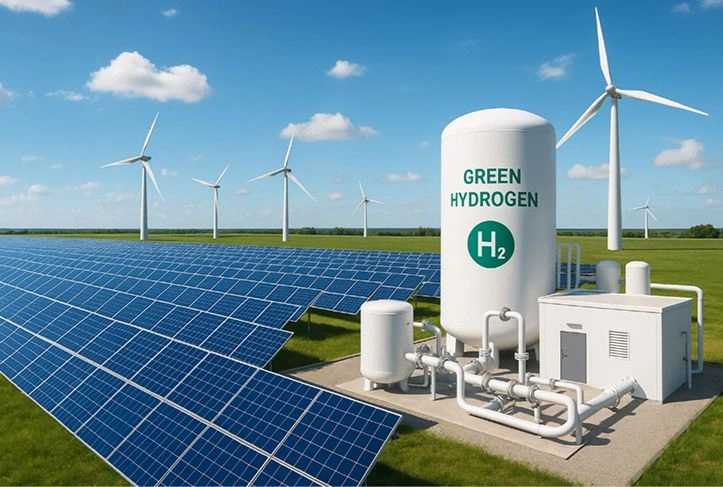
India’s green hydrogen mission is no longer just a policy headline. It is about going from intention to early execution. The government is pushing hard to establish a cleaner fuel environment that can cut emissions and reduce oil and gas imports, while giving Indian industry a new long-term advantage.” The difficulty is now easy to describe, hard to tackle: can India scale green hydrogen quickly enough to be meaningful?
Why Green Hydrogen is Important Now
Green hydrogen is made using renewable electricity, usually from solar or wind, to split water into hydrogen and oxygen. Green hydrogen, unlike grey hydrogen which is produced from fossil fuels, has zero carbon emissions in its production process. And it’s one of the most monitored technologies in the global energy transition.
The pull for India is not just in climate targets. The country imports a major portion of its energy needs therefore any clean fuel that may substitute for fossil imports has strategic relevance. It also provides a route for hard-to-abate industries like fertilisers, refineries, steel, shipping and heavy transport to cut emissions without having to wait for a full electrification breakthrough.
The Mission Behind The Push
4 January 2023 The Union Cabinet authorized the National Green Hydrogen Mission with an outlay of ₹19,744 crore. The primary objective is to develop India into a global hub for green hydrogen and its derivatives in terms of production, consumption and export by 2030.
The project aims for 5 million metric tonnes of green hydrogen a year by 2030, supported by around 125 GW of new renewable energy capacity to make hydrogen. The government has also estimated large economic and environmental benefits including over 6 lakh employment, over Rs 1 lakh crore in fossil fuel import cost reductions and approximately 50 million metric tons of greenhouse gas emissions averted every year by 2030.
This is not a narrow energy agenda. It’s a broad industrial policy that ties together clean electricity, manufacturing, logistics, standards, ports and exports. Larger design is one of the reasons why the mission has gained so much attention in India and worldwide.
So Far What’s Going On
The major story is that India has started to construct significant capacity but the numbers are still minor relative to the aim. According to the legislative data provided in March 2026, India had commissioned roughly 8,000 tons per annum of green hydrogen production capacity under the mission as of February 2026.
That number is key because it demonstrates movement after a sustained buildup of policy. And it illustrates the divide. Eight thousand tons is a good start, but nowhere near the 5 million metric tonnes a year. Can a country shift from pilot scale to industrial scale fast enough to meet the target year of 2030? That’s the question that’s driving investor and policy debate now.
The new funding will also help institutional support, standards, testing facilities and hub expansion. In the first phase, the Ministry of New and Renewable Energy has planned at least two green hydrogen hubs with ₹400 crore allocated up to 2025-26 for hubs and associated projects.
Prices, Bids & Early Indications
“Price discovery is one of the clearest signals that the market is still in its early phase. The mission already has quote prices for green hydrogen supply through competitive bidding for Indian Oil Corporation’s refinery (₹397 per kg) and Bharat Petroleum and Hindustan Petroleum refineries (₹387 per kg), including 18% GST.
Those numbers provide a yardstick, but they also show why green hydrogen is still difficult to scale. The fuel remains costly relative to conventional options, thus early demand is likely to come from sectors that either require clean fuel for regulatory reasons, or can bear higher costs through long-term contracts.
This is why the first phase of India’s hydrogen rollout will likely be limited to refineries, fertilizer plants and export-oriented industrial clusters, rather than large consumer markets. The market will probably develop like most energy transitions do: little by bit, sector by sector.
Why India has the edge
India has three big advantages in the green hydrogen competition. First, it has a lot of solar and wind potential. Second, it has a substantial industrial base to generate domestic demand. Third, it has a strong policy interest in reducing dependence on imports, notably on energy and industrial inputs.
The importance of this combination is that green hydrogen is not simply about forming the molecule itself. It also requires inexpensive renewable energy, electrolyzers, water, storage infrastructure, transportation systems and a reliable market for its product. Bringing these aspects together, rather than in isolation, could improve India’s energy transition.
Strategic export aspects also exist. If India can ramp up production of green hydrogen and green ammonia, it may supply markets in Europe, Asia and the Middle East that are eager for low-carbon industrial fuels. That export prospect is one reason the mission has not been sold as a climate program but as an industrial growth engine.
The Major Obstacles
The main problem is the price. Green hydrogen is still more expensive to create than traditional hydrogen derived from natural gas or coal. Without good renewable power economics, cheaper electrolyzers and infrastructural assistance, the sector won’t be able to develop fast.
The second difficulty is infrastructure. Hydrogen is not easy to store or transfer, thus India needs pipelines, storage systems, export handling capacity, port renovations and industrial clusters that can support the whole value chain. The project does contain green hydrogen hubs, but it will require time and effort to spread them out at scale.
The third barrier is certainty of demand. There is little incentive for industries to commit significant capital until they see solid governmental signals, long-term contracts and assurance that clean hydrogen will remain competitive. “That’s where standards, certification and clear procurement frameworks are critical.”
India’s Climate and Industry Interests
India’s green hydrogen mission is at the crossroads of climate policy and economic development. First, it supports the country’s net-zero direction by 2070. On the other hand it makes possible the decarbonization of hard-to-electrify regions.
Low-carbon iron for the steel industry could ultimately be produced using green hydrogen. It can substitute the normal hydrogen used in fuel processing in refineries. It could reduce emissions from ammonia manufacturing for fertilisers. These are not hypothetical use cases but represent some of the largest industrial sources of emissions in the country.
The potential economic upside is enormous if India can establish itself as a serious exporter of green hydrogen derivatives. Whether India can keep renewable electricity cheap and build systems fast enough to outpace or match competitors in Australia, the Middle East and parts of Europe will determine export competitiveness.
2026: What To Watch
The coming years will show whether the green hydrogen tale is a serious industrial transition or a promising but limited pilot phase. Look for three items in particular:
New capacity additions above the base of 8,000 tons per annum.
Development of the proposed green hydrogen hubs and supporting infrastructure.
Signs that big companies are locking in extended offtake deals at more feasible prices
And if those pieces move together, India may establish a serious clean fuel economy, not just a policy framework. If they move slowly, the mission can still help, but at a slower rate than the government wants.
India’s Green Hydrogen Push Gains Momentum, But the Real Test Is Yet to Come