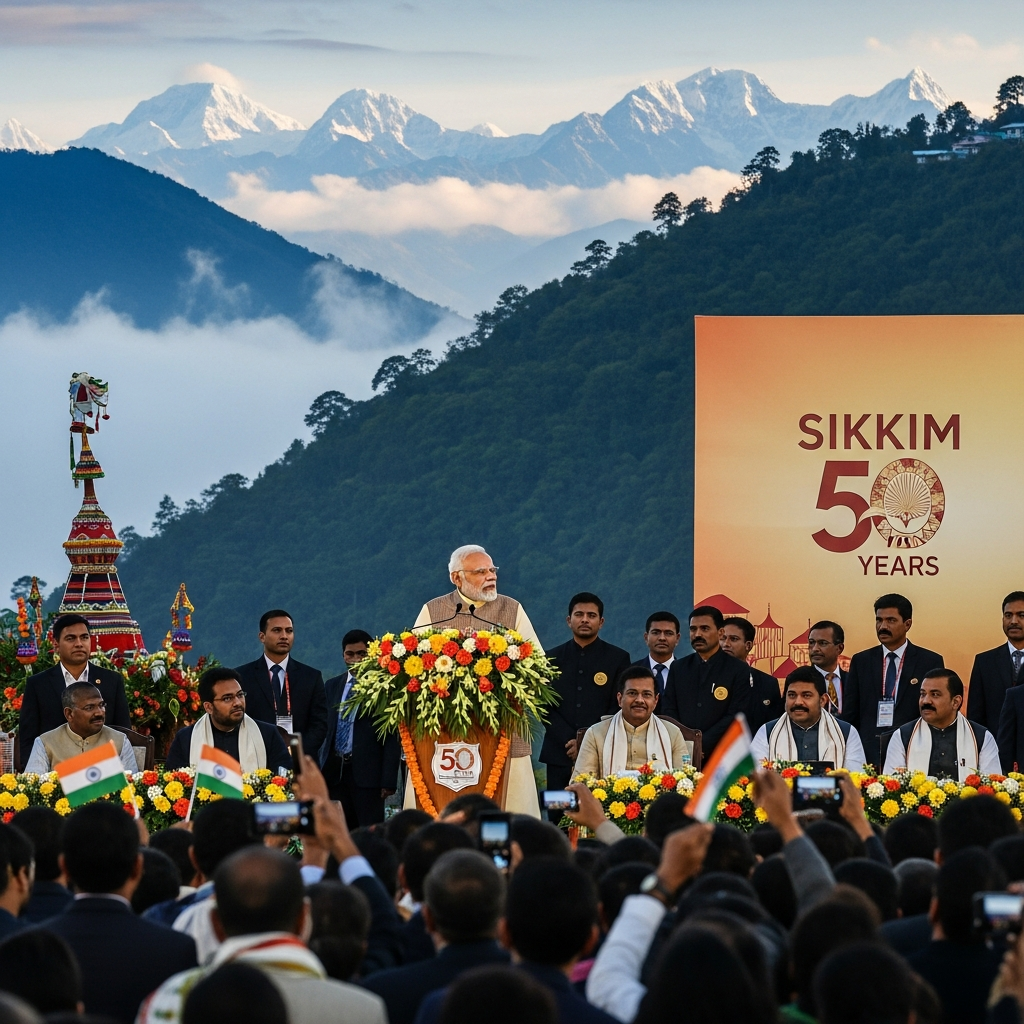
As Sikkim completes five decades as part of the Indian Union, Prime Minister Narendra Modi’s visit to Gangtok carries both historical weight and forward-looking intent.
here is something quietly extraordinary about Sikkim. Tucked into the eastern Himalayas, bordered by Nepal, Bhutan, Tibet, and the Indian state of West Bengal, it is one of the smallest states in the country — and yet, by almost every measure, one of its most remarkable. As the state marks 50 years of statehood in 2026, Prime Minister Narendra Modi’s visit to Gangtok feels less like a ceremonial obligation and more like a moment of genuine reckoning: with history, with geography, and with the question of what the next fifty years might look like for a state that has already come so far.
Modi arrived in Gangtok to attend the official Sikkim Statehood Day celebrations, joining thousands of residents and officials who had gathered to mark the occasion. The atmosphere, by most accounts, was one of quiet pride. Sikkim formally became India’s 22nd state in May 1975 — a process that was not without its political complications — and the decades since have seen a transformation that few small states anywhere in the world can match. From being one of the highest Human Development Index scores in the country to becoming India’s first fully organic state in 2016, Sikkim has carved out an identity that is both unique and deeply rooted in the land itself.
“Sikkim’s story is not just about a state joining a nation. It is about a people choosing a future — and building it, steadily, over fifty years.”
The Prime Minister used the occasion to inaugurate a series of development projects, from road infrastructure to tourism facilities to ecological conservation efforts. This is not just about cutting ribbons. For a state located at a critical strategic location — bordering China to the north and east — infrastructure development in Sikkim has implications that go far beyond mere convenience for its inhabitants. Connectivity in the Northeast has always been a national priority, and the investments announced during Modi’s visit are part of a larger government effort to bring the region more closely into the country’s economic mainstream, while preserving the ecological sensitivity that makes it such a unique place.
“Modi spoke eloquently about Sikkim’s journey, lauding its commitment to sustainable development and its reputation as one of India’s cleanest and most liveable states. He also reiterated the government’s support for tourism — a sector that has become increasingly central to Sikkim’s economy since the opening of the Bagdogra air corridor and the expansion of road connectivity through the Nathu La pass. Sikkim’s monasteries, trekking routes and the towering presence of Kangchenjunga, the world’s third-highest mountain, have drawn visitors from across India and beyond. The government’s aim is to grow this sector in ways that respect the state’s delicate ecosystems and cultural heritage — a balance that Sikkim has, so far, managed better than most.”
Beyond tourism, the visit also highlighted Gangtok news that often gets drowned in the din of larger states: the quiet achievements of local governance, the growth of healthcare and education infrastructure and the lasting cultural vibrancy of communities such as the Lepcha, Bhutia and Nepali speaking groups that collectively make up the vibrant social fabric of Sikkim. Northeast development has been a stated priority of the Modi government for some time, but what makes Sikkim’s case distinct is that much of the foundational work was already done — by successive state governments, by community leaders, and by citizens who took the idea of responsible growth seriously long before it became a national talking point.
The visit also has an unmistakable political dimension that it would be naive to ignore. Sikkim’s geography makes it one of the most strategically sensitive states in India, especially in view of the continuing tensions along the Line of Actual Control with China and the shadow cast by events such as the 2017 Doklam standoff. A high-profile prime ministerial visit reinforces both to residents and to neighbouring countries that India’s attention to the region is sustained and serious. It is a signal, as much as it is a celebration.
Yet it would be reductive to read Modi’s Gangtok visit purely through a political lens. There is genuine affection in the air when Sikkim 50 years is discussed — a sense that half a century is long enough to have produced a real story, one with its own textures and contradictions, its setbacks and breakthroughs. The Sikkim of 1975 was a place with dirt roads and limited access to the wider world. The Sikkim of 2026 has national parks, a functioning organic agricultural economy, and some of the best schools in the Northeast. That is not a miracle — it is the result of deliberate choices, sustained effort, and, yes, the not-inconsiderable advantage of India’s financial and administrative support over those fifty years.
As the celebrations wound down in Gangtok and the Prime Minister departed, what lingered was not the fanfare but the longer question. Sikkim has shown what a small state, thoughtfully governed and carefully connected to its natural environment, can achieve. The challenge – and the opportunity – is to take that spirit forward into the next fifty years, with all the pressures and possibilities, that a changing climate, a shifting geo-political landscape and a growing population will inevitably bring. The mountains, as always, will be watching.
Fifty Years and Still Climbing: Modi’s Sikkim Visit Marks a Milestone for the Himalayan State.