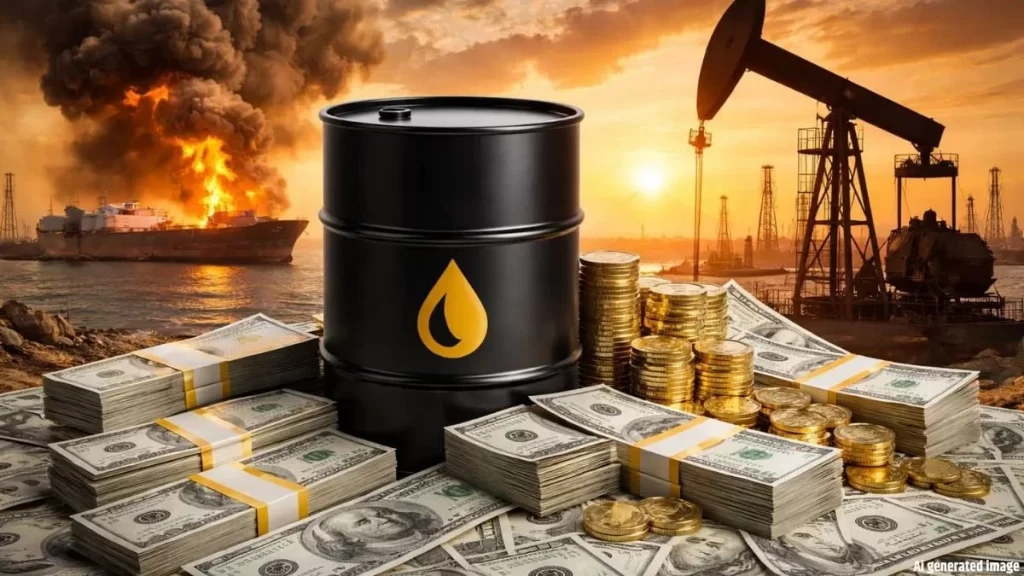
Global oil prices have risen beyond $110 a barrel for the first time in more than four years, as the battle in the Middle East deepens. The shift has sent new alarm bells ringing across central banks, finance ministries and households from New Delhi and Mumbai to New York and Berlin, with analysts warning that a protracted period at or above this level might push inflation higher, stall growth and strain public finances throughout the world.
Central to the gathering is the escalating military and political crisis over Iran that has already brought about a near-total suspension of tanker traffic through the Strait of Hormuz — one of the world’s most vital energy chokepoints — and raised the specter of a wider regional war. Markets are no longer pricing in a transient geopolitical bump; they are pricing in a lasting “oil shock” that may linger over the global economy through much of 2026.
How did oil get back over $110?
Brent crude, the international standard, rose from about $70–75 a barrel at the end of February 2026 to just over $115 in early March, before settling in the $107–110 area by the end of April. The US benchmark, West Texas Intermediate (WTI), has behaved similarly, spiking above $110 in March and trading in the mid-to-high $90s for much of April while the war dragged on.
Analysts refer to three main reasons:
Direct military escalation in Iran: The US and Israel have hit Iranian energy facilities, especially near the South Pars gas field (which Iran shares with Qatar), rattling traders and sparking worries of a wider interruption to LNG and oil supplies. They are more than just production facilities. They are emblems of national energy security in an area where politics and oil are intertwined.
Risk of chokepoint at strait of Hormuz: Tanker traffic across the strait, which accounts for around a fifth of the world’s oil and gas supplies, has ground to a halt as insurers, shippers and operators assess the risk of mines, drones and missile strikes. Even the fear of a shut down is pinching the world market; there is no fast, large scale alternative route for Middle‐eastern crude.
Market psychology and risk premia: Futures markets now price in a big “war premium.” Traders are pricing in averages of $110, $130 or even $150 a barrel oil if the war continues or expands. That means every headline from Tehran, Tel Aviv, Washington or the Gulf nations can prompt sharp intraday moves, keeping volatility high.
The increase beyond $110 is not only a response to somewhat lower supply but also a sign of how delicate the global energy system looks when a major supplier is at war.
Why $110 is an inflation warning sign
One of the most significant transmission mechanisms between global markets and household budgets is crude oil. When the price goes up, it hits everything. Fuel at the pump, trucks with diesel, airline, plastics, fertilizers, packaging, and a long tail of industrial inputs. With oil prices around $110 a barrel, the threat of a wider inflation surge is not a theoretical worry; it is an active policy debate in central banks from Washington to Mumbai.
Economists worldwide anticipate that a persistent jump in oil prices might add about 60 basis points (0.6 percentage points) to headline inflation if oil averages about $85 per barrel in 2026. Current levels are well above that, suggesting that the inflationary impact could be more pronounced if the increase sticks.
The sensitivity in India is even sharper. Warning from a number of macro-research houses and rating agencies:
India’s headline inflation in FY27 could be higher by roughly 55-60 basis points for every $10 per barrel rise in average oil prices.
If crude stays at $80-85 a barrel, India can certainly take the hit without derailing growth.
If prices continue above $100 for the rest of 2026, India’s GDP growth might be closer to 6%, and CPI inflation might be as high as 5.75%, weighing on the Reserve Bank’s 4% goal.
Now consider this. India imports over 85 per cent of its oil needs and fuel-related commodities have a heavy weight in the consumer-price index. Higher crude prices lead to higher freight, logistics and industrial input costs, even if petrol and diesel retail prices are kept stable initially through subsidies or excise cuts. That trickle-down effect can silently push up the prices of food, travel and manufactured products.
Which gets us to a dilemma policymakers are discreetly asking themselves: How long can governments and central banks “wait and watch” before they have to choose between safeguarding growth or battling inflation?
India’s urgent dilemma: growth, rupee and crude
For India, the jump to $110 a barrel is not simply an external headline, it’s a direct blow to the country’s twin anchors: GDP and the rupee. India is already one of the most sensitive large economies in the Asia-Pacific to crude-price shocks, both in terms of inflation and GDP.
On the fiscal side, increased oil prices imply:
Need more funds to pay for imports: With India’s crude basket hovering close to $110 per barrel, every dollar higher in crude costs millions more in annual import bills.
Pressure on the currency A weakening rupee, in turn, makes oil even more expensive, creating a self-reinforcing cycle. Reports claim the Reserve Bank has already intervened into the FX market to curb volatility, selling dollar through state-owned banks to cushion the fall in the rupee.
In terms of monetary policy, the RBI is caught in a classic “supply-shock” conundrum. The central bank has a neutral policy stance and has kept the repo rate unchanged at 5.25% with officials preferring to “wait and watch” the evolution of the conflict and the extent to which the oil shock is actually passed through to consumer prices. But if inflation starts to pick up above the 4% objective, the RBI could be forced to go hawkish even if growth slows.
For the average Indian, the immediate impact may still appear subdued in a number of cities where petrol and diesel prices have not surged in tandem with the worldwide spike. But if Brent hovers around $110 for weeks or months, oil marketers may seek for a price adjustment or the government may have to revisit the current tax and subsidy regime. That is when the pain is more obvious at the pump, in transport fees and in the greater expenses of everything that goes by truck or plane.
Global growth and central bank policy come under pressure
The oil price surge is changing the global economic outlook beyond India. The IMF-led consensus had global growth at roughly 3.3% for 2026 before the flare-up around Iran, assuming oil at approximately $65 a barrel. Crude is presently sitting at or around $110 and a number of economists say that may cut about 0.3-0.4 percentage points off growth, while inflation might be about 60 basis points higher.
In Europe, where energy prices are still a heavy burden on families following the Ukraine-related shocks of 2022, a prolonged spike to $110 risks rekindling the energy component of CPI just when the European Central Bank (ECB) was beginning to sound more upbeat about inflation. Higher oil might keep eurozone inflation higher for longer, putting the ECB’s June rate-cut plan under “active scrutiny”, economists believe.
The US Federal Reserve is also examining the oil-inflation connection closely. The US is a significant oil producer, but it’s not immune to global price shocks, notably in gasoline and diesel. If energy-driven inflation surprises to the upside, the Fed may be forced to postpone or scale down its easing cycle, even as growth slows.
Other major oil-consuming emerging-market economies such as Turkey, Egypt and Pakistan, and some countries in Southeast Asia are facing similar arithmetic: higher import bills, weaker currencies and inflationary pressure that may force a choice between tighter monetary policy and higher borrowing.
The fresh oil increase feels like a stress test for the entire system at a time when the world is struggling to recover from a succession of shocks – pandemic, Ukraine war, banking pressures and persistent inflation.
What can governments and markets do?
Policymakers are not wholly without options, but the options available are restricted and often involve trade-offs.
Strategic reserves release: The International Energy Agency (IEA) has already declared one of its biggest coordinated emergency releases, with almost 400 million barrels to be pulled from reserves in member countries. The US has said it will draw on its Strategic Petroleum Reserve, releasing about 172 million barrels over 120 days, to reduce the burden on markets. These can soften the blow but they cannot compensate for a long war-induced shortfall.
Fiscal and monetary policy balancing acts: Governments may respond with temporary gasoline subsidies, tax cuts or targeted support to disadvantaged people, while central banks weigh the extent to which the oil shock is permanent. The problem is to prevent anchoring inflation expectations at higher levels, while safeguarding the most vulnerable elements of society.
Diversification and efficiency of energy: The current rise underscores the case for accelerated adoption of renewables, electric mobility and steps to improve energy efficiency. But crude cannot be replaced suddenly by solar power and electric vehicles in a world still dominated by oil-based transport and manufacturing.
As for markets, they are adjusting by trading in greater volatility, wider risk premia, and more complex hedging methods. But the important takeaway for investors and households is this: if the Iran crisis does not de-escalate soon, $110 a barrel may not be a high but a new, painful baseline.
What does this mean for the average consumer
To the typical person, the climb above the $110 per barrel mark is not an abstract chart line. It can be presented as:
Higher gasoline & transport expenses. Even if pump prices are kept stable for a while, airlines and logistics companies may pass on higher fuel bills through fare increases, freight fees or higher delivery charges.
Higher food and goods prices When oil goes up, diesel-powered trucks, fertilisers and packaging become more expensive, which can lead to higher prices for staples, gadgets and household goods.
Higher inflation, higher rates: If central banks hold interest rates higher for longer to bring inflation down, EMIs on home loans, car loans and other credit could continue high, even as the cost of living goes up.
How long can wallets and budgets take shock after shock – on inflation, on petrol, on everyday staples – until something has to give? That’s the question many a household is now asking, be it in Mumbai or Manhattan.
Global oil prices have jumped beyond $110 a barrel due to the turmoil in Iran, threatening inflation and growth globally.