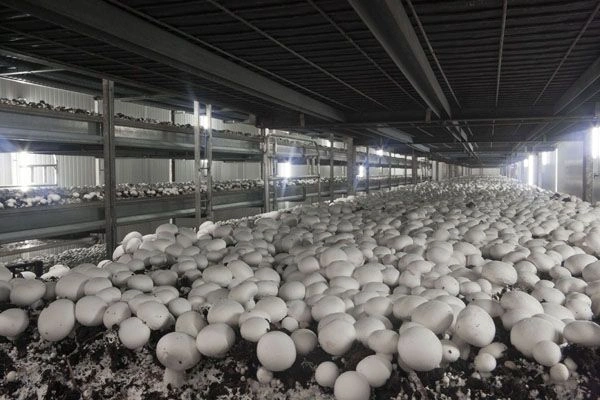
Andhra Pradesh government has revealed an ambitious strategy to make the state a national leader in mushroom production and is expected to change the agricultural scenario of South India. Chief Minister N. Chandrababu Naidu has announced the Mushroom Mission with a whopping ₹13,000 crore investment. This is not just an exercise in crop diversification but a determined endeavor to promote rural entrepreneurship, empower local people and build a sustainable, high-value agri-business model that can be a blueprint for the rest of the country.
For many, mushrooms have been a niche commodity for years, but this purpose is to bring them solidly into the mainstream of the agricultural economy. With a target of 67,500 tons annual production capacity, the state is not merely attempting to improve yields, but is actively looking to beat current industry leaders like Bihar. But what’s with the mushroom obsession and what does it mean for the regular farmer in a remote village?
Empowering the Grassroots Economy
The guiding principle of the Mushroom Mission is to democratize agriculture. The administration plans to enable the up of about 1.62 lakh mushroom producing units in the state, instead of depending only on big industrial farms. Each of these units is usually about 5,000 square feet, designed to be manageable for small-scale entrepreneurs and rural homes.
The decentralization is strategically linked to the strong network of Self-Help Groups (SHGs) in Andhra Pradesh. The government is integrating rural women and small-scale farmers, focusing on their participation, and giving them the skills to move away from traditional, often unpredictable crop cycles, to a more controlled and profitable venture.
Equally as important is the financial structure to support this purpose. Of the entire investment of ₹13,000 crore, a major amount of about ₹5,184 crore will be spent on subsidy assistance. Supported by the state and federal governments, this joint funding strategy contributes to about 40% of project costs, decreasing the entry barrier for people who would otherwise be sidelined due to high initial costs.
Market Reach and Strategic Variety
Success in agriculture often depends on choosing the right crop for the right climate, and the government has been deliberate in its choices. The mission will focus on economically viable variants like:
Milky mushrooms, very resistant and well adapted to the surrounding climate.
Paddy straw mushrooms, using agricultural waste, turning a possible liability into an asset.
Button mushrooms continue to have great consumer demand in metropolitan areas.
By categorizing mushrooms as official agricultural produce under the mission framework, the state is also unlocking the crucial institutional support. This designation is more than bureaucratic; it allows for greater policy assistance, quicker market access, and a genuine seat at the table for farmers seeking financing or insurance.
Ever thought about the possibility of a modest 5,000 square foot plot of land when you take your attention off seasonal grains and put it on high demand, climate controlled produce? It is a question to which the state government is currently putting quite a lot of faith.
Establishing a Sustainable Value Chain
The ambition doesn’t end at the farm gate. The government is also investing in what is called the “infrastructure of success” to make sure the mission is viable for the long term—a word commonly heard in agricultural planning circles, but here it involves real, tangible investments. That means building bigger processing units to handle post-harvest logistics, the traditional Achilles’ heel of Indian agriculture.
The state seeks to have a strong value chain that does more than satisfy local demand. There is a definite focus on international markets, especially the Gulf nations, where the appetite for quality produce is rapidly expanding. If it succeeds, it might mirror the high impact success stories of the nation’s millet promotion campaigns, where coordinated campaigning and technological support helped turn a traditional food into a global superfood category.
Farmers’ Road Ahead
The objective is clear but it is the implementation phase that will be the real test of the government resolve. It’s not only about financing, but an ecosystem of training, quality control and continuous market linkages that would allow thousands of farmers to make the transition to a new, technically demanding crop.
The government’s choice to hire agricultural experts and focus on specialized training, like programmes already witnessed in areas like Krishna, points to a nuanced approach. It acknowledges that technical expertise is as important as financial aid. For a small farmer, the idea of a steady stream of cash throughout the year, instead of waiting for one harvest season, may mean the difference between debt and wealth.
In the next years, the success of the Mushroom Mission will probably be evaluated by the number of profitable, independent enterprises that emerge from those anticipated 1.62 lakh units. It’s an optimistic bet on the power of decentralized production and the promise of tech-enabled agriculture to fix the systemic problems that have long plagued India’s rural economy.
This is a brave, contemporary attempt to bridge its traditional agrarian roots and the demands of a changing world market. Whether it will succeed in making Andhra Pradesh the mushroom capital of India remains to be seen but the sheer scale of the investment and the focus on the people at the grassroots level shows that a substantial shift is already in the air. It is a story of economic change taking place in real time, and it is a story that warrants the curiosity of anyone who care about the future of sustainable development and rural upliftment.
Andhra Pradesh’s ₹13,000 Crore Mushroom Mission: Opens New Avenues for Rural Prosperity