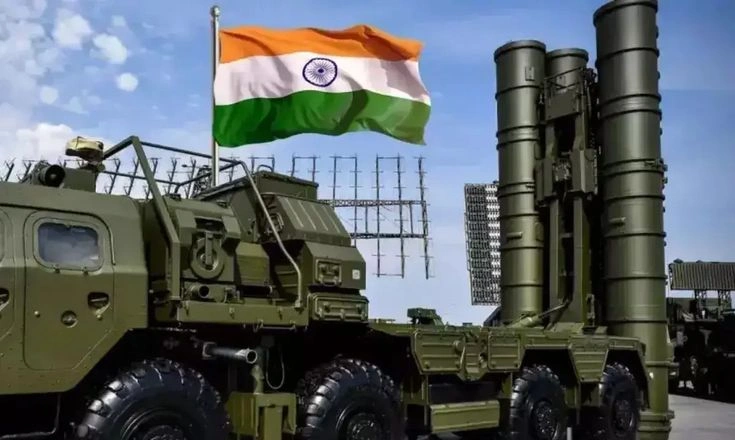
India’s fourth S-400 air defence squadron lands from Russia as focus shifts more to its frontiers. The delivery is due as early as early May, at a time when aerial threats from neighbours have strained the boundaries of India’s defences and the S-400’s long-range punch is more critical than ever.
Background to a landmark transaction
In October 2018, India secured a large $5.43 billion deal with Russia for five regiments of the S-400 Triumf system, despite US concerns of possible sanctions under CAATSA. The deal, valued around Rs 40,000 crore, was a bold step to enhance the capability of the Indian Air Force to deal with modern aerial threats like stealth fighters, drones and ballistic missiles. Three squadrons are been delivered and proven in real settings.
What started as a strategic buy has become a cornerstone of India’s multi-tier air defence. Russia has kept its promises despite the turmoil in Ukraine and the problems in global supply chains. Deliveries have sped up after high-level negotiations between PM Modi and President Putin. Now, with the fourth unit shipped and underway, all eyes are on integration and the timing of the fifth to arrive by late 2026.
Inside the S-400: Technical Powerhouse
The S-400, or Sudarshan Chakra in India, named after its spinning shield-like protection, is not just another missile system, it is a beast on wheels. “Every squadron is equipped with eight transporter-erector-launchers, powerful radar, and a command post able to detect targets 600 km distant, while tracking 300 things at the same time. It can target 80 targets at the same time , unleashing up to 160 missiles . Speeds can deal with Mach 14 threats . Think hypersonic missiles or enemy jets flying at 17,000 km/h .
The main specifications are:
Short-range missiles (9M96) have a range of 100-120 km.
Medium range (48N6DM): 250 km.
Long-range (40N6E): a huge 400km, enough to strike deep into enemy territory.
The advantage is its mobility, it may be moved within minutes to avoid counterstrikes. For India that means filling gaps in radar coverage along sprawling borders, making vulnerable airspace no-fly zones.
Where Systems Stand Today
India’s first three S-400 squadrons are now in operation, positioned at critical locations to cover hotspots. One is in the Punjab-Pathankot sector to cover against Pakistan and keep vigil over Jammu & Kashmir. Another patrols the Siliguri Corridor, the tiny “chicken’s neck” linking mainland India to the Northeast, crucial given tensions between China and Bangladesh. The third strengthens Rajasthan and Gujarat on the western front versus Pakistan’s air might.
There are no blind areas in these installations, the radars overlap providing seamless coverage. The fourth squadron? Likely heading to Rajasthan for more muscle along the Pakistan border where tensions boil. Commanders would not have to worry about surprise raids and could focus more on deterrence.
Operation Sindoor: Hardened Battle Glory
Combat is the ultimate test of a system’s reputation. 2025 saw the launch of Operation Sindoor, with India’s S-400 squadrons shining in countering Pakistani invasions. It shot down cruise missiles, an AWACS plane at a record distance of 314 km, forced enemy fighters to turn back and even hit a huge aircraft deep inside Pakistan. Pakistan tried to hit two units in Punjab and Gujarat but backed off, relocating its bases to safer places like Quetta.
This wasn’t a theory, 11 long-range missiles flew, showing the S-400’s accuracy under fire. Post op, PM Modi even went to Adampur base and posed with a battery to send a clear message. Wonder how one system may change the whole air battle. Sindoor demonstrated it; discouragement by dominance.
Why it matters to India’s borders
India’s neighbourhood is not getting any quieter. China looms large in Ladakh and Arunachal with regular flying patrols probing fortifications. Sindoor has taught Pakistan the lesson But still it shows off with drones and rockets. Alongside the indigenously produced Akash and Israeli SpyDer systems, the S-400 adds crucial layers to India’s air barrier.
Siliguri’s protection on the China front cuts that route and eight states get disconnected to the Northeast’s supply lines. Rajasthan’s forthcoming expansion promises better coverage over deserts where Rafales already patrol versus Pakistan. It’s a global statement: India hedges away from Western suppliers and balances US connections with Russian reliability. Local maintenance hubs are popping up, producing jobs and tech transfers.
Russia Ties and Bumps in the Road India and Russia have long-standing defence ties, with Moscow accounting for more than 60% of India’s military purchases. S-400 contract survives US sanctions threats, Ukraine war delays, logistics snarls The Modi-Putin summits kept things on track and the fourth delivery was set close to the anniversary of Sindoor as a nod to success.
Challenges? Of course. Integrating with the Indian radars took time and CAATSA waivers were a result of skillful diplomacy. But Russia delivered. Even fast-tracked missiles post-Sindoor. 288 more approved at Rs 10,000 crore via emergency acquisition. Whispers about five more squadrons and expansion in Pantsir shorts.
Looking Ahead: Fleet, and Beyond
By the end of 2026, all five squadrons will be operational, creating an almost impenetrable net from Gujarat to Sikkim. But India is not standing still – DAC approvals for missile replenishment, possible co-production of S-500 show ambition. Russian technology blends with Indian ingenuity for self-reliance, local production increases.
This not only enhances borders, but boosts national morale. In a time of drone swarms and hypersonics, can any country afford weak skies? The advice from India is simple: layer up, hit hard and stay ready. The S-400, shortly to be a complete quintet, is a bulwark, a reminder to enemies that India’s alert and its distance is considerable, as threats change form.
(1428 words)
India prepares for fourth S-400 squadron, a huge boost to air defence amid border tensions