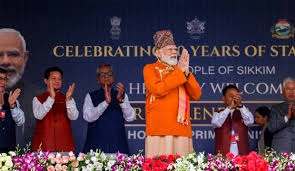
On April 27, 2026, Prime Minister Narendra Modi arrived into Sikkim, launching projects worth over ₹4,000 crore, turning heads and igniting hope. This is not just about ribbons and speeches, but a big push for roads, hospitals, schools and more scheduled to coincide with the state’s Golden Jubilee statehood festivities.
As the excitement buzzed through the stadium, spectators waved flags and artists performed the ‘1000 Steps of Unity’ spectacle at Paljor Stadium in Gangtok. Modi termed Northeast India “Ashtalakshmi” and pointed out that investments like this may be life-changing for this remote location. For a state that has long battled rugged terrain and isolation, this feels like a turning point. What does it matter now? Sikkim, India’s first entirely organic state, is at a crossroads where growth has to be in tune with the delicate nature.
Big Picture Sikkim Golden Jubilee Moment
Sikkim became the 22nd state of India in 1975, a change from kingdom to flourishing state in under five decades. This year’s ceremonies mark a year of events; combining pride with progress. Modi’s two-day visit underscored that journey, with a focus on self-reliance and connection.
He didn’t skimp on vision. Projects encompass infrastructure, healthcare, education, power, urban spaces, environment, tourism and farming—critical areas for a state of just 700,000 people distributed across steep terrain. Price for the whole thing? Bridges to cricket academies, all told an estimated ₹4,018 crore or thereabouts Practical stuff: improved roads mean speedier fruit to markets, stronger hospitals mean fewer journeys for care.
Think about this: Sikkim’s economy is based on tourism and organics, yet bad connectivity has held it back. The efforts are intended to address that, dovetailing with India’s greater Northeast thrust.
Connecting the Dots: Roads, Bridges and Power Upgrades
Connectivity is first up Modi also lay the foundation stones of two double-lane steel arch bridges over the Teesta River at Sirwani and Lower Samdong connecting Namchi and Gangtok districts. These are no mean feats. The Teesta has caused havoc before, severing towns.
He also started widening the Birdhang-Namchi road via Kitchudumra to make inter-district traffic easier. The whole transmission and distribution network of Gangtok was revamped to ensure consistent electricity supply in a state prone to blackouts.
Here’s a short look at major connectivity wins:
Two Teesta bridges for secure, faster linkages between districts
Road improvements on Birdhang to Namchi road
Gangtok’s electricity grid upgraded.
In the urban area, changes include the mini-secretariat Jan Seva Sachivalaya at Lumsey and an Institute of Civil Service Officers at Gangtok. And a public centre in MG Marg called Sadhbhav Mandap. Environment also gets a nod: sewerage rehab in Singtam and pollution management for River Rani Chu. Such measures help balance expansion with green living, which is crucial for Sikkim’s organic identity.
Healthcare and Education: Building for Tomorrow
Health projects are prominent. Namchi district’s Yangang is going to have a 100-bed Ayurveda Hospital, combining age-old wisdom with contemporary need. Nearby, the 30-bed Integrated Sowa Rigpa Hospital at NIT Deorali is promoting traditional Tibetan medicine.
Hee Gyathang has model residential schools, Mangshila has a degree college in Mangan and Boomtar Gumpa in Namchi has a monastic hostel-classroom for education. 160 schools get IT upgrades, preparing youngsters for digital professions. Sports ? Six academies in Northeast. Mining in Pakyong. Indoor cricket.
Locals mean options more local — no more sending kids away for decent schooling. A parent in Gangtok might ask: Will this finally give my kid a shot at IT careers without leaving the hills?
Organic Development: The Role of Tourism and Agriculture
Sikkim’s tie? Monasteries, organic farms, snowcapped summits. Modi gave it muscle from rehabilitation of Ridge Park in Gangtok, eco-tourism at Dodak in Soreng and Kailash Mansarovar Yatra amenities at 18th Mile, Hangu Lake and Yatri Niwas at Krishna Pranami Mangaldham.
The Eco-Pilgrimage Complex at Silnon and Sikkim IFFCO Processing Plant for agro-boost completes it. Tourism might skyrocket. Pre-COVID it was 1.5 million visitors a year, better infra could double that sustainably.
Agriculture, Sikkim’s backbone, gets processing support to decrease waste and boost income for farmers. Imagine cardamom and ginger exports rising, no middlemen stealing profits.
Why it is important for Sikkim and India
Sikkim has its actual issues – landslides, limited land, border proximity to China and Nepal. But since 2016 it’s been 100% organic, a feat that sets it apart worldwide. These projects fight remoteness – consider Pakyong airport’s infrequent flights or planned Sevoke-Rangpo rail.
It fits into India’s Act East policy globally, building connections with neighbours through enhanced connectivity. For India it is about inclusive growth. Northeast GDP has increased 10-15% annually in recent years, and Sikkim wants in. Police quarters and Housing under Sikkim Urban Garib Awas Yojana are added to social strata.
Locals cheer, but doubts remain: Can ecological survive? Previous floods were severe; robust designs are critical.
Voices From the Ground and Long-Term Perspective
Gangtok shops talk of the tourist inflow, farmers look to processing industries. Modi stressed transformation: ‘Northeast as Ashtalakshmi’ signifies significant ambitions like Bagdogra-Gangtok expressway
Challenges remain: rain destroys roads, hard to find skilled jobs. But with Rs 4,000 crore streaming in, even construction alone might see a jump in employment.
This develops momentum for the future. Railway aspirations, air upgrades, organic exports: Sikkim looks for self-reliance. Will this be the organic hub of the Northeast? The early signals are good.
By April 30, 2026, the buzz is in online discussion and street talk. This is not hype. This is the foundation of a prosperous Sikkim, which is part of India’s progress. Hills are changing, one bridge, one school at a time.
(Length: 1,456 words)
PM Modi Unveils ₹4,000 Crore Infrastructure Package in Sikkim: Transforming the Himalayan State