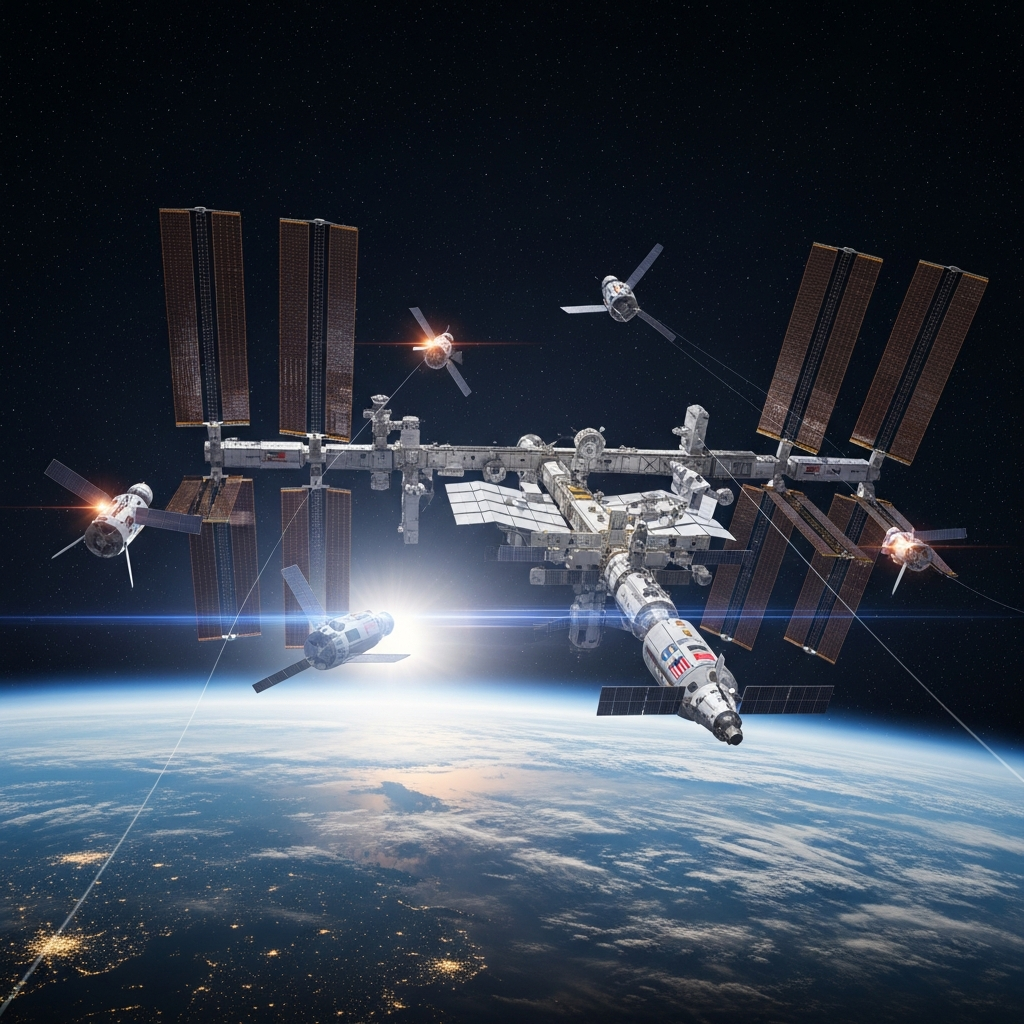
In a fragmented world of politics, trade wars and suspicion, one arena still brings nations to the same table: the vast, indifferent, endlessly fascinating frontier of space. Global collaboration in space exploration is not just surviving — it is quietly thriving.
There is something quietly extraordinary about the fact that nations which cannot agree on trade tariffs, border policies, or climate timelines still manage to collaborate, sometimes seamlessly, in the cold silence of outer space. Space exploration has always had this unusual quality — it demands cooperation not as a nicety, but as a necessity. No country, however advanced its technology, can go it alone. And that simple truth holds good in 2026, bringing together governments, space agencies and research institutions in a common upward gaze. The global mission landscape today reflects the ambition and pragmatism that characterise modern space science. Missions to the Moon, Mars and beyond are no longer the preserve of two superpowers locked in Cold War rivalry. They are increasingly collaborative endeavours, stitched together from shared data, jointly developed hardware, and scientific teams that span continents and time zones. The model has changed — and for the better.
Partnership as a working principle
NASA collaboration with international partners remains one of the most visible expressions of this spirit. The Artemis programme, which aims to return humans to the lunar surface and establish a sustainable presence there, is not an American project that others are invited to observe. It is a multilateral undertaking involving space agencies from Europe, Japan, Canada, and beyond. Each partner brings specific capabilities — whether in habitat design, robotics, life support systems, or communications infrastructure — that the whole mission depends on.
This is not charity or optics. It is engineering logic. Space missions are extraordinarily expensive, technically demanding, and inherently risky. Distributing that burden across capable partners is not weakness — it is wisdom. And the scientific returns are correspondingly richer when diverse teams bring diverse approaches to shared problems.
Beyond the Moon, the ambition stretches further. Mars remains the great horizon of this generation’s space science ambitions, and multiple agencies are contributing instruments, data, and mission architecture toward the long-term goal of human exploration of the red planet. The timeline remains ambitious, but the collaborative infrastructure being built now — in terms of deep space communication, autonomous systems, and life support research — is laying real foundations for what comes next.
“Space doesn’t care about borders. The physics is the same from every launchpad. That shared reality has a way of making collaboration feel less like diplomacy and more like common sense.”
New players, new energy
What makes the current era of space exploration particularly compelling is the range of nations now meaningfully participating. India’s ISRO, fresh from the historic success of Chandrayaan-3’s lunar south pole landing, continues to expand its international footprint — signing agreements, contributing to joint missions, and developing future technology capabilities that place it firmly in the first tier of global space science nations. The UAE’s Hope Probe mission to Mars demonstrated that newer entrants to space exploration can punch above their weight when they invest seriously in talent and technology. South Korea, Japan, and a growing cohort of African nations with nascent space programmes are all part of a broadening map of human curiosity pointed at the cosmos.
Private enterprise has also fundamentally changed the texture of space collaboration. Companies that develop rockets, satellites, and space habitats now operate across borders, forming partnerships with government agencies and research institutions in ways that would have seemed implausible a decade ago. This commercial layer does not replace the role of national space agencies — it amplifies it, providing infrastructure and logistics that free up scientific budgets for the work that matters most.
Worth knowing: The International Space Station, perhaps the most enduring symbol of space collaboration, has hosted astronauts from 20 different countries since its first crew arrived in 2000. Its continued operation — and the planning underway for successor stations — reflects the deep institutional habit of cooperation that global space science has built over decades.
Future technology: the real dividend
It would be easy to view space collaboration purely through a scientific or geopolitical lens. But the future technology spillovers from joint space programmes have historically been enormous — and the current era is no different. Advances in materials science, medical diagnostics, water purification, communication systems, and energy efficiency have all found their origins, in part, in the demands of space engineering. When nations pool their scientific intelligence to solve the extreme problems of surviving and working in space, they generate innovations that eventually filter down into everyday life.
This is the dimension of space exploration that often gets lost in the drama of rocket launches and planetary landings. The slower, quieter work of joint research programmes, shared satellite data for climate monitoring, and collaborative development of propulsion technologies carries enormous long-term value — not just for the nations involved, but for the planet those nations collectively inhabit.
Why this moment matters
At a time when global institutions are under strain and multilateral cooperation is frequently described as fragile, space exploration offers a different narrative. Not a naive one — there are genuine rivalries, competing interests, and strategic calculations embedded in every partnership. But beneath all of that, there is something that functions, something that produces real outcomes, something that keeps bringing people back to the table despite every reason to walk away.
The universe is large enough for all of us. And the problems of reaching it are hard enough that we are still better off trying together.
That, in the end, may be the most human thing about space exploration — not the technology, not the heroism, but the stubborn insistence on showing up, side by side, and looking up.
We Still Look Up — Together.