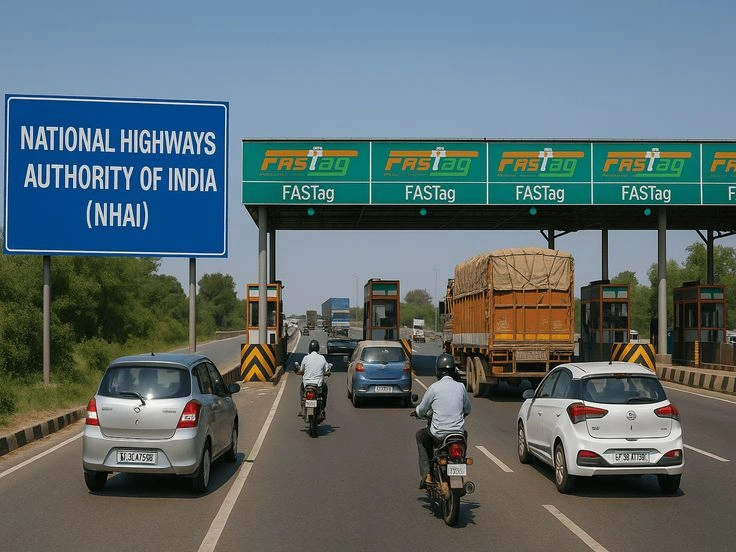
India took a definitive stride towards fully “smart” highways with the launch of its first barrier-less tolling system on the Surat–Bharuch stretch of National Highway 48 (NH–48) in Gujarat. The new Multi-Lane Free Flow (MLFF) system at the Chorayasi toll plaza allows cars to move through toll zones without stopping, with FASTag and Automatic Number Plate Recognition (ANPR) enabling fully automated deduction.
This is a departure from the usual lineups, slowdowns and occasional commotion at traditional toll plazas, to a model more in line with what many sophisticated economies already employ: toll collecting without barriers, without booths, and without requiring traffic to brake. For a country where truckers queue for hours at toll points and commuters clench their teeth at every highway “break”, this could be one of the quietest yet most substantial changes its road network has seen in years.
What “Barrier-Free” Tall Means
Barrierless tolling sounds like a complex term, but the premise is simple: eliminate actual toll booths and the necessity for vehicles to halt or slow down. Instead, the system uses two current technologies – FASTag and ANPR – to tag and charge vehicles as they move at near-normal speed.
The Multi-Lane Free Flow (MLFF) system at Chorayasi on NH-48 employs high-performance ANPR cameras and FASTag-reader sensors along the roadway. As the vehicle enters the toll zone, the system scans the RFID data of the FASTTag and cross checks it with the registration plate collected by the ANPR to confirm the identity and toll class (two-wheeler, automobile, bus, truck etc) applicable to the vehicle. The accepted amount is subsequently debited from the associated FASTag wallet, without the driver ever needing to apply the brakes.
This is not a pilot tucked away in isolation but is being billed as the first such full-scale barrier-less tolling system in India and a prototype for what might eventually replace many traditional toll plazas across the national highway network.
Why NH-48 Was Selected
It is no coincidence that NH-48, the busy corridor connecting Mumbai, Surat, Vadodara, Ahmedabad and Delhi, has been chosen. It is one of the country’s busiest freight and passenger corridors with a dense mix of trucks, buses and private cars. The Surat-Bharuch route is often a bottleneck, especially during peak hours and is a good test bed for a system to reduce congestion and travel time.
The debut of the MLFF system here is a signal by the government that it is not only experimenting on a quiet rural stretch, but is willing to test barrier-less tolling on a key commercial artery. If the system can cope with the load here, the case for rolling it out nationally gets much stronger.
Union Minister Nitin Gadkari has previously termed it a move towards ‘Ease of Living’ and ‘Ease of Doing Business’, stating that better logistics may save time by hours in delivery, and cut fuel use for truckers. That kind of efficiency increase isn’t trivial at all for a country that depends significantly on road freight.
How the System Operates
The NH‑48 MLFF rollout is based on the backbone of a tightly integrated stack of FASTag, ANPR and backend clearance systems on the National Electronic Toll Collection (NETC) platform built by NPCI.
Here’s what normally happens for a user:
Recognition and classification: As the vehicle approaches the toll zone, ANPR cameras record the license plate and overhead FASTag scanners pick up the data from the RFID tag (vehicle class, tag ID and connected account).
Toll calculation: The system calculates the right toll depending on vehicle type, distance and tariff laws and checks the FASTag wallet balance.
Seamless Deduction: If the tag is legitimate and the account has sufficient balance, the money is automatically deducted and entered in the central toll-clearing system.
No stops, no queues You don’t need to crawl to a halt, pull down your windows or wait for a barrier to rise. The driver just drives through and in the background the vehicle is logged and charged.
The process is so seamless for conforming users that it is nearly undetectable. But authorities can identify irregularities, such as vehicles not having FASTags or with low balances, by means of backend warnings and automated notices.
Benefits for drivers, trucks and the environment
Barrierless tolling has the most obvious potential for relieving congestion. Even FASTag lanes in regular plazas have vehicles lining up during peak hours leading to extended sag points on otherwise-smooth roadways. By eliminating the actual need to stop, the MLFF system can flatten those bottlenecks, boosting average speeds and minimizing driver dissatisfaction.
For commercial truckers and logistics organizations the impact can be considerably sharper:
More predictable delivery windows and less idle time means less time at toll points.
Less idle time in lines can minimize fuel usage and maintenance costs that eat into business margins on long-haul routes.
Faster movement of goods enables time-sensitive supply chains, from perishables to e-commerce consignments, an increasingly critical consideration in India’s expanding digital-commerce sector.
More broadly, the administration is also selling this as an environmental victory. Fewer sudden slowdowns and shorter waits, especially from diesel trucks and buses, which often make up the bulk of highway traffic, result in reduced emissions per trip. Smoother toll zones, if applied network-wide, could provide a tiny but cumulative contribution to reducing urban and peri-urban air-quality stress.
Enforcement, Compliance and Penalties
The convenience of barrier-less tolling comes with stronger enforcement approach. That also makes it easy to track and sanction non-payment . The same mechanism that allows complying drivers to breeze through .
If a vehicle is detected crossing an MLFF without a valid FASTag or with an insufficient balance, the system can generate an electronic warning (e-notice) against the vehicle listed in the VAHAN database. Failure to pay on time might result in suspension of FASTag, denial of services including transfer of ownership and blocks on fitness and permission renewals.
This is a big departure from the more lax enforcement style of the past, where dodging a toll was generally a low-stakes bet. Is this amount of connectivity between toll compliance and core car services too much, or is it a necessary tightening to maintain the system fair and functional?
Guarantee of TECHOCAL and Practical Difficulties 3.
On paper, the MLFF system with FASTag and ANPR is a refined upgrade: contactless, automated and scalable. It also is part of a global trend where several countries have switched to open-road tolling with ANPR and RFID to keep traffic moving.
But there are barriers with any large-scale technology change:
System reliability: What if the ANPR misreads a plate or a FASTag is not picked up? Will there be a seamless redressal mechanism or will drivers be fined unfairly?
User awareness: Millions of drivers are still on cash lanes or have only recently shifted to FASTag; the shift to a completely digital and barrier-free approach may confuse or make some users nervous.
Infrastructure and cost: High-performance ANPR, sensors, data linkages and robust backend systems don’t come cheap, and the government will have to decide how fast it can deploy identical installations at hundreds of toll plazas.
India has already been experimenting with barrier-free tolling at a handful of highway plazas, so the NH-48 debut is more an accelerated formal launch than a wholly green-field experiment. It’s going to take several months to see if this converts into seamless, glitch-free operations at scale.
What it Means for India’s Highway Future
The barrier-less MLFF system on NH-48 is not just a technical modification. It is a communication of purpose about how India wants her highways to function.
If the government goes forward, future highway traffic could increasingly look like this:
No real toll booths on significant portions. Instead, digital toll lanes, identified only by signage and gantries.
FASTag is transitioning from a “nice-to-have convenience” to an almost obligatory requirement for hassle-free highway travel.
A data-rich highway network, with toll data feeding analytics for traffic management, congestion alarms and design of new alignments and bypasses.
Better toll stations might also assist lower logistics costs as a percentage of India’s GDP, which remains higher than many comparable economies. Faster circulation of commodities can further raise India’s stature as a manufacturing and export hub, where time-sensitive logistics key.
India’s First Barrier-Less Toll System on NH-48: FASTag and ANPR Make Highway Travel Smooth