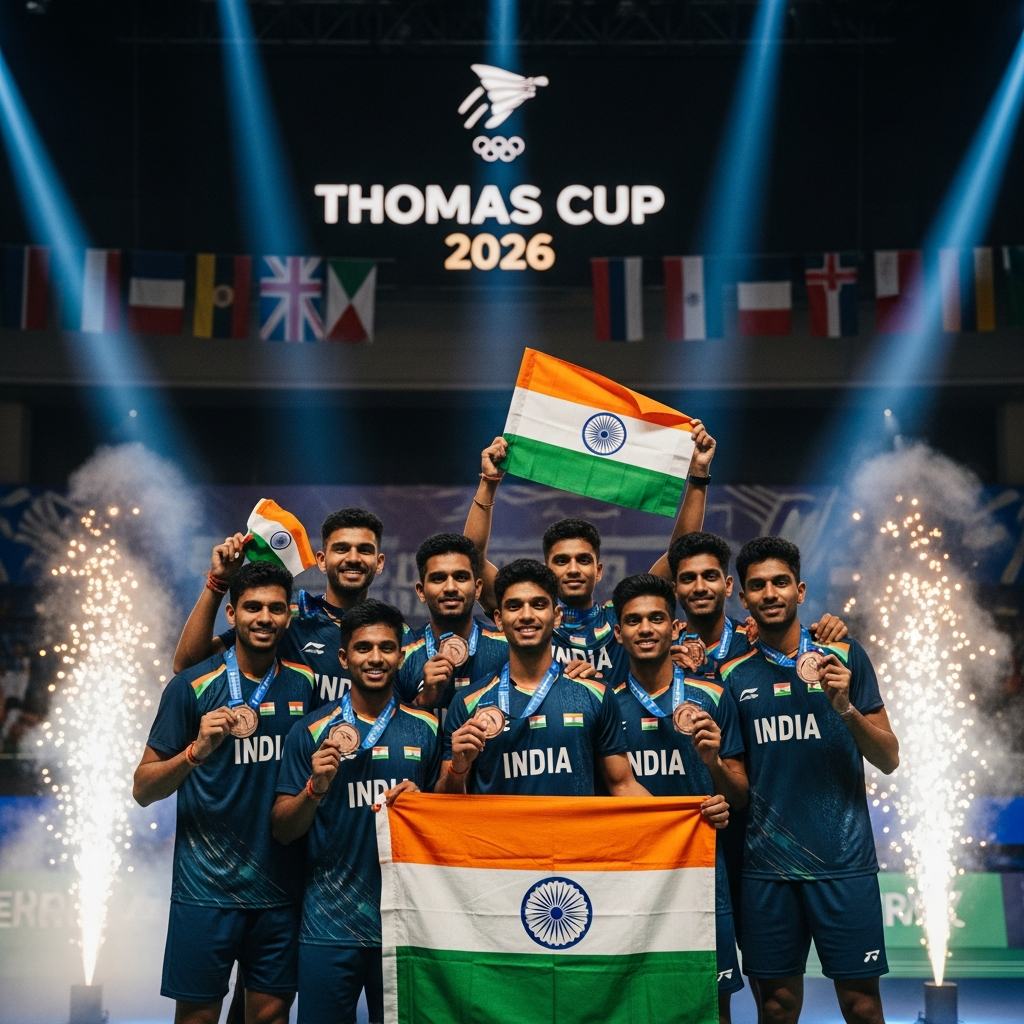
India’s men’s badminton team walked away from the Thomas Cup 2026 with a bronze medal and something arguably more valuable — proof that they belong among the world’s very best, every single time.
Bronze at the Thomas Cup 2026 in the only way that makes a third-place finish feel like a real achievement — by playing with courage, consistency, and a collective belief that, not so long ago, simply did not exist at this level.
🏸
2026
Thomas Cup edition secured
🥉
Bronze
India’s medal at this global tournament
📈
Top 3
India’s finish among world’s best nations
What the bronze actually represents
To understand why this bronze medal matters, you have to remember where Indian men’s badminton was not very long ago. For decades, India produced world-class singles players — Prakash Padukone, Pullela Gopichand, then Saina Nehwal and P.V. Sindhu on the women’s side — but team success in the Thomas Cup, the most prestigious global tournament in men’s team badminton, remained stubbornly elusive. India would make exits in the early rounds, occasionally cause an upset, and then head home while the East Asian powerhouses — Indonesia, China, Malaysia, South Korea, Japan — contested the medals among themselves. It felt like a ceiling that Indian badminton simply could not break through.
Then came 2022. India’s historic Thomas Cup victory that year in Bangkok was not just a sports achievement — it was a cultural moment. The country won its first-ever Thomas Cup title, defeating Indonesia in the final in one of the most dramatic upsets in the tournament’s long history. The celebrations were enormous, and rightly so. But the real question was always what came after — whether 2022 was a peak or a beginning. The 2026 bronze medal, arrived at through hard-fought matches against some of the best teams in the world, suggests firmly that it was a beginning.
About the Thomas Cup
The Thomas Cup is the premier global team badminton tournament for men, contested biennially by national teams. Named after Sir George Thomas, a former All England champion, the tournament began in 1949 and is often called the “World Cup of badminton.” Indonesia holds the record for most titles, but the competition has grown increasingly competitive, with Japan, China, South Korea, Malaysia, and now India regularly contending for honours.
The players who made it happen
Team sports medals are collective by definition, but they are built on individual brilliance. Badminton India’s performance at Thomas Cup 2026 was no different. The singles players carried enormous responsibility — in team badminton, the number one singles match frequently sets the psychological tone for everything that follows. India’s top singles representative this year delivered under pressure in the way that defines elite competitors: not by playing perfect badminton, but by finding ways to win when the shuttles weren’t falling cleanly and the legs were heavy from previous rounds.
The doubles combinations were equally crucial. India’s doubles pairings, historically a relative weakness compared to the specialist pairs from Indonesia, Malaysia, and Japan, showed genuine development in 2026. Winning a doubles rubber in a tight Thomas Cup tie requires not just technical skill but tactical flexibility — the ability to read opponents quickly and adjust mid-match. India’s pairs demonstrated both qualities at key moments, and it made the difference between advancing and going home early.
“This team doesn’t just compete at the Thomas Cup anymore — they contend. That shift in expectation is everything in elite sport.”
The semifinal — and what it means to fall short
The bronze medal also means India fell in the semifinals — and that deserves honest acknowledgement too. Reaching the last four of the Thomas Cup is a genuine sports achievement by any measure, but the teams that win this global tournament are distinguished not just by talent but by the ability to perform in the highest-pressure matches, against the best opponents, when everything is on the line. India’s semifinal opponents were formidable, and the loss — however it ultimately played out — is information as much as it is disappointment. It tells the coaches, the selectors, and the players themselves where the work still needs to happen.
That kind of honest self-assessment is actually a marker of a maturing programme. Teams that make excuses after semifinal exits stagnate. Teams that study the defeat, identify the gaps, and come back sharper are the ones that eventually lift the trophy. Given what India did in 2022, and what they demonstrated again in 2026, there is no particular reason to doubt that the learning will happen.
A sport finding its moment in India
Badminton in India has been on a quiet but unmistakable upward trajectory for years. The Premier Badminton League has created a domestic ecosystem of competitive matches and fan engagement. Investment in training infrastructure, particularly at the Gopichand Academy and its offshoots, has raised the floor for what Indian junior players can achieve. And the constant flow of Indian players coming through on the individual BWF World Tour has created a pipeline of talent that feeds right into the team performances at events like the Thomas Cup.So the bronze in 2026 is not an isolated result in that respect. It is part of a pattern — of India arriving at major global tournaments not as hopeful outsiders but as genuine contenders whose name belongs on the shortlist of potential champions. That shift in status, from participant to contender, is one of the slowest and most difficult transitions in elite sport. Indian badminton has made it. And if the bronze at Thomas Cup 2026 adds a little fire to the ambition for 2028, then the medal will have served its highest purpose — not as a destination, but as fuel.
Bronze, But Make It Brilliant.