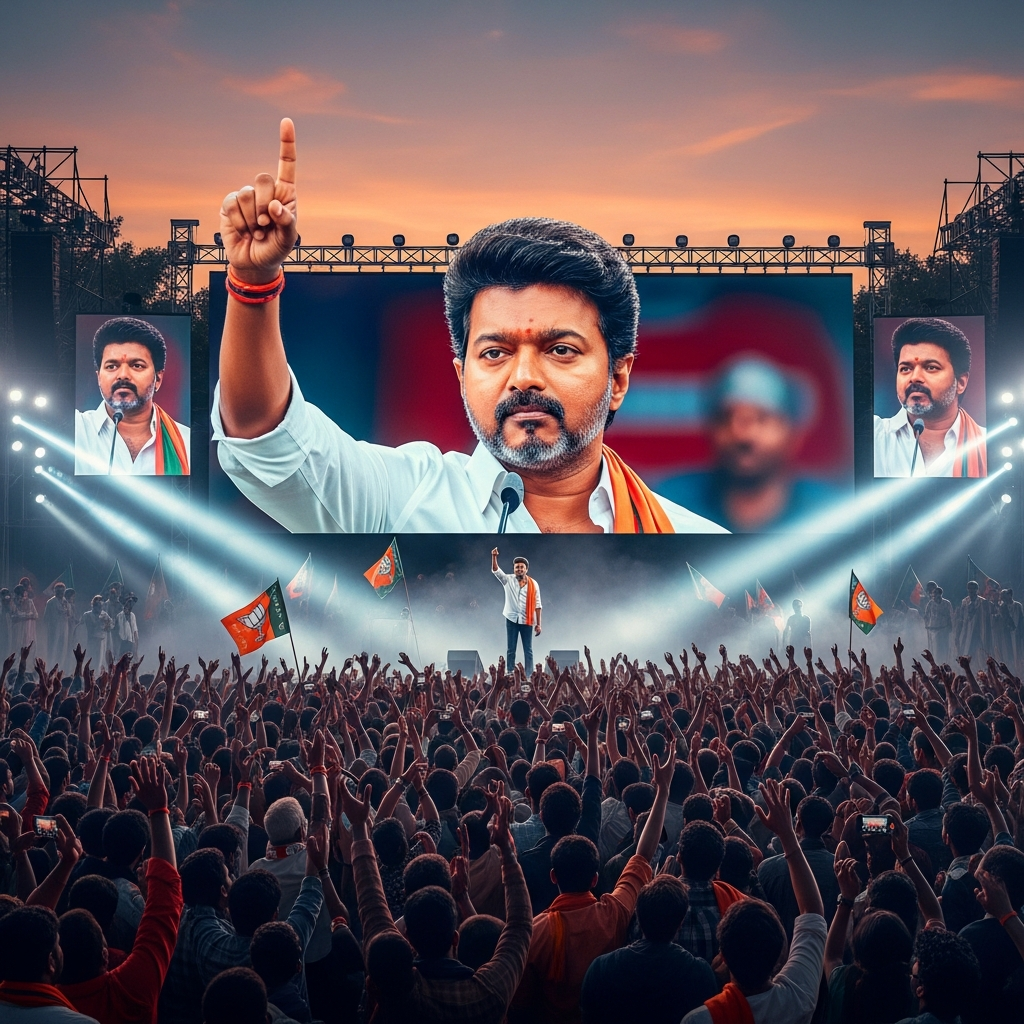
Actor turned politician, mass hero turned party leader — Vijay’s entry into active politics is not just Vijay news today. It is a mirror held up to a state that has always understood that culture and power are two names for the same thing.
Tamil Nadu has never really separated its cinema from its politics. The two have been tangled together for so long — feeding each other, borrowing from each other, sometimes becoming indistinguishable from each other — that when a major film star announces a political ambition, the reaction is less surprise and more a kind of collective exhale. Of course. This is how it works here. This is how it has always worked.
And yet, Vijay’s rise into political leadership still managed to generate a conversation that felt genuinely new. Not because an actor entering politics is unusual in Tamil Nadu — it isn’t — but because of who Vijay is, what he represents to a generation that grew up watching him, and the particular moment in Tamil Nadu culture that his entry has arrived in. Vijay news today isn’t just entertainment gossip crossing into politics columns. It’s a story about identity, aspiration, and the evolving grammar of public trust.
40M+
Vijay’s social media following across platforms
67
Films in Vijay’s career spanning three decades
#1
Trending nationally on social media at peak
Tamil cinema politics has a lineage that reads like a who’s who of the state’s modern history. M.G. Ramachandran — MGR — built a political movement on the same moral authority his characters carried on screen. J. Jayalalithaa turned her film fame into one of the most formidable political careers the country has seen. Karunanidhi, a screenwriter before he was a statesman, understood better than most how storytelling shapes loyalty. Tamil Nadu has, in many ways, been the national laboratory for the theory that mass entertainment creates mass political capital.
What makes Vijay’s moment different — or at least differently textured — is the generational shift it represents. His fan base is not just large; it is young, digitally native, and politically impatient in ways that older Tamil Nadu political culture didn’t have to reckon with. These are voters who consume Indian entertainment news and political commentary on the same feed, who don’t recognize a firm wall between celebrity and civic life, and who are increasingly skeptical of legacy parties and dynastic politics. Vijay, in this context, isn’t being drafted into politics by nostalgia. He’s being pulled in by a vacuum.
“In Tamil Nadu, the screen has never been just entertainment. It has always been the place where the people practice believing in someone.”
— Cultural commentator, Chennai
Social media engagement around his political developments remained extraordinarily high throughout the day — not just in Tamil Nadu, but nationally and even among diaspora communities in the UK, the US, Singapore, and the Gulf. This is what modern political branding looks like when it emerges organically rather than being manufactured by a campaign team. Vijay didn’t need a launch event or a press conference to trend. The announcement of his political intentions did the work itself, traveling through fan networks and political commentary ecosystems simultaneously and at speed.
What fans say
He speaks for ordinary people, not elites
His screen values match his real-life image
A fresh face in a stale political system
Connects with youth in ways parties can’t
What analysts caution
Fan loyalty differs from voter loyalty
Governance demands policy depth, not charisma
Tamil Nadu’s politics reward organizational muscle
Debut parties face brutal first-election tests
Of course, political analysts and veteran observers of Tamil Nadu culture have been quick to add the necessary qualifiers. Fan loyalty and voter loyalty are not the same currency, even in a state where the two have historically overlapped. The actor turned politician faces a transition that is genuinely hard — from being loved to being judged, from playing a hero to governing like one. The cinematic instincts that make a star compelling on screen — the instinct for the dramatic gesture, the emotionally resonant speech, the crowd-pleasing moment — don’t always translate into the grinding, unglamorous work of building a political organization that wins at the booth level.
And Tamil Nadu’s political landscape is not forgiving to newcomers, however celebrated. The state’s two dominant parties have deep organizational roots, caste arithmetic that takes years to understand, and institutional memory that no amount of star power can shortcut. The road from beloved actor to effective political leader is longer and harder than the announcement makes it look.
But perhaps that’s the wrong frame entirely. Vijay’s entry into politics may matter less as a conventional electoral calculation and more as a cultural signal — evidence that Tamil Nadu culture continues to evolve, that the boundaries between Indian entertainment news and political news are dissolving in real time, and that a new generation of voters is actively looking for a language of public life that doesn’t sound like it was written fifty years ago. Whether Vijay can build the structure to match the signal is the question that will unfold over months and years. For now, the conversation itself is the story — and Tamil Nadu, as always, is having it loudly, passionately, and entirely on its own terms.
When the Screen Becomes the Stage: Vijay’s Political Moment and What It Means for Tamil Nadu.