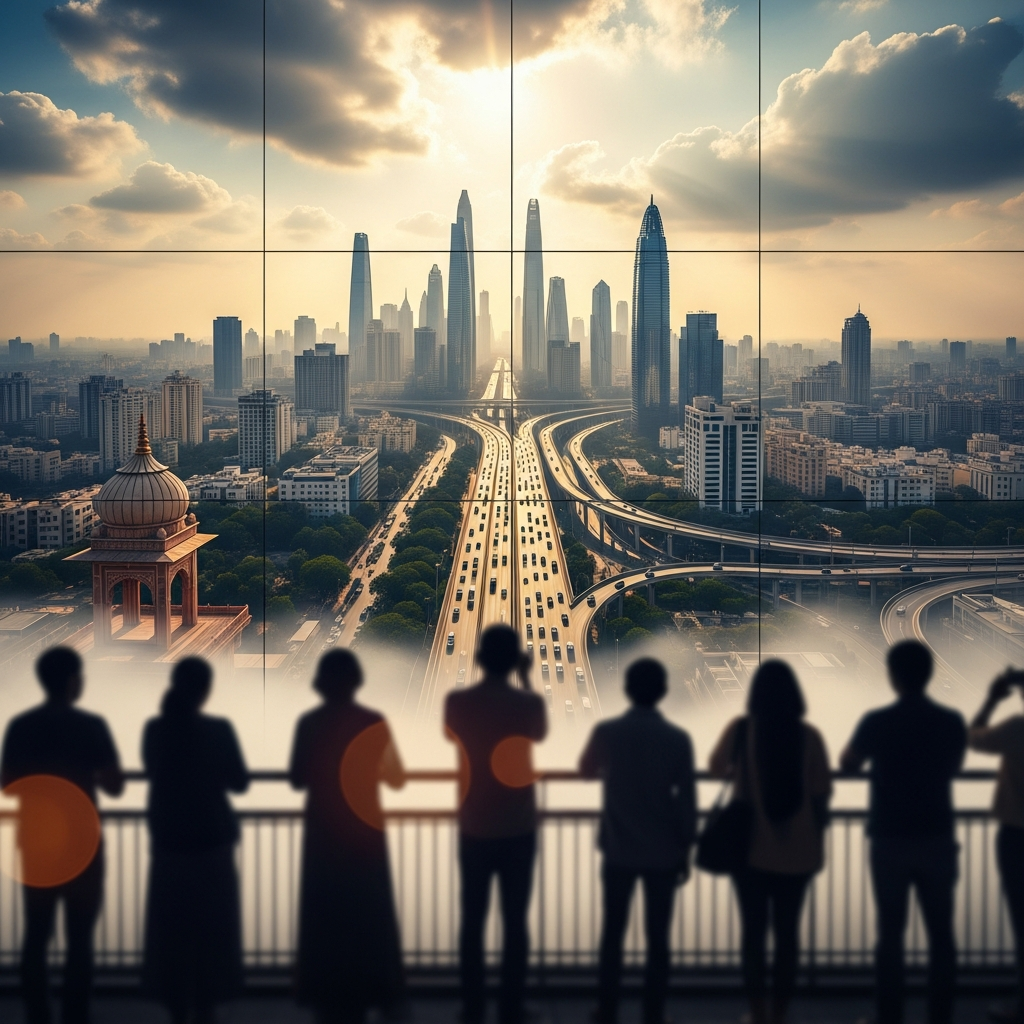
In a year defined by geopolitical friction and slowing global trade, India’s domestic engine has refused to stall — and international observers are taking note.
There is a version of the global economic story in 2026 that goes something like this: trade routes disrupted, energy prices volatile, central banks still wrestling with the aftermath of years of rate adjustments, and major Western economies muddling through modest growth at best. And then there is India — which, by most credible projections, is growing at a pace that makes the rest of the table look like it is sitting still.
International economic observers, including the International Monetary Fund, the World Bank, and several major investment banks, continue to rank India among the fastest-growing major economies in the world. Forecasts for the current fiscal year cluster around the 6.5 to 7 percent GDP growth range — numbers that would be remarkable in any environment, and are genuinely striking given what is happening elsewhere. The question worth asking is not whether India is growing. It is why, and whether it can last.
~6.8%
Projected GDP growth, FY 2026
#1
Fastest-growing major economy globally
$4T+
Economy size, now world’s 4th largest
The honest answer to both parts of that question begins with domestic demand. India’s growth story has never been primarily an export story — unlike China’s decades-long manufacturing-led expansion or the export-driven models of Southeast Asian economies. India grows, in large part, because Indians are buying things: homes, motorcycles, smartphones, insurance policies, train tickets. A rising middle class, expanding into Tier-2 and Tier-3 cities, continues to drive consumption in ways that are largely insulated from what happens in Washington or Brussels or Beijing.
“India’s resilience is not accidental. It is the product of an economy that was, by necessity, built to look inward — and that architecture is now a strategic advantage.”
This domestic orientation is not simply a happy accident of history. It reflects the reality of a country that, for much of its post-independence economic life, was partially closed to global trade and had to develop self-sufficient demand structures. The liberalization of the 1990s opened India to the world without fully dismantling those structures. What emerged was an economy with a large, consumption-driven core that global shocks can rattle but rarely derail.
Exports Hold Steady — In Some Sectors
The export picture is more complicated. India’s goods exports have been hit by slowing global trade and merchandise categories such as textiles and gems have taken the brunt of weaker demand from key markets. But services exports – especially in information technology, business process management and, increasingly, digital and AI-enabled services – have been more resilient. India’s technology services sector, long the country’s most internationally competitive industry, continues to attract outsourcing contracts even as clients globally tighten discretionary spending elsewhere.
A newer and increasingly important export driver is pharmaceuticals. India’s generic drug manufacturing industry — which supplies a significant share of the world’s essential medicines — has benefited from sustained global demand and, in some cases, from supply chain diversification efforts that have redirected procurement away from Chinese suppliers. This is a quiet but consequential shift, and Indian pharmaceutical exporters are investing to meet it.
Infrastructure Investment as a Growth Engine The government’s consistent push on infrastructure is responsible for the consumption numbers and export figures, and is changing the economic geography of India. Capital expenditure on roads, railways, ports, urban transit, and digital infrastructure has remained a policy priority through recent budget cycles, even as fiscal pressures from other directions have mounted. The logic is straightforward: infrastructure spending creates immediate employment, reduces the cost of doing business over time, and signals to private investors that the operating environment is improving.
The results are visible in data and on the ground. National highway construction has accelerated year on year. Freight rail capacity is expanding. Airport terminals are being upgraded across second-tier cities. And the Unified Payments Interface — India’s real-time digital payments backbone — now processes billions of transactions monthly, enabling commerce in corners of the economy that were previously cash-dependent and largely invisible to formal economic measurement. Each of these investments compounds over time, and the compounding has begun to show.
“The infrastructure push is not just about building roads. It is about shrinking the economic distance between India’s cities and its hinterlands — and that is a structural change.”
The Risks Are Real
None of this means the outlook is without shadow. Inflation in food prices remains a persistent concern for policymakers and a real burden for lower-income households, where a larger share of spending goes to essentials. Global geopolitical tensions — particularly disruptions to shipping lanes and commodity markets — create input cost pressures that are difficult to fully absorb. And India’s labor market, though large, remains informal and skill-mismatched, limiting the breadth of shared growth.
Private investment, which needs to pick up where government capital expenditure leaves off, has recovered but remains uneven across sectors. And any meaningful external shock — a sharp oil price spike, a significant deterioration in global financial conditions — would test the resilience that analysts currently praise.
Still, the overall picture that India presents to international observers in 2026 is one of an economy that has done something genuinely difficult: maintained momentum through years of global turbulence, diversified its growth drivers, and built institutional capacity to sustain expansion. The surprises, at this point, are less about whether India will grow and more about how fast the rest of the world will catch up to taking that fact seriously.
India’s Economy Keeps Growing. The World Keeps Being Surprised.