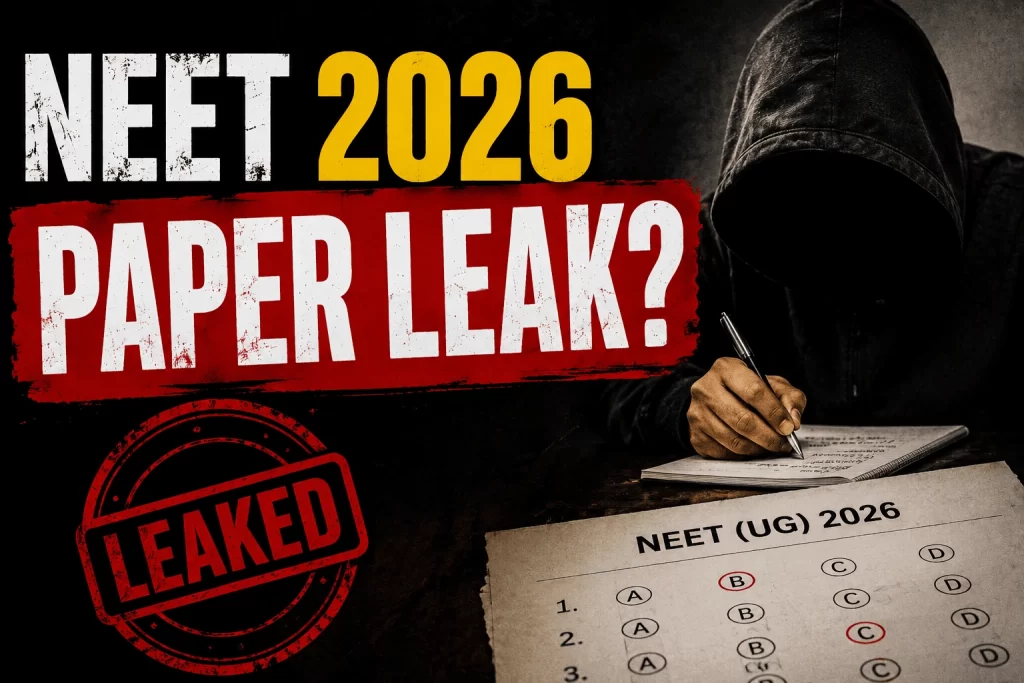
India woke up to a familiar – and terribly sad – headline on Monday. The National Testing Agency (NTA) has suspended the NEET UG 2026 exam just nine days after it was held on May 3 after credible evidence of a massive paper leak from Rajasthan. The Centre has subsequently asked the Central Bureau of Investigation (CBI) to conduct a thorough probe putting the country’s most competitive medical admission test back in the middle of a political and institutional maelstrom.
The news has been terrible for the nearly 22.79 lakh kids who sat the exam – months of sleepless nights, numerous coaching courses and the kind of strain that a NEET candidate truly understands. No new date for the examination has been announced. What is certain is that the sanctity of the May 3 test has been formally deemed violated.
— ### How It Went Wrong: The Trail from Jaipur
Things happened rapidly, even by the standards of India’s chaotic examination dispute calendar. NEET UG 2026 was conducted on May 3 in pen and paper mode from 2:00 pm to 5:00 pm in 551 cities in India and 14 locations overseas at over 5,400 examination centres.
Four days later, on the night of 7 May, the NTA got reports of foul play. The agency elevated the problem to central agencies the very following morning, May 8, for independent verification. What the agencies found was sufficient to make cancelation recommended, and indeed inevitable.
The flame was ignited in Rajasthan where the state’s Special Operations Group (SOG) has initiated a detailed probe after finding a handwritten ‘guess paper’ bearing a striking similarity to the actual NEET question paper. The document had some 410 queries, investigators said. From these, around 120 questions were on the actual exam, roughly 90 from Biology and 30 from Chemistry. Some publications have suggested an even higher figure, of 135 to 140 questions, with a possible marks worth of around 600 out of the entire 720.
And the timing makes it even worse. The guess paper was purportedly circulated on WhatsApp groups over 42 hours before the examination was scheduled to begin. That is no coincidence. That is, if the inquiry proves it, a willful, concerted violation.
The leak is thought to have originated from a printing company in the city of Jaipur. From there, the material allegedly moved to at least six locations: Sikar, Jhunjhunu, Nagaur, Dehradun, Jaipur and even Kerala, where police are investigating reports that the question paper was shared in private messaging groups before the exam. So far, around 15 persons have been questioned by the police. SOG has already taken into custody the suspects from Dehradun, Sikar and Jhunjhunu.
Question sets that are somewhat identical also seem to have been doing the rounds on social media from a tutoring facility in Latur, Maharashtra, but police in the area have not confirmed whether they are probing the matter yet.
— ### The NTA’s Defence – and Its Limits
The NTA did not remain quiet. The agency defended the integrity of its activities in a statement posted ahead of the decision to cancel, saying question papers were moved in GPS-tracked vehicles with unique, traceable watermark IDs. AI-assisted CCTV was used to monitor the examination halls from a central control room and every candidate was verified through biometric process and 5G jammers were in operation, it claimed.
That security architecture sounds quite reassuring on paper. And here we are.
If the CBI confirms the leak in its entirety, it would mean that the breach happened well before the paper reached the test halls. Traditionally, printing, packing and distribution have been the weakest links in India’s exam security chain. GPS tracking and biometric identification at the venue are useful protections but are no substitute for a compromised upstream supply chain.
The NTA has, to its credit, realised the seriousness of the situation. The agency noted in its official statement released on May 12 that re-conducting the examination “would create genuine and significant inconvenience to candidates and their families,” but not doing so “would have caused larger and more lasting damage” to the trust upon which the entire examination system is built. Re-examination will be performed without fresh registrations and no additional examination cost will be charged. Any paid fees will be returned.
— ## Become a CBI member
The case now enters a different league with the Government of India submitting the case to the Central Bureau of Investigation. The CBI will probe how the purported guess paper, said to contain all 90 Biology and all 45 Chemistry questions from the actual examination, reached students before the exam started. The breach will be traced by investigators down to its alleged point of origin in the Jaipur printing facility and via each node in its distribution chain.
The CBI will have to answer both specific and sweeping questions: Was it the work of some organised paper leak racket? Who were the go-betweens? How many pupils helped? In how many states? And critically – was this an isolated failure, or was this indicative of a systematic rot permitted to fester?
The NTA has assured full co-operation and promised to give all materials, records and technical data requested for the purpose of the inquiry.
— ## NEET: A Troubled History, A Déjà Vu
To view this as an isolated incidence would be naïve. Those with memories of 2024 will recall that NEET UG that year was mired in its own controversy – allegations of grace marks manipulation, paper leaks in Bihar and Gujarat, and a Supreme Court intervention that almost led to a complete re-test for over 24 lakh students. The situation resulted in the departure of key NTA officials and a wide-ranging reassessment of examination processes.
Reforms were pledged. Security mechanisms were revamped – at least on paper. And yet, less than two years later, the same conversation is at the center of the same study. If the reforms were real and complete, the question that cannot be evaded is: how did this happen again?
The trend suggests something more serious than logistical failure. India’s coaching sector is a huge enterprise with a lot of clout, especially in places like Kota, Sikar and Nagaur in Rajasthan. The need to generate results, at any cost, makes a fertile ground for organised cheating networks. Until the basic economics of exam manipulation are addressed – through legislation, accountability and structural reform – no amount of GPS tracking or biometric verification will do it.
— ## Brewing up Political Storm
The political backlash was quick and pointed. Leader of the Opposition Rahul Gandhi had no qualms in stating, “It is no longer a test – NEET has become an auction now.” It is a brutal line, but it speaks to the frustration of millions of families who spend years, and often their life savings, getting a child ready for this one test.
Opposition parties have asked for accountability beyond the CBI probe, seeking ministerial responsibility and a wider revision of the structure for examination conduct. Meanwhile, the ruling administration has said the CBI referral and the decision to re-conduct the exam are evidence of its commitment to openness and fairness.
Both replies are predictable, each in its own way. What will key is if the inquiry results in prosecutions, whether the re-examination is completed without incident, and whether the structural reforms that will follow this crisis will have genuine teeth.
— ## Next Steps for Student
The immediate practical picture for the 22.79 lakh students caught in this turmoil is: current registrations will be automatically rolled over. No new registration will be needed and no additional fee will be collected. The re-examination date will be informed through the official portals of NTA — neet.nta.nic.in in the coming days.
Students are urgently urged to depend exclusively on official communiqués and to avoid the deluge of unsubstantiated material on social media. The preliminary answer key has already been issued for the students to refer but in view of the cancellation, its utility now lies in allowing the students to assess their readiness for the re-examination.
It’s especially bad news for people who did well on May 3. There is a sensation of loss that is natural — of momentum, of assurance, of feeling that months of work had finally paid off. That pain is real. But the alternative, of letting a possibly corrupted exam stand, letting admissions to India’s medical colleges proceed on a contaminated result, would have been worse.
— ### A System at the Crossroads
India has some of the largest examinations in the world. NEET alone with 22 lakh plus aspirants is a logistical achievement like no other tried anywhere else. You have to remember the tremendous size of what the NTA tries to do every year.
But there is no excuse for failure on a scale. This is not simply a logistical failure. It’s a failure of ethics, accountability and, if this probe bears out what investigators already seem to think, criminal neglect that denied millions of kids a fair shot at their ambitions.
India can fix NEET? The honest answer is: it must. Medical education is not an abstract concept. The doctors who will someday treat patients in government hospitals, rural clinics, emergency rooms, are sitting somewhere today, waiting for a re-examination date, wondering if the system they are competing with is worth trusting at all.
That is the question that the CBI probe, the re-examination and the reforms that follow, must answer together. The stakes could not be greater for India’s young medical aspirants, and for the integrity of the nation’s public health infrastructure.
—
* Date of re-examination will be published by NTA through official channels. Students are urged to keep an eye on neet.nta.nic.in for any updates.*
NEET UG 2026 Cancelled: Paper Leak Scandal Hits India’s Medical Entrance Again, CBI Probe Ordered