Moscow Claims Successful Launch of World’s Most Powerful Nuclear Missile; First Combat Regiment Set for Deployment by End of 2026
—
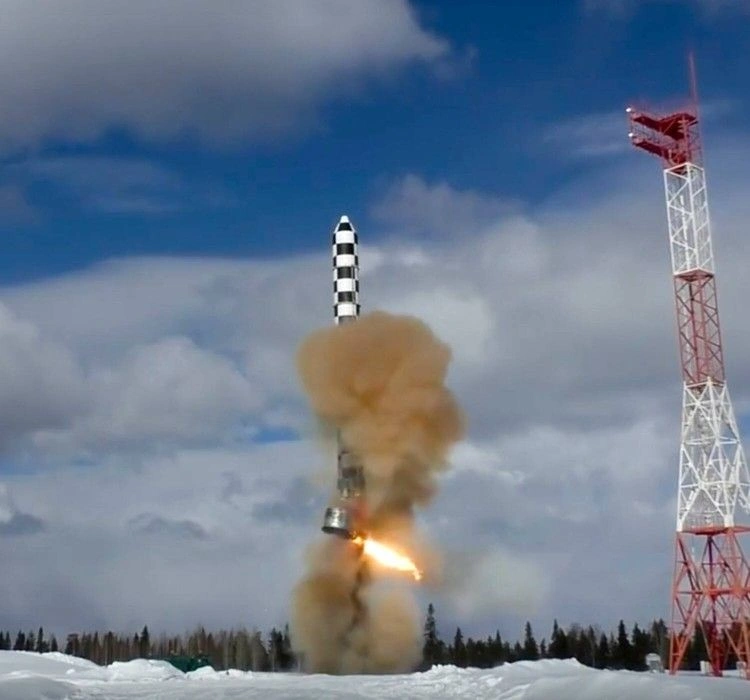
On the morning of May 12, 2026, the skies above the Plesetsk Cosmodrome in Russia’s Arkhangelsk region parted to something the world had been watching — and dreading — for years. At precisely 11:15 Moscow time, Russia’s RS-28 Sarmat intercontinental ballistic missile roared out of its silo in a test launch that the Kremlin wasted no time calling a defining moment for the country’s strategic arsenal. Roughly thirty minutes later, the warheads reached their designated target at the Kura test range on the Kamchatka Peninsula — thousands of kilometres away in Russia’s Far East — and Vladimir Putin, watching the entire sequence via video link from his office bunker, reportedly leaned forward and called it a “major event and unconditional success.”
The announcement landed with predictable weight in Western capitals, arms control circles, and defence ministries from Washington to New Delhi. This is, after all, not just another weapons test. The Sarmat — NATO codename “Satan II,” a name chosen with little subtlety — is designed to be the most destructive land-based nuclear delivery system on Earth. And after years of delays, explosions, and embarrassing failures, Russia appears to have finally cleared a critical technical hurdle.
## A Weapon Years in the Making — and Fraught with Setbacks
The Sarmat program has been anything but smooth. Russia first publicly unveiled the missile in March 2018, when Putin used a dramatic animated presentation during his annual Federal Assembly address to show the weapon flying over the South Pole and raining warheads down on what appeared to be the coast of Florida. It was theatre, obviously, but effective theatre. The missile was originally scheduled to enter operational service by 2021.
That didn’t happen. Development stretched on, complicated by the breakdown in Russia-Ukraine defence cooperation after the 2014 annexation of Crimea — a meaningful detail, since Ukrainian enterprises had historically been involved in Soviet-era ICBM maintenance. The first genuine flight test came only in April 2022, successfully striking the Kura range, and was hailed by Moscow as a breakthrough. But a February 2023 test was reported as unsuccessful. Then came September 2024, when satellite imagery obtained and analysed by open-source analysts showed what appeared to be a large crater and burn marks at Plesetsk’s launch silo — evidence of a catastrophic silo explosion. Another failure followed in November 2025, this time near Yasny in the Orenburg region, where the missile reportedly lost stability, caught fire, and disintegrated mid-air.
So how seriously should the world take Tuesday’s claimed success?
## What Happened on May 12 — And What Moscow Claims
According to the Kremlin’s official readout, Strategic Missile Forces Commander Colonel General Sergei Karakayev personally briefed Putin on the test results, confirming the missile had completed all assigned objectives. Russian state media released footage showing the Sarmat ascending from its silo, though independent verification of the full flight profile has not been possible.
Putin moved quickly to extract maximum political value from the announcement. He described the missile as the most powerful in the world and claimed its combined warhead yield is more than four times greater than any comparable Western system. He also announced that the first regiment equipped with Sarmat missiles will enter combat duty with the Uzhur missile division — part of the 62nd Red Banner Rocket Division in Krasnoyarsk Krai, Siberia — before the end of 2026. “The Sarmat will indeed be placed on combat duty at the end of the current year,” he confirmed.
Andrey Kartapolov, chairman of Russia’s State Duma Defence Committee, echoed the triumphalism, calling the test a demonstration that the Sarmat system is now “fully ready for operational use.”
## What Makes the Sarmat So Consequential
Strip away the political theatre and the Sarmat is, by any objective measure, an extraordinary piece of engineering — assuming it works as described. The missile is a three-stage, liquid-fuelled behemoth standing roughly 35 metres tall and weighing over 208 tonnes at launch. It is capable of carrying approximately 10 tonnes of payload — a figure that matters enormously in strategic terms.
That payload capacity means the Sarmat can be fitted with a variety of nuclear warheads and delivery vehicles simultaneously: up to ten 750-kiloton MIRV warheads, or as many as 15 to 16 lighter warheads, or a combination of warheads and Avangard hypersonic glide vehicles, which travel at speeds exceeding Mach 20 and manoeuvre unpredictably to evade interception. Russian officials claim its range exceeds 18,000 kilometres on a standard ballistic trajectory, and can extend to over 35,000 kilometres via suborbital paths — meaning it can approach the United States from the South Pole, circumventing radar and missile defence systems anchored to the northern axis.
For comparison, the Sarmat is designed to replace the Soviet-era R-36M Voyevoda — itself no lightweight, known in NATO parlance simply as “Satan” — which carried up to ten warheads and remained one of the most destructive weapons deployed during the Cold War. Russia has approximately 40 of those ageing missiles still in active service.
## The Arms Control Vacuum — A Problem That Just Got Bigger
Perhaps the most sobering dimension of Tuesday’s test is the geopolitical context in which it occurred. The last remaining nuclear arms reduction framework between Russia and the United States, the New START Treaty, expired in February 2026 — leaving the world’s two largest nuclear arsenals unconstrained by formal treaty limits for the first time in more than five decades.
This is not a technicality. Under New START, both sides were limited in the number of deployed warheads, land-based ICBMs, submarine-launched ballistic missiles, and nuclear-capable bombers. With those constraints gone, Russia can now replace its Voyevoda missiles with Sarmat on a one-for-one or greater basis, while simultaneously advancing other strategic programmes — the Poseidon autonomous nuclear-armed underwater drone, and the Burevestnik nuclear-powered cruise missile, both of which Russian officials said on Tuesday are in the final stages of testing.
The Oreshnik intermediate-range ballistic missile, meanwhile, has already entered active combat duty according to Moscow.
What all of this adds up to is a Russian nuclear modernisation push proceeding at a pace and scale that would have been legally constrained just months ago. Arms control analysts have described the current moment as the most dangerous in terms of nuclear risk since the early 1980s — a period that saw genuine fears of inadvertent war between the superpowers. Whether Tuesday’s Sarmat test accelerates that concern or eventually prompts renewed diplomatic engagement is a question that strategists are already debating.
## How the World Is Watching — and Why India Pays Attention
The immediate Western reaction to the test has been measured but unmistakably alert. NATO member states have been briefed, and analysts at think tanks in Washington and London spent Tuesday pulling apart whatever footage and Kremlin statements were available. One plausible outcome, as defence experts have noted, is accelerated investment by Western nations in missile defence infrastructure and hypersonic interceptor technologies. Another — arguably the more constructive one — is that the test could paradoxically push both sides toward new arms control talks, if the risks of unconstrained escalation become too uncomfortable to ignore.
For India, the Sarmat’s development carries its own strategic resonance. India operates within a complex nuclear neighbourhood — Pakistan to the west, China to the north — and tracks global nuclear modernisation closely as it calibrates its own deterrence posture and defence acquisitions. Russia has historically been India’s most significant defence supplier, and any major shift in Russian strategic capabilities or posture inevitably intersects with Indian security calculations, even if indirectly. A more assertive Russia brandishing next-generation nuclear weapons also affects the global balance of power in ways that ripple into multilateral forums where India has invested diplomatic capital.
## A Troubled Programme That Refuses to Stay Down
It is worth pausing on what Tuesday’s test actually represents in the longer arc of the Sarmat programme. The missile’s test record — one successful flight in 2022, failed tests in 2023, 2024, and twice in 2025, and now a claimed success in May 2026 — is patchy enough that independent analysts remain cautious about treating Moscow’s announcements at face value. The September 2024 silo explosion alone reportedly caused significant damage to launch infrastructure at Plesetsk. That kind of setback doesn’t simply get repaired overnight.
And yet there is the footage. There is the official Kremlin readout. There is Karakayev’s personal briefing to Putin. Absent hard evidence of another failure, the working assumption for Western governments has to be that Russia has achieved something real here — even if the path to full operational deployment by December 2026 remains ambitious.
The timing is also notable. Just weeks after Putin presided over a Victory Day parade on Red Square and declared the Ukraine conflict is “coming to an end,” the Sarmat test sends a very deliberate signal. It says: whatever the outcome in Ukraine, Russia’s strategic nuclear capability is not diminished. It is growing.
## What Comes Next
Putin has said the first Sarmat regiment will be operational at Uzhur in Krasnoyarsk by year’s end. If that happens, it will mark the end of a chapter that began with a 2018 animated video and stretched through years of humiliating setbacks. More practically, it means Russia’s nuclear triad will have a new, more capable land-based pillar — one that can carry hypersonic glide vehicles, approach targets from unexpected directions, and carry enough payload to threaten multiple cities in a single launch.
The absence of any arms control framework to verify or constrain this deployment is the part that should concern everyone — not just defence ministers and nuclear strategists, but ordinary citizens in every country that has ever placed some faith in the idea that nuclear weapons can be managed rather than simply accumulated. The last half-century of arms control architecture, however imperfect, created at least a shared vocabulary for managing existential risk. Right now, that architecture is gone.
Whether Tuesday’s test becomes a catalyst for rebuilding it — or for a new and more dangerous competition — may be one of the defining questions of the next decade. For now, a missile called Satan II has flown successfully for the first time in four years, and the world is watching to see what comes next.
—
Russia’s Satan II Finally Flies: Sarmat ICBM Test Shakes Global Security Order