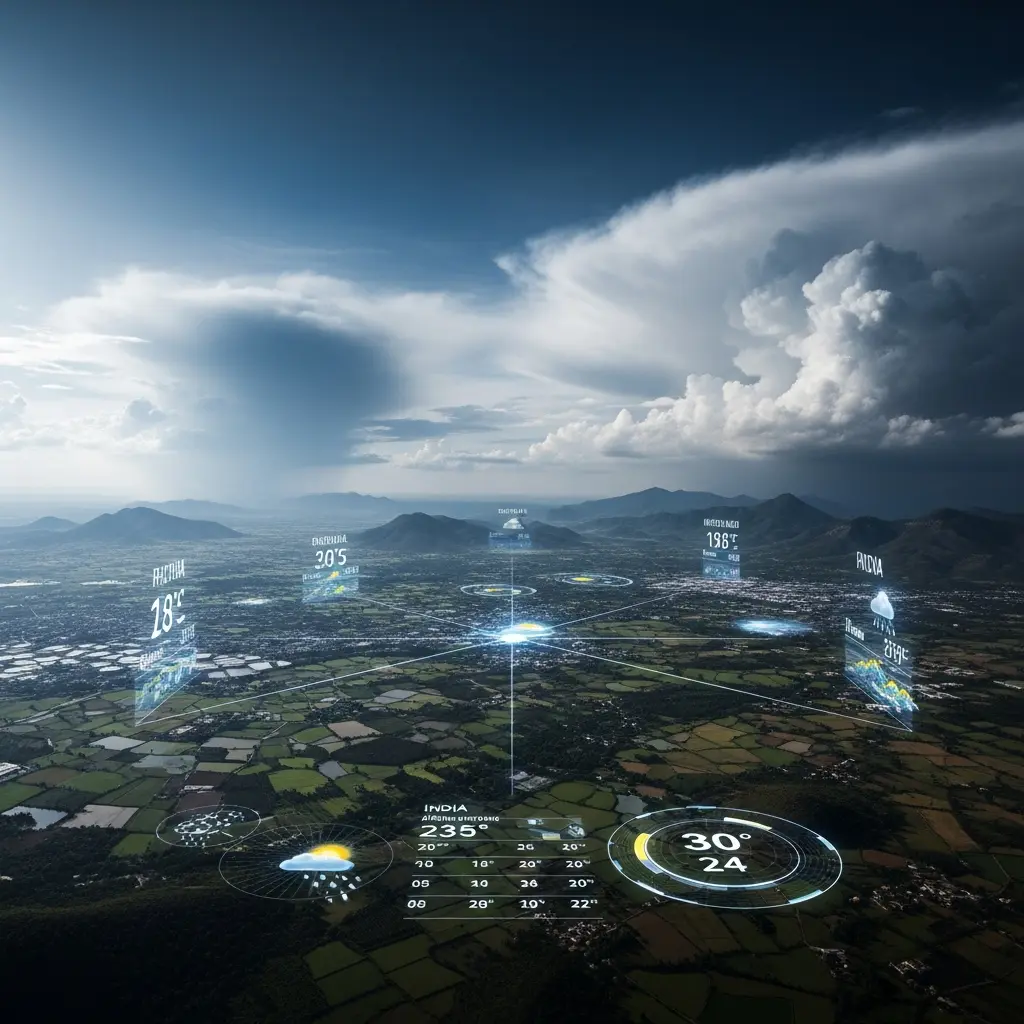
For a country where a single unexpected monsoon can flood a city or devastate a harvest, better weather prediction isn’t a convenience — it’s a lifeline. India’s new AI-powered forecasting expansion may finally deliver it.
There is a particular kind of helplessness that comes with watching a storm build on the horizon and not knowing exactly where it will land, how hard it will hit, or how long it will last. For generations of Indian farmers, fishermen, disaster responders, and city planners, that uncertainty has been the baseline condition. The Indian government’s latest push — an ambitious expansion of AI-enabled, hyper-local weather forecasting systems — is a direct attempt to change that.
The upgraded AI weather system will allow meteorologists and, crucially, the people who rely on weather information most directly, to receive predictions that are far more granular than what traditional forecasting models have historically been able to deliver. Not just “heavy rain in Maharashtra” — but hour-by-hour, village-by-village breakdowns of what’s coming, when, and with what intensity. That shift in precision isn’t a minor technical upgrade. It is, for many communities, a matter of safety and survival.
“A forecast that tells a farmer it will rain ‘somewhere in the district’ is almost useless. A forecast that tells him it will rain on his block at 4pm on Tuesday is a tool he can actually use.”
What IMD Technology Is Now Capable Of
The India Meteorological Department has been quietly undergoing one of the most significant technological transformations in its long history. The integration of artificial intelligence into IMD technology marks a step-change from the numerical weather prediction models that have dominated the field for decades. Where traditional models crunch atmospheric data at relatively coarse resolutions — think large grid squares covering hundreds of square kilometres — AI-driven systems can learn patterns from vastly richer datasets and produce predictions at resolutions that get close to individual neighbourhoods.
The systems being expanded draw on satellite data, radar networks, ground-based sensor arrays, ocean buoys, and historical climate records — all fed into machine learning models that get sharper with every passing season. Importantly, they are also designed to communicate uncertainty more honestly. Rather than issuing a single deterministic forecast, the newer AI models can express probabilistic ranges — telling users not just what is likely to happen, but how confident the system is, and what the alternative scenarios look like.
The expansion also includes investment in last-mile communication — ensuring that hyperlocal forecast data actually reaches the people who need it most, including rural farming communities, fishing villages along the coast, and disaster management teams in flood-prone river basins. Prediction without communication is only half a solution.
Why Agriculture Cannot Wait
No sector in India has more riding on the accuracy of climate monitoring than agriculture. More than 600 million Indians depend directly or indirectly on farming for their livelihoods, and over 60% of cultivated land remains rain-fed — meaning it is entirely at the mercy of monsoon patterns that have grown increasingly erratic as global temperatures rise. A farmer deciding when to sow, when to irrigate, when to apply fertiliser, or when to harvest is essentially making a series of bets on the weather. Better information doesn’t eliminate the risk, but it changes the odds dramatically.
The push toward hyperlocal forecast capability in India is, in this sense, an agricultural policy as much as a meteorological one. Studies from comparable systems deployed in other parts of Asia have shown that access to accurate, localised weather advisories can reduce crop losses by 20–30% in some contexts. Applied at India’s scale, that kind of improvement translates into billions of rupees in preserved output and, more importantly, millions of families better protected from the income shocks that bad harvests produce.
The timing matters too. India is heading into a period of increasing climate volatility. The monsoon — already one of the most complex weather systems on earth — is behaving with less predictability than it did a generation ago. Dry spells that stretch longer, rainfall that arrives in shorter, more intense bursts, heat waves that push further into spring and autumn. Each of these shifts makes precise climate monitoring in India not just useful but essential.
Disaster Preparedness: Reading the Warning Signs Earlier
The 2013 Kedarnath floods. 2015 Chennai floods 2021 Uttarakhand disaster India’s recent history is punctuated by extreme weather events that overwhelmed early warning systems and left responders scrambling. In each case, the gap between what meteorologists knew and what reached the people in harm’s way in time to act was a significant part of the tragedy.
Expanded AI weather systems directly address this gap. When a system can predict not just that a cyclone is forming in the Bay of Bengal but that it will make landfall within a specific 40-kilometre stretch of coastline at a particular tidal window, evacuation planning becomes a different exercise entirely. Resources can be pre-positioned. Alerts can be targeted. And the lead time that saves lives — the hours between a warning and an impact — can be stretched from hours into days.
India’s National Disaster Management Authority has already been working toward tighter integration between meteorological data and operational response planning. The upgraded forecasting infrastructure gives that integration a much stronger foundation to build on.
The Bigger Picture
India’s investment in AI weather systems sits within a broader global reckoning with what climate change demands of public infrastructure. The countries that will manage the coming decades of climate volatility best are the ones that invest now in the tools that help them see what’s coming — and communicate it to the people who need to act on it.
For a country as geographically and climatically diverse as India — from the Himalayan foothills to the Deccan plateau, from the Thar Desert to the Andaman coast — there is no single weather story. There are thousands of them, unfolding simultaneously, each requiring its own accurate, timely prediction. That is exactly the kind of challenge that hyperlocal, AI-powered forecasting is built to meet.
The storm is always coming somewhere in India. The difference now is that more people will know exactly where, and have enough time to prepare.
Knowing the Storm Before It Arrives: India’s AI Weather Revolution Is Here.