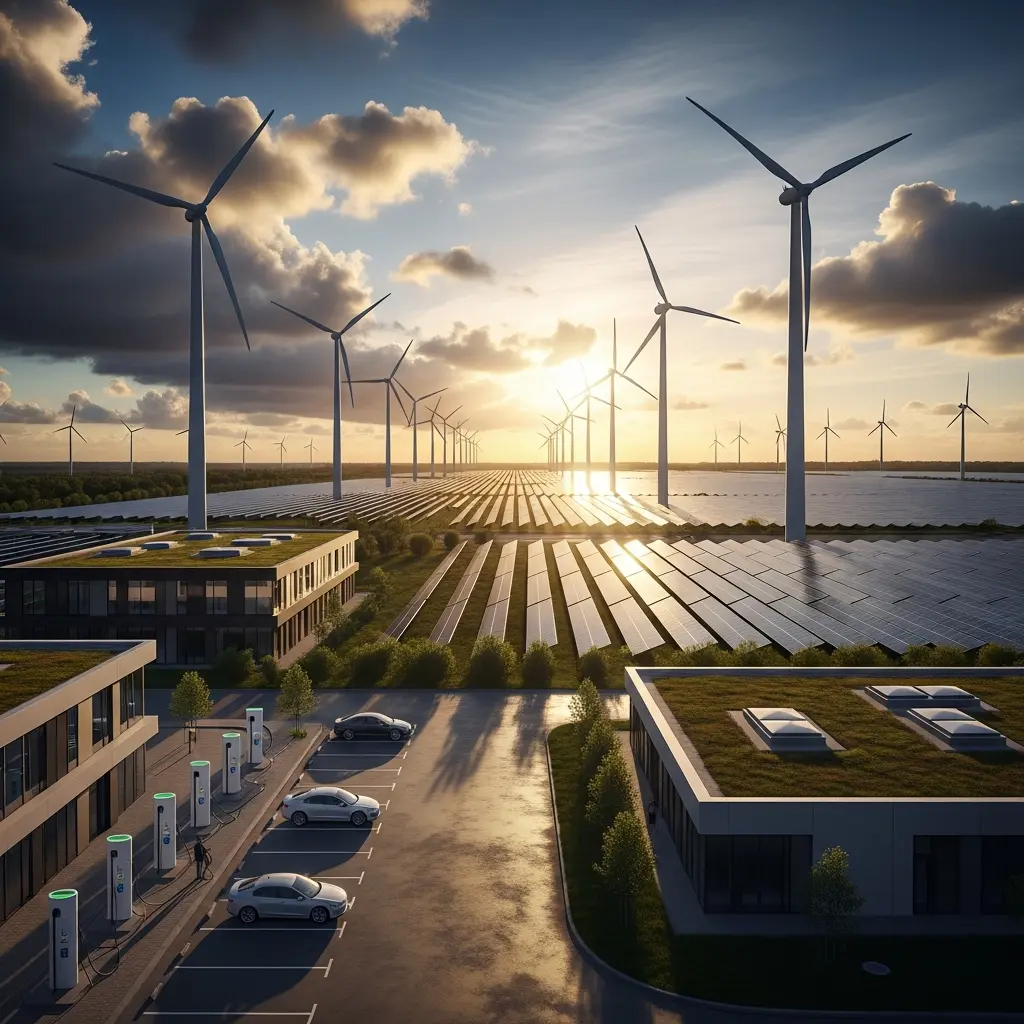
Something fundamental has changed in the way the world powers itself. It hasn’t happened overnight, and it hasn’t happened without friction. But if you step back and look at the trajectory — the investment figures, the policy commitments, the industrial decisions being made by governments and corporations alike — the direction is unmistakable. The global energy transition is no longer a future event. It is happening right now, and the pace is accelerating.
Renewable energy investment has reached levels that would have seemed implausible even fifteen years ago. Solar panels that once required heavy government subsidies to be economically viable are now among the cheapest sources of electricity ever built. Wind farms are appearing offshore in waters that engineers once considered too hostile and too expensive to develop. And nuclear energy — long controversial, long complicated — is experiencing a genuine reassessment in capitals around the world. The conversation has shifted. The question is no longer whether clean energy will define the future of global power. It is how quickly, and who leads.
Why Governments Are Moving With New Urgency
Policy support for clean energy infrastructure has strengthened considerably in recent years, and the reasons are not purely environmental. Energy security has become a driving force in its own right.
The disruptions of the past several years — supply chain shocks, fossil fuel price spikes, geopolitical instability affecting energy exports — reminded governments everywhere of a basic vulnerability. Dependence on imported fossil fuels means exposure to forces outside your control. A country that generates its electricity from domestic solar and wind resources, or from nuclear plants running on diversified fuel sources, is a country with far more control over its own economic destiny.
This realization has made clean energy investment a matter of national strategy, not just environmental conscience. When energy ministers talk about solar energy today, they are talking about manufacturing jobs, grid resilience, long-term price stability, and strategic independence. That framing has unlocked political support in places where environmental arguments alone never could.
Carbon emissions remain a central concern, of course. The scientific case for decarbonizing the global energy system has only grown stronger, and international commitments — however imperfect in their implementation — have created real pressure on governments to demonstrate progress. But the story of why renewable energy is surging is richer and more pragmatic than climate policy alone. It is about economics. It is about security. And increasingly, it is about competition.
Solar Energy: The Technology That Changed Everything
If one technology has defined the first chapter of the global energy transition, it is solar. The cost of solar photovoltaic panels has fallen by more than ninety percent over the past decade — a trajectory of improvement that rivals the most dramatic technology cost curves in history. What was once a niche, premium technology has become a commodity, deployed at enormous scale across deserts, rooftops, farmland, and floating on reservoirs.
Countries across Asia, Europe, the Middle East, and the Americas are building solar capacity at record rates. Utility-scale solar farms are now among the largest energy projects anywhere in the world, and the pipeline of projects under development suggests that installed capacity will continue to grow rapidly. Solar energy is no longer the future of electricity in a poetic sense — it is the present, already generating a meaningful share of electricity in dozens of countries.
The next frontier is pairing solar generation with storage — batteries that can hold energy generated at peak sunlight hours and release it when demand rises in the evening. Progress on battery technology has been substantial, though the economics of long-duration storage at grid scale remain an active area of development. Solving that problem fully would change the calculus of clean energy dramatically.
Wind, Nuclear, and the Full Portfolio
Solar gets much of the attention, but the global energy transition is not a single-technology story. Wind energy — both onshore and offshore — has expanded rapidly and continues to grow. Offshore wind in particular has opened up enormous new potential, particularly for densely populated coastal countries where land for large energy projects is scarce.
Nuclear energy is having a more complicated but ultimately significant moment. After years of declining investment in many Western countries, a reassessment is underway. The appeal is straightforward: nuclear plants produce large amounts of zero-carbon electricity with extraordinary reliability, running continuously regardless of weather. Small modular reactors — a newer generation of nuclear technology — are attracting serious investment from governments and private developers who believe they can make nuclear cheaper and faster to build than the large conventional plants of the past.
Sustainability goals that once seemed to exclude nuclear on ideological grounds are increasingly being rewritten to acknowledge that decarbonizing a modern industrial economy requires every available low-carbon tool. The science of climate change does not leave room for ruling out sources that generate reliable, zero-emission power at scale.
Clean Energy as Economic Engine
Perhaps the most important shift in how clean energy investment is understood is the recognition that it is not a cost to be managed but an opportunity to be captured. The industries being built around renewable energy — manufacturing, installation, grid infrastructure, storage, hydrogen — represent one of the largest economic opportunities of the coming decade.
Countries and regions that move early to build clean energy industries are positioning themselves for long-term economic advantage. Those that move slowly risk finding themselves importing clean technology from abroad, much as previous generations found themselves dependent on imported fossil fuels. The geopolitics of energy are being rewritten, and clean energy infrastructure is the new currency of industrial power.
The global energy transition will not be smooth or linear. There will be bottlenecks, political reversals, and technologies that underperform expectations. But the investment flows, the policy commitments, and the economic logic are all pointing the same direction. The world has made its bet on clean energy. Now it is building it.
The World Is Spending More on Clean Energy Than Ever Before — And There’s No Turning Back.