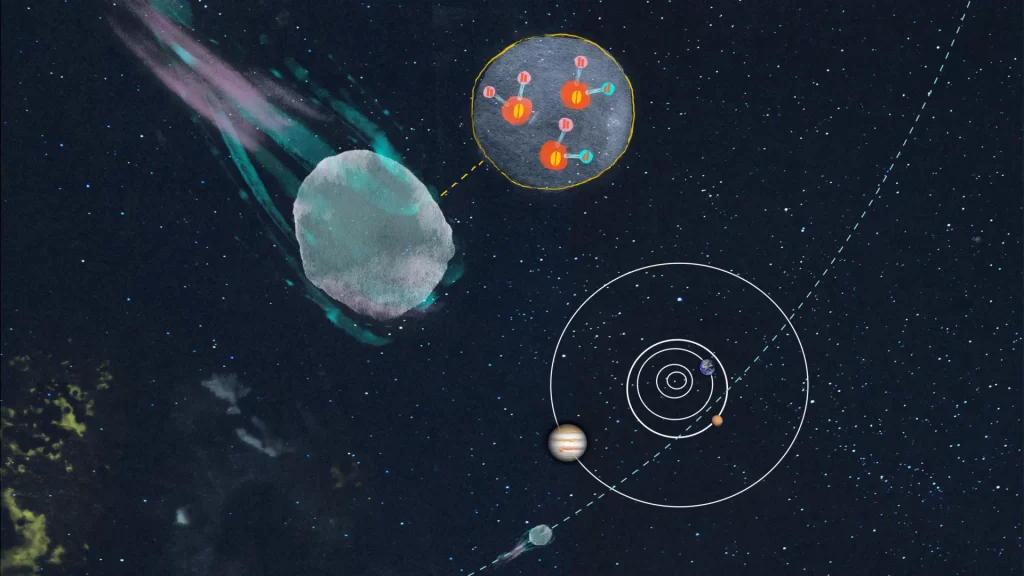
NASA announced this week that astronomers have detected an object passing through the solar system that originated beyond our stellar neighborhood — only the third interstellar visitor ever identified. The discovery, made with rapid-response observations and careful orbital analysis, raises fresh questions about how frequently such interlopers visit, what they can tell us about distant planetary systems, and whether our instruments are ready to capture more detailed data when the next one arrives.
How astronomers identify interstellar objects
Detecting an interstellar visitor begins with wide-field surveys. Over the past decade, projects like the Pan-STARRS telescopes, the Zwicky Transient Facility, and other automated systems have revolutionized how quickly moving objects in our sky are found. These surveys take repeated images and use machine learning and image-differencing algorithms to pick out candidates.
Once a moving object is discovered, astronomers quickly determine its orbit by combining multiple observations across different nights and, if possible, from different observatories. If the calculated eccentricity is greater than one and the object’s inbound trajectory indicates it is not gravitationally bound to the Sun, researchers classify it as interstellar. Speed also matters: interstellar objects typically approach at velocities inconsistent with objects originating in the Kuiper Belt or Oort Cloud.
This most recent detection followed that pattern. Rapid sharing of coordinates through professional networks and amateur observers allowed telescopes around the world to secure enough data points for a robust orbital solution. Spectroscopic observations — the splitting of light into its component colors — will be crucial next steps to determine whether this object is icy, rocky, or something in between.
What early observations reveal
At present, preliminary reports describe the object as small and relatively dark, with a size likely measured in tens to a few hundreds of meters across. Its brightness varies slightly as it rotates, and initial spectra show a neutral to slightly reddish color, similar to many small bodies in our own solar system. Those are tentative findings; as the object moves quickly through the inner solar system and then away, windows for high-quality data will close fast.
Two characteristics scientists will watch closely:
Activity: Does the object develop a coma (a fuzzy, dusty atmosphere) or a tail as it nears the Sun? If so, that points to volatiles like water ice sublimate — more comet-like behavior.
Non-gravitational acceleration: Does the object accelerate in ways not explained by gravity alone? That could indicate outgassing (small jets pushing it) or, less likely, unusual forces such as radiation pressure if it is extremely low mass or has non-standard structure.
Why interstellar visitors are scientifically valuable
Each interstellar object is a direct sample — however limited — of the material present in other stellar systems. They allow comparisons across many fronts:
Composition: Spectra reveal chemical fingerprints. Are volatile ices common or rare? Is the dust similar to cometary dust in our system?
Structure: Shape and rotation tell us about formation and collisional histories. ‘Oumuamua’s odd shape and tumbling rotation shocked many; Borisov was more conventional.
Population statistics: Every detection updates estimates of how many such objects are drifting through interstellar space. That, in turn, informs theories about the efficiency of planetesimal ejection during planet formation.
Delivery mechanisms: Understanding how objects are ejected from their home systems — by gravitational interactions with giant planets, stellar encounters, or other dynamical processes — improves our models of system evolution.
These questions matter in the Indian and global contexts. Indian observatories, including those part of international networks, contribute to follow-up tracking and spectroscopy. The discovery underscores the need for coordinated global responses: the next interstellar object could be brighter or produce unexpected signals that require rapid, multi-wavelength observations from instruments in different longitudes. For India’s growing astronomy community, it’s an opportunity to participate in high-profile, time-sensitive science.
How common are interstellar visitors?
Before 2017, interstellar interlopers were purely theoretical curiosities. The detections of ‘Oumuamua and Borisov forced scientists to revise estimates upward: such objects are likely far more common than earlier models suggested, but many are too small or too faint for current surveys to catch.
Researchers now use detection rates to estimate the number density of these objects in the galaxy. Those estimates come with large uncertainties, because they depend on survey sensitivities, object sizes and brightness, and the brief windows when an object is observable. The fact we’ve spotted three in less than a decade suggests a steady trickle of interstellar bodies through the inner solar system. But whether the population is dominated by icy comets, rocky asteroids, or some hybrid mixture remains an open question.
Preparing for the next encounter
The astronomical community is already planning for the next opportunity to study an interstellar object in depth. Several strategies are under discussion:
Dedicated rapid-response protocols that link wide-field surveys, follow-up spectrographs, and radio telescopes to capture data as early as possible.
Space-based observations to avoid atmospheric interference, crucial for faint or fast-moving objects.
Pre-positioning small, fast instruments or adapting existing spacecraft to perform flybys when early discovery allows some lead time.
There’s also interest in more ambitious long-term plans: conceiving missions that could chase an interstellar object if detected early enough. That’s technologically challenging because of the high relative speeds involved, but concept studies are underway. India’s space program and private space industry have shown growing interest in small-satellite capabilities; in future decades, a nimble mission could be one way to sample an interstellar visitor at close range.
Open questions and scientific debates
Every interstellar detection stokes debate. ‘Oumuamua provoked extreme ideas about its nature because observations showed non-gravitational acceleration and an absence of an obvious cometary coma. Some scientists proposed outgassing from volatiles below the detection limit; others considered more exotic possibilities. Borisov, by contrast, behaved like a familiar comet, tempering some of the more speculative claims.
With a third object, scientists will ask: Do interstellar objects come in two broad types (rocky and cometary), or is there a continuum? Are peculiar properties like ‘Oumuamua’s shape rare exceptions or indicators of a class we have yet to fully understand? Do planetary systems eject large numbers of small bodies during their formation, making these visitors common, or are we seeing a biased fraction that is unusually detectable?
Practical implications for planetary defense and science policy
Interstellar visitors also intersect with practical concerns. While the chance of an interstellar object posing a collision risk is effectively negligible compared with near-Earth asteroids that are gravitationally bound to the Sun, the science community treats these detections seriously because of the unique knowledge they provide.
Policymakers and funding agencies face choices about investing in survey infrastructure, rapid-response coordination, and potential mission concepts. The cost-benefit calculus isn’t only scientific curiosity: better detection capabilities improve our overall catalog of small bodies, which helps both science and planetary defense planning.
A human moment in the cosmic story
There’s a narrative appeal to interstellar visitors. They are messages in bottles tossed between star systems, carrying clues about remote places we cannot otherwise sample. They arrive unannounced, spend a short time in our neighborhood, and then continue their journey toward unknown destinations. That transient visit sparks international collaboration, rapid observation campaigns, and lively public interest — a reminder that our solar system is not a closed island but part of a dynamic galactic environment.
If you could send one instrument to study this object before it escapes forever, what would you choose — a high-resolution imager, a mass spectrometer, or something else? That question captures both the limits of our current tools and the imagination that drives space science.
Key takeaways (brief)
This is the third confirmed interstellar object detected in the solar system.
Rapid observations and orbital solutions show it to be on an unbound trajectory confirming its interstellar origin.
Early data suggest a small, dark body; further spectroscopy will clarify composition and activity.
Each detection refines estimates of how many interstellar objects wander through space and offers unique clues about other planetary systems.
The discovery highlights the need for global, rapid-response observation networks and may inform future mission planning.
What comes next
In the coming days astronomers will publish more detailed analyses of the object’s orbit, brightness variations, and spectral signatures. Observing time on major telescopes will be prioritized, and amateur astronomers may find opportunities to contribute useful data. For the wider public, this discovery will be another reminder of our place in a far larger cosmos and the small, intriguing fragments of other systems that occasionally visit us.
As analysis continues, the scientific community will refine estimates of the object’s size, rotation, composition, and potential activity. Each new piece of information will help place this interstellar visitor in context with ‘Oumuamua and Borisov and refine our picture of how planetary systems form and evolve.
This detection won’t answer every question, but it widens our window into the galaxy. Expect more details soon as telescopes focus, data accumulate, and teams parse what this wanderer tells us about the universe beyond the Sun. Would you want real-time alerts when future interstellar visitors are spotted so you can follow them as they pass by?
NASA Confirms Third Interstellar Visitor Passing Through Solar System — What We Know and Why It Matters