India’s electric vehicle story has been long on promise and, often enough, short on delivery. Something shifted in Bengaluru this week and the ripples will likely be felt across the country’s clean mobility space for years to come.
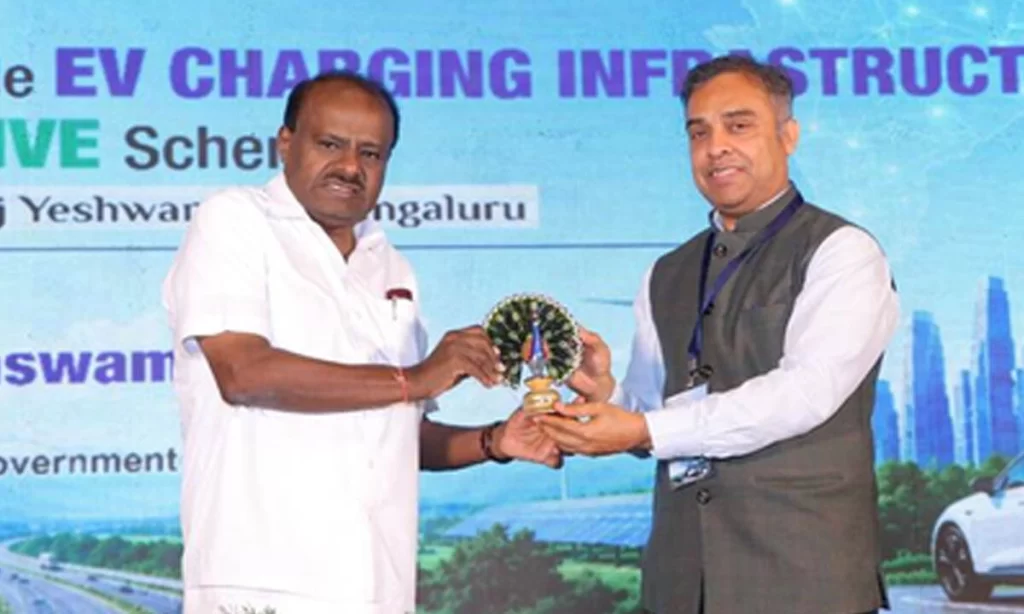
Union Minister for Heavy Industries H.D. Kumaraswamy announced two headline developments while addressing the National Conference on Enabling Nationwide EV Charging Infrastructure under the PM E-DRIVE Scheme, namely the upcoming Unified Bharat e-Charge (UBC) platform, a national app to unify the fractured EV charging experience and the sanction of 1,243 EV charging stations in Karnataka with a financial outlay of ₹123.26 crore. The statement, announced in front of state government officials, charge point operators and industry leaders, signifies a major change from policy discourse to boots-on-the-ground infrastructural implementation.
— #The Numbers Behind the Drive
The Karnataka permission is part of a broader federal drive under the PM E-DRIVE plan, under which bids worth ₹503.86 crore have already been granted for the installation of 4,874 EV chargers across various states and Central Public Sector Enterprises (CPSEs). The accepted plans span a large geography – Rajasthan, Andhra Pradesh, Uttar Pradesh, Gujarat, Kerala, Telangana, Tamil Nadu and Karnataka – and key public sector oil corporations including HPCL, IOCL and BPCL.
The first phase of the EV charging infrastructure under PM E-DRIVE includes a total allocation of ₹2,000 crore with a broad objective to install over 72,000 stations across the country. This is no little ambition. And for Karnataka — which already has 5,765 public EV charging stations, one of the largest in the country — these 1,243 additions under the new system are a consolidation of its lead, as well as a prototype for what other states could achieve.
Under the former FAME-II initiative, oil marketing companies installed 8,932 EV chargers nationally with subsidy support of ₹873.5 crore, of which 721 were deployed in Karnataka itself. The new phase essentially adds on to that state-level total by around 70 percent with one announcement.
— ## India’s UPI Moment for EV Charging: The UBC App?
The more relevant of the two initiatives could be the Unified Bharat e-Charge (UBC) platform, if only for the 30 million or more EV customers across India who now have to navigate a confusing patchwork of apps, proprietary networks, and payment systems to even charge their vehicles.
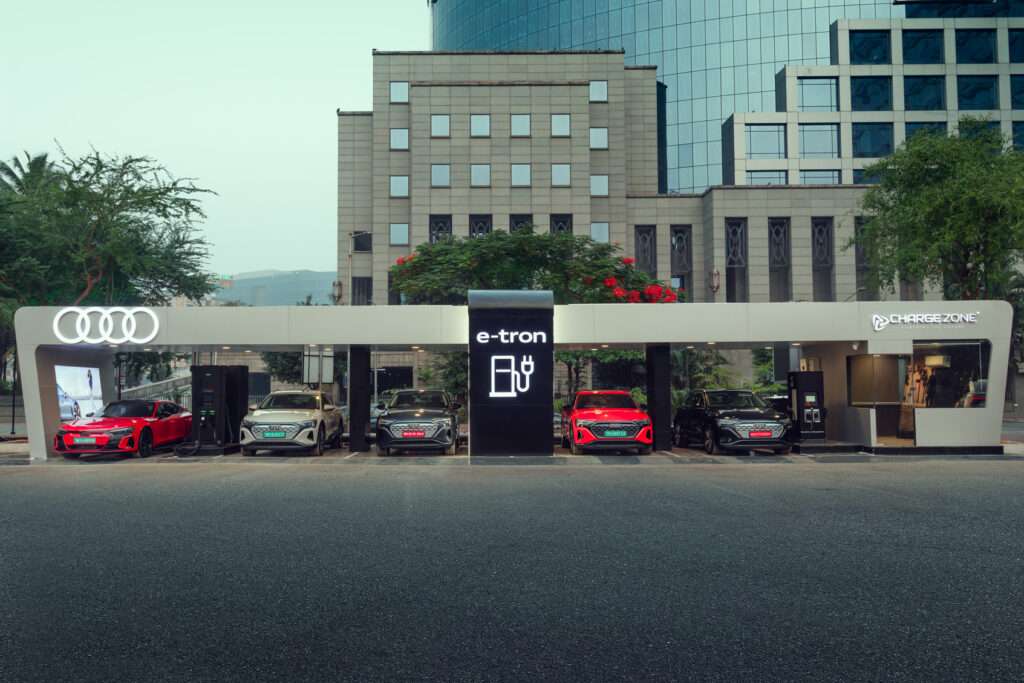
If you own an electric car and need to charge it at a public station, you might need one app to charge at Tata Power’s network, one for ChargeZone, and even one for a charger managed by an oil firm. It’s complex. It’s time-consuming. And, frankly, it’s a real turn-off for a lot of fence-sitters when it comes to EV adoption.
This is where the UBC platform comes in to solve this problem by bringing together all charging operators in one interface, letting customers to find local chargers, see real-time availability, start a charging session and pay – all in one trusted app. The government has been looking at integration with BHIM, the national payments app, while BHEL (Bharat Heavy Electricals Ltd) is said to be working on a “super app” layer on top of it, that includes real-time booking and smart session management.
“UPI has made a revolution in digital payment and UBC is going to make a revolution in EV charging in India,” the connection was drawn by Kumaraswamy himself. It’s a bold claim, but it’s not altogether implausible. UPI worked because it got rid of friction – no longer did you need to use several banking apps to pay anyone, wherever. Same rationale here. If UBC delivers on its commitment, it may do more to break down the psychological barrier to EV ownership than any subsidy alone.
The Ministry of Heavy Industries is working with the Ministry of Power, state governments and industry stakeholders to ensure grid readiness, standardisation and digital integration, the three pillars without which any app, however well-designed, will struggle to provide a reliable experience.
— ### Why It Matters: The Infrastructure Gap India Must Close
India’s EV adoption numbers appear good on paper. In 2024, EV sales reach 2 million, six times more than four years ago. Almost 90 percent of that tonnage is two- and three-wheelers, however passenger car EV sales are on a steady upswing. The global EV market is predicted to be worth $54.41 billion in 2025 and is projected to more than quadruple to $110.7 billion by 2029.
But here is the hard truth that often lies behind the optimism: Today, in India, you have one public charging station for every 235 electric automobiles. Public charging stations grew from around 5,000 to over 26,000 between 2022 and 2024 – a fivefold increase – but are still being used at a stubbornly low rate. Less than 10 percent of the operational stations are used in any meaningful way on a daily basis and a considerable chunk of the installed base is non-operational owing to hardware failures, connectivity problems or bad placement choices.
What does this mean in real life? The biggest psychological hurdle to EV adoption in India is still range anxiety, or the worry of running out of charge before reaching a working station. It keeps petrol car purchasers in the fold, and it keeps current EV users sticking to known urban corridors where chargers are generally predictable.
This is made worse by the geographical divide. Karnataka and Maharashtra have a disproportionately high share of public charging infrastructure. Meanwhile, the Tier-2 and Tier-3 cities and the vast rural portions of India are still chronically under-served. Slow adoption in non-metro areas has been attributed to high energy bills, cost of grid connections for charge station providers, challenges in land acquisition and inadequate cooperation among several government departments.
Is there a genuine risk that India’s EV infrastructure drive will again be concentrated in cities that already have options, leaving smaller towns behind? That’s a question officials will have to answer with details — targets at the state level, deadlines and accountability procedures — not just big national statistics.
— ## Bengaluru as a Blueprint, Not the Full Story
Kumaraswamy said Bengaluru is among the best EV charging hubs in India and urged other states to follow the city to expedite deployment. The city has already created some room on major intercity roads – charging stations on the Bangalore-Mysore Expressway and Bangalore-Chennai Highway now allow for longer EV drives, directly tackling range anxiety on high-traffic corridors.
That said, Bengaluru’s success is also due to its peculiar economic character – a dense, tech-savvy populace with relatively high EV ownership among young professionals, a supportive state government and early private sector investment from players like Tata Power and ChargeZone. You need different tactics to do it in Patna or Nagpur or Coimbatore, different stakeholder alignment and, crucially, a bigger central push to make the economics work for charge station operators outside premium markets.
This is partially addressed by the subsidy structure of the PM E-DRIVE scheme. The government will subsidize up to 100 percent of the cost of upstream infrastructure at state-owned premises and 70 percent of the cost of chargers – a huge financial cushion that decreases the barrier to investment for operators who may otherwise think twice about setting up in lower-traffic regions.
Tata Power, ChargeZone and Mahindra & Mahindra are among the companies that have made a mark in the industry and admitted to attending the Bengaluru conference. These companies have created credible EV charging networks through a combination of capital investment and operational execution. Their ongoing participation in the government-backed expansion will be key in ensuring the rollout of the chargers is about quality and not just quantity.
— ## The Strategic Case: Clean Air Is Not Enough—Energy Security
It is interesting to see how Kumaraswamy positioned the government’s focus on EVs. It wasn’t just about air quality or climate commitments — although those featured prominently. He pointed to India’s need on imported fuel and to geopolitical disturbances, particularly tensions in the US-Iran corridor, as a reminder of the risks inherent in petroleum dependency.
This is a tactical argument, and it’s a good one. India’s auto industry produces over 7 percent of GDP, accounting for about half of the manufacturing GDP and provides employment to close to 30 million people. A sector that size that’s structurally dependent on imported fuel – with global oil markets as volatile as we’ve seen in recent years – is a strategic danger as much as an economic one.
The government’s parallel investments in the Production Linked Incentive scheme for Advanced Chemistry Cell batteries (worth ₹18,100 crore), rare earth magnet manufacturing to reduce import dependence, and PLI schemes for cleaner vehicles are all part of a broader industrial policy designed to shift the dependency curve. In this light, the EV charging infrastructure is not just a convenience benefit – it is strategic infrastructure, as fundamental to future transportation as roads or gasoline stations were to the prior century.
— ## What’s Next
Bengaluru’s pronouncements are weighty, but the proof of the pudding is in the eating. India has a mixed record when it comes to huge infrastructure programs – targets are made, money is given and then the story becomes one of the gap between what is planned and what gets constructed on schedule.
There are things that will matter in the coming months. We need to build the UBC platform correctly, not merely announce it. A half-working software that lists chargers that are actually offline – is, in a way, worse than no app at all – it erodes trust and supports bad narratives around EV ownership. The government’s proposal to integrate BHIM is a wise move if it works, because it piggy-backs on an already established, extensively installed payments environment.
Karnataka’s 1,243 stations need to have quality benchmarks, not installation certificates. It’s uptime, connection standardization and transparent pricing that will be the benchmarks for this round of investment really improving the charging experience for real users.”
And the second phase of PM E-DRIVE – which Kumaraswamy specifically said will take on board further state suggestions – needs to prioritise coverage gaps, not just volume. Each charger placed in a Tier-2 city or along a national highway corridor that has none, does more to increase effective EV adoption than three extra chargers in an urban area that is already served.
India’s goal of 30 percent EV penetration by 2030 is ambitious. The charging network needs to maintain pace with the fleet of vehicles to get there – and it isn’t at the moment. But the Unified Bharat e-Charge platform and the Karnataka sanction are real moves in the right direction, if pursued with discipline and haste.
India is very much in the middle of the EV revolution. The infrastructure to support it is finally starting to catch up, but unevenly.
—
India’s EV Revolution Gets a Boost: Kumaraswamy Launches Unified Bharat e-Charge Platform, Approves 1,243 Charging Stations in Karnataka