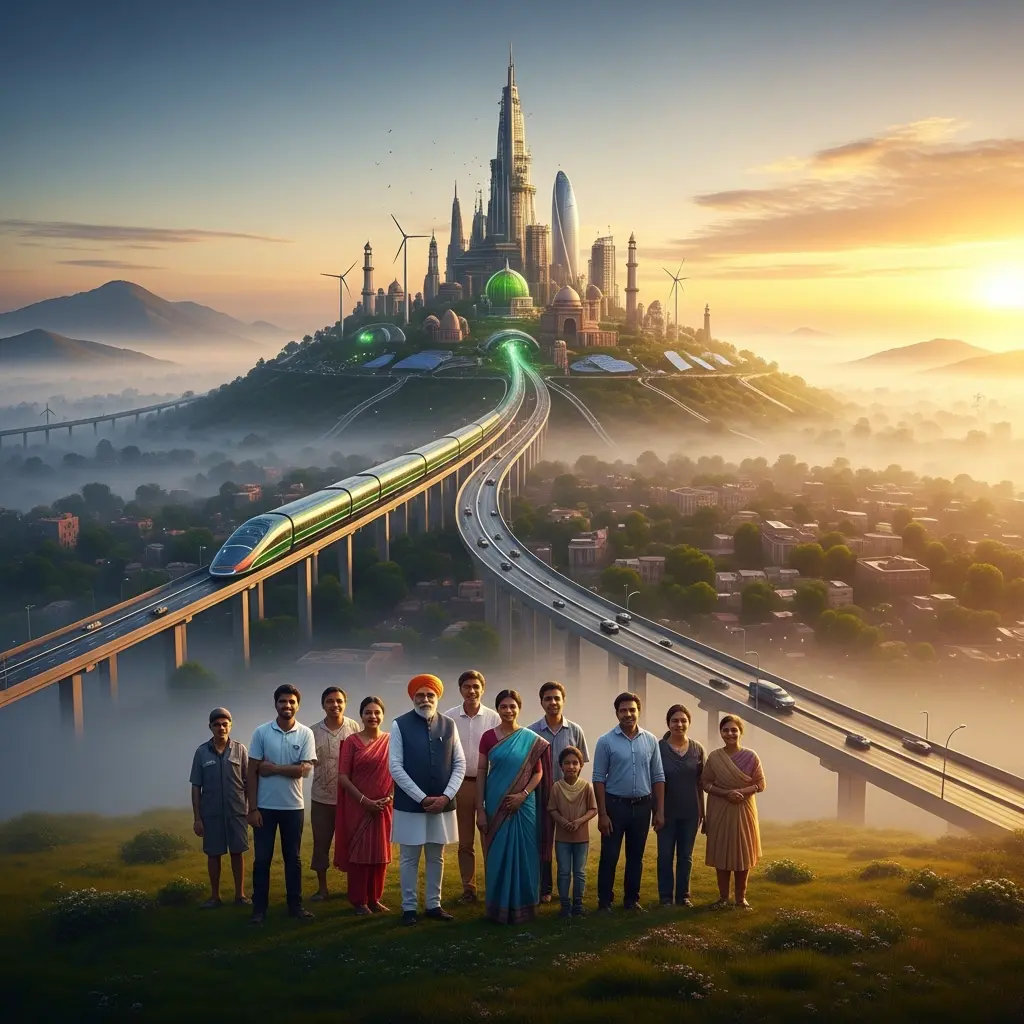
New Delhi | May 2026 — Four and a half hours. That’s how long Prime Minister Narendra Modi sat with his Union Council of Ministers on Thursday evening, reviewing India’s most ambitious long-term development roadmap — the Viksit Bharat 2047 vision. In a government that routinely holds meetings measured in minutes, this one was different in both its length and its tone.
Modi didn’t just review progress. He issued a challenge. “Viksit Bharat 2047 is not merely a slogan,” he told ministers. “It is our commitment.” Then, in what sources describe as an unusually direct address, he asked his cabinet to stop looking backward at what has been achieved since 2014, and focus entirely on what still needs to be built.
That combination — urgency, ambition, and a deliberate pivot toward the future — captures something important about where India’s policy direction is headed.
What Happened in the Room
The meeting, held at Seva Teerth in the national capital, brought together ministers from across nine key departments. Presentations were made by the Ministries of Agriculture, Forests, Labour, Road Transport, Corporate Affairs, External Affairs, Commerce, and Power, each laying out their governance priorities and future action plans against the Viksit Bharat 2047 framework.
External Affairs Minister S. Jaishankar also briefed the Council on PM Modi’s recent five-nation diplomatic tour, bringing the international dimension of India’s development story directly into the room.
But the sharpest messages reportedly came from Modi himself. He directed ministries to ensure faster movement of files and eliminate bureaucratic delays that slow down policy implementation at ground level. He asked ministers to maximise productivity in minimum time, simplify administrative systems, and approach governance with what he described as a mission-driven mindset. Ministries with relatively weaker performance rankings were reportedly told directly to improve their implementation records. No soft edges, no diplomatic cushioning.
Discussions also covered the energy security concerns of India with regard to the ongoing West Asia crisis – an indication that even long-term visionary planning must confront immediate geopolitical realities.
The Vision Itself: What Viksit Bharat 2047 Actually Proposes So what is Viksit Bharat 2047 beyond the headline? It is the blueprint of the Government of India to make the country a fully developed, self-reliant and globally influential nation by 2047, the centenary of independence.
The economic target is daunting: a $30 to $40 trillion GDP by 2047, from around $4 trillion today. Expected per capita income of $21,000 will launch India into the upper-middle income group and beyond. Manufacturing’s proportion of GDP is poised to rise from about 17% to 25%, while India’s services sector is being primed to take a 10% share of world services trade.
The vision is based on four human pillars: Yuva (Youth), Garib (Poor), Mahila (Women) and Annadata (Farmers). This framing is intentional — it signifies that the development model being pursued is not just about headline GDP figures, but about whether growth actually trickles down to the people who have historically been furthest from it.
Besides the human pillars, the policy framework is based on six strategic priorities. These are transforming India into a global manufacturing hub, revival of Indian knowledge systems, ensuring global presence of Indian products, powering green energy, expanding tourism and promoting inclusive global development. These aren’t abstract aspirations. Each has a corresponding policy architecture already in motion.
Governance Reform: The Piece That Holds Everything Together
There is a crucial insight buried inside Thursday’s meeting that often gets overlooked in the excitement over GDP targets and infrastructure announcements: none of this works without governance reform.
Prime Minister Modi reportedly stressed that reforms must not remain confined to paperwork. They must translate into faster, simpler, and more effective services for citizens on the ground. He asked that every ministry treat public welfare — not procedural compliance — as the primary measure of success.
India’s digital governance push is central to this. Scaling UPI, Aadhaar, and AI-powered public systems to automate service delivery, reduce friction, and bring government closer to citizens is a core enabler of the Viksit Bharat development roadmap. The government’s push under Digital India has already demonstrated what is possible when public infrastructure is built with genuine scale in mind — and the ambition now is to extend that model across all government functions.
The push for “Ease of Living” as well as “Ease of Doing Business” is also a major shift in the framing of the Modi government’s reform agenda. The goal is not just to make India a more appealing destination for investors. It is to tangibly improve the everyday lives of ordinary Indians – in their access to healthcare, education, legal services and government benefits.
Manufacturing, Infrastructure and the Long Game
No write-up of Viksit Bharat 2047 is complete without a look at the physical infrastructure that supports it.
India’s PLI (Production-Linked Incentive) schemes are already bearing fruit in 14 priority sectors and the manufacturing push is expected to intensify significantly in the decades ahead. The semiconductor mission, clean energy investments, smart city development and the Gati Shakti national master plan for infrastructure – all of these are pieces of a larger puzzle that the Viksit Bharat vision is trying to assemble with intent and coordination.
India has also set an ambitious renewable energy target of 1,500 gigawatts of installed capacity by 2047 and remains committed to achieving net-zero carbon emissions by 2070. Energy security — particularly relevant this week given the West Asia tensions — is itself identified as a structural pillar of long-term development, not an afterthought.
Education and human capital are equally central. A proposed High-Powered “Education to Employment and Enterprise” Standing Committee signals recognition that turning India’s demographic dividend into real economic output requires a far more deliberate connection between what its schools and universities produce and what its economy actually needs.
Why This Moment Matters
India is approaching the second anniversary of Modi’s third term against a backdrop of strong economic momentum. The IMF has forecast 7.3% growth for fiscal 2026. Goldman Sachs expects 6.9% in the calendar year. The economy has already become the world’s fourth largest and is on a credible path toward third.
At moments like this, governments face a fork in the road. One path is to manage the momentum — protect what’s working, avoid big disruptions, and let the numbers speak for themselves. The other is to raise the ambition — to ask what more is possible, to identify the structural bottlenecks that could cap the growth story before it reaches its potential, and to push harder while the window is open.
Thursday’s meeting suggested clearly which path Modi intends to take. The Viksit Bharat 2047 vision is not a document gathering dust. It is being treated as an active governance framework that every ministry is expected to align with, measure against, and be held accountable to.
Twenty-one years is both a long time and — given the scale of what India is attempting — not very long at all. The clock is running. The Prime Minister, it seems, knows it.
More Than a Slogan: What Modi’s Viksit Bharat 2047 Vision Really Means for India.