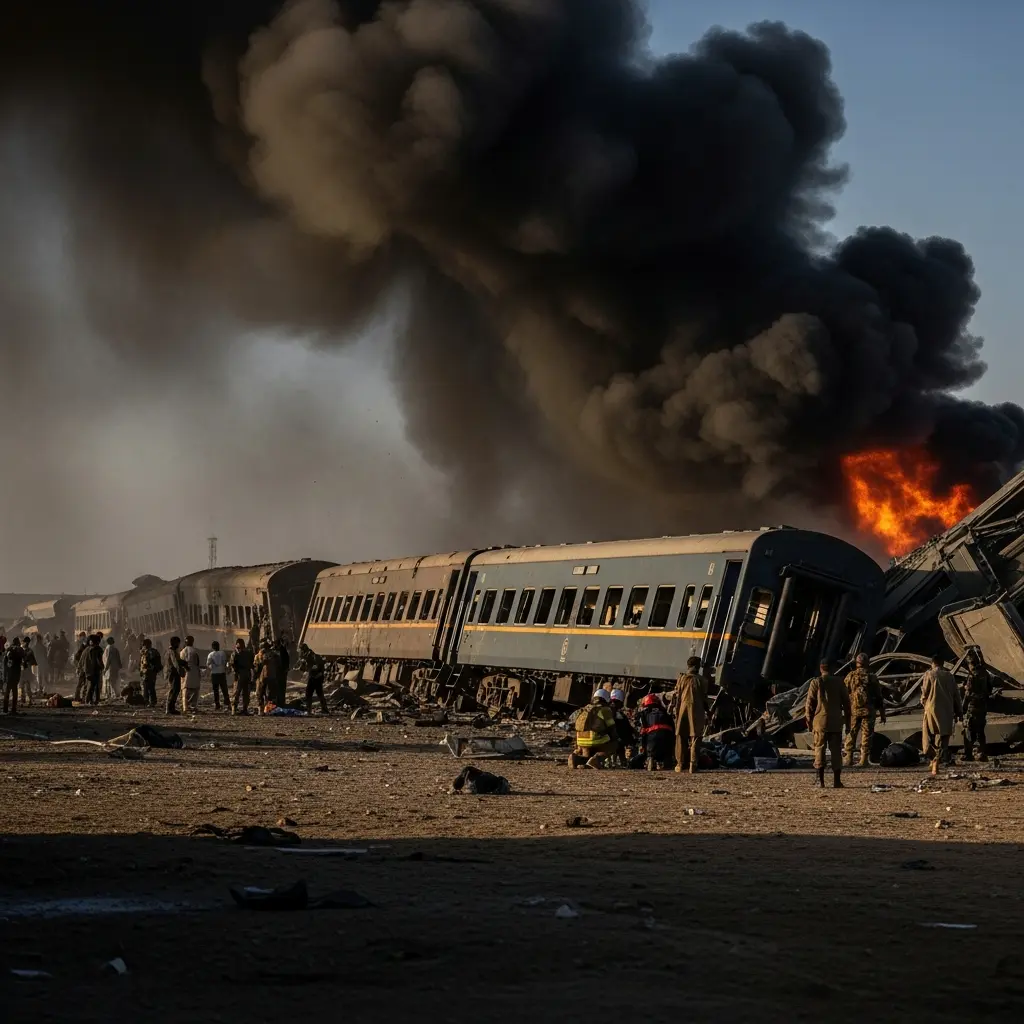
It was just another day on the train for the hundreds of passengers who boarded the train that day — families traveling between provinces, workers heading to far-off cities, and everyday people just trying to get from A to B. But within moments, that ordinary morning was destroyed in a horrific explosion, and something unimaginable took its place. A deadly Pakistan blast ripped through the train, killing at least 24 and injuring dozens more, their cries lost in the smoke and debris of what was left.
The train attack was one of the most brazen acts of violence against civilian infrastructure that Pakistan has seen in recent years, and it sent shockwaves far beyond the railway tracks where it happened. It struck at something so deeply human – the basic right to travel safely, to go home, to simply move through the world without fear.
What Happened
Regional authorities confirmed the explosion targeted the train while it was in transit through an area long known for separatist tensions. The blast was powerful enough to derail carriages and cause structural damage that made immediate rescue operations painfully difficult. Emergency services scrambled to the scene, pulling survivors from twisted metal as thick black smoke rose into the sky.
The death toll, confirmed at 24 at the time of reporting, was feared to rise as rescuers continued searching through the wreckage. Hospitals in nearby areas went on high alert, as the injured arrived in waves, some with critical burns, others with shrapnel wounds and broken bones. Medical staff worked through the night, doing what they could for victims who had simply been going about their lives hours before.
A separatist group operating in the region subsequently claimed responsibility for the train attack, describing it as a deliberate strike against the Pakistani state. Security forces launched a large-scale investigation almost immediately, deploying additional personnel across major transport routes in the surrounding provinces to prevent any follow-up attacks and to reassure a rattled public.
A Pattern of Targeted Violence
This is not the first time Pakistan’s transport and civilian infrastructure has been targeted. For years, certain separatist factions operating in volatile regions of the country have used bombings and ambushes as tools of political pressure — tactics that inevitably result in the deaths of ordinary civilians who have no direct role in the conflicts these groups claim to be fighting.
The cruelty of such attacks lies in precisely this contradiction: those who suffer most are rarely those the attackers claim to oppose. Commuters, traders, students, and families become the unintended — or, disturbingly, intended — casualties of a struggle that is waged in the language of ideology but executed in blood.
The attack is a tragedy and a test for Pakistan’s security establishment. It highlights the ongoing challenge of securing sprawling, open networks of civilian infrastructure — railways, roads and pipelines — against groups that are willing to strike without warning and without regard for human life. Security forces stepped up patrols across major transport routes in the immediate aftermath but experts say longer term solutions require more than military presence.
International Outcry The world responded swiftly to the attack. International observers and foreign governments denounced the terror news from Pakistan as a painful reminder of the threats faced by civilian populations in conflict-affected areas. Several international organizations renewed calls for greater anti-terror cooperation and urged Pakistani authorities to bring perpetrators to justice.
Such condemnations are politically necessary, but often ring hollow for the families of the 24 killed, who don’t need statements, they need answers, justice and the reassurance that the next time they or their loved ones get on a train, they will arrive home safely.
Railway Services Grounded across the Country The human toll aside, the attack had a major effect on railway services, disrupting travel across several provinces and triggering economic ripple effects in a country where rail is an important and economical means of transport for millions. Freight shipments were delayed, passenger trains were stranded on affected lines, and thousands of travelers were left stranded or were forced to seek alternative, often more expensive, means to reach their destinations.
Such disruptions are never trivial for the economy of Pakistan, already stretched. The railways are a lifeline — especially for the working class and rural communities that rely on cheap long-distance transport. Every attack on this infrastructure is, in a very real sense, an attack on the daily lives and livelihoods of ordinary people.
A Nation That Refuses to Be Broken
What strikes observers most about Pakistan’s response to repeated tragedies of this kind is not the grief — though the grief is immense — but the resilience. Within hours of the blast, railway workers were already beginning the process of assessment and repair. Volunteers gathered at hospitals. Communities opened their doors to the displaced and the wounded.
Regional security issues in South Asia are nothing new, and Pakistan has survived decades of internal and external pressures with a complexity that defies simple narratives. It is the daily, unglamorous work of protecting civilians, building trust between communities, and refusing to let those who thrive on chaos set the terms of public life.
Twenty-four lives were lost on that train. Each one was someone’s world. As investigations continue and security forces work to bring those responsible to justice, Pakistan mourns — and, as it has done before, prepares to carry on.
Deadly explosion on Pakistani train kills dozens, shaking country’s conscience.