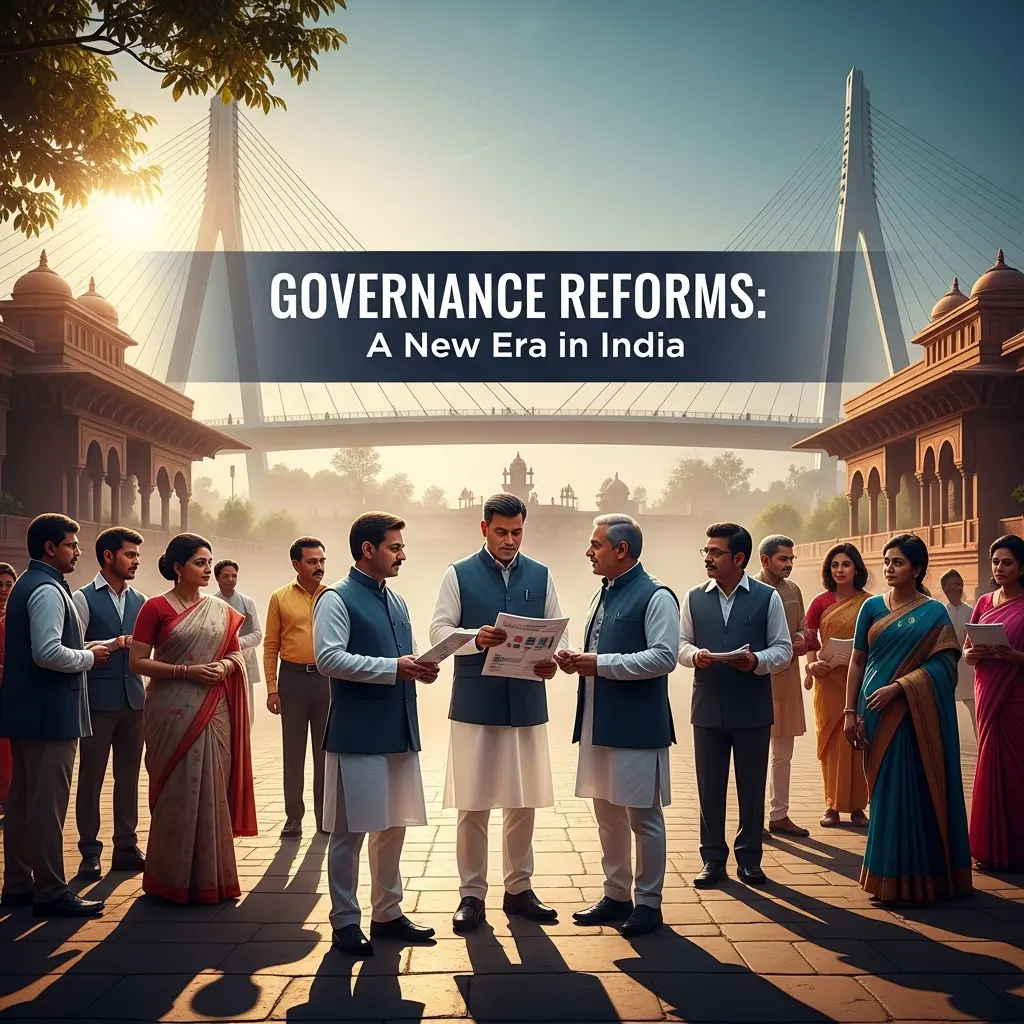
Every election in India ends with a promise. Roads will be built. Schools will be transformed. Jobs will follow. Corruption will be tackled. These are not merely slogans — they are the terms on which millions of voters grant their trust to new governments, and they become the yardstick by which those governments are eventually judged. In 2026, that accountability moment is arriving for several Indian states simultaneously, making this one of the most consequential periods for public policy and state government reforms in recent memory.
Across the country, newly constituted legislative assemblies are moving from campaign mode into governance mode — and the distance between those two things, as any political observer knows, can be vast.
A Season of Political Transition
The Election Commission of India announced assembly election schedules for Assam, Kerala, Tamil Nadu, West Bengal, and Puducherry in March 2026, with votes counted on May 4. The results of these contests have set off new governance cycles in states that together represent hundreds of millions of citizens, diverse economic profiles, and sharply different political traditions.
In Tamil Nadu, the results pointed to a dramatic reconfiguration of the state’s political landscape, with actor-turned-politician Vijay’s party TVK making a striking entry into mainstream politics — a development being read as a signal of anti-incumbency sentiment and a shift among younger and urban voters. Meanwhile, in West Bengal, the BJP denied Mamata Banerjee a record fourth term as Chief Minister, marking one of the most significant political transitions in the state in over a decade.
These are not just electoral statistics. These are real changes in who has power, what gets funded, and whose voices shape public services on the ground.
Infrastructure: The Visible Face of Governance
When new state governments talk about development, infrastructure is almost always the first battleground — because it is visible, tangible, and personally experienced by voters every single day. A pothole-free road, a functioning bus depot, a new hospital wing — these things speak louder than any press release.
The central government has been reinforcing this direction from the top. “India’s Reform Express is gathering steam with a comprehensive investment push and demand-led policies,” Prime Minister Narendra Modi has said. The transformational initiatives include infrastructure, manufacturing, digital public goods and the Ease of Doing Business framework, he said.
States that move in sync with this national reform momentum — leveraging central funding while adding their own administrative energy — are best positioned to deliver visible outcomes quickly. Those that do not risk falling behind on both development and political credibility.
For instance, Rajasthan has launched a state-level governance model named Raj-UNNATI, which is patterned on the Prime Minister’s PRAGATI framework to stimulate development and efficient project monitoring, and gives a replicable template of how state administrations can build accountability structures around infrastructure promises.
Employment: The Most Personal Policy Priority
No governance reform lands more personally with citizens than employment. For a young person in rural Bihar or urban Bengaluru, the question of whether the government is actually creating opportunity — rather than simply announcing it — is deeply felt.
The Union Budget 2026-27 also announced an ambitious national framework. It announced a new High-Powered ‘Education to Employment and Enterprise’ Standing Committee to make India a global leader in services with a 10% global share by 2047 and assess the impact of AI on jobs and embed new technologies into education from the school level up. InsightsIAS The government is implementing the PM-SETU scheme with an outlay of ₹60,000 crore to upgrade 1,000 Industrial Training Institutes through a hub-and-spoke model focusing on industry-aligned courses and Centres of Excellence to enhance employability. IBEF But national schemes work only if states implement them effectively. The political developments of 2026 — new governments with fresh mandates — present both the opportunity and the obligation to drive this implementation with urgency. Employment is where governance either gains or loses its credibility entirely.
Education: The Long Game of Reform Budget 2026 has reclassified education as economic infrastructure, directly correlating learning to employment and enterprise – a move that is in line with the National Education Policy 2020, especially with regard to the integration of multidisciplinary learning, industry integration and entrepreneurship.
The Department of School Education and Literacy received its highest-ever budget allocation of ₹83,562 crore — an 8.27% increase over the previous year, reflecting a continued focus on strengthening school education.
These are meaningful investments. But political observers are watching closely to see whether newly elected state governments translate this funding into classroom reality — because educational reform is a long game, and new leaderships must resist the temptation to prioritize the visible and immediate over the generational.
Administrative Renewal: The Deeper Reform Challenge
Beyond individual policy sectors, the deeper question facing India’s state governments is one of institutional quality. The Governance and Reforms Division of NITI Aayog, created to lead the structural transformation that is essential to the vision of Viksit Bharat 2047, is working to re-imagine institutions, make regulatory frameworks more nimble, improve administrative efficiency and promote innovation in public service delivery. NITI Aayog India’s new criminal laws, which will come into effect from Republic Day 2026, are a major legal change that promises reforms in the justice system, adding another dimension to the ongoing transformation of governance. the governance post For citizens across the states of India, the coming months are not just a period of political transition — they are a test of whether democratic accountability still has the power to translate campaign commitments into lived reality. Political observers, policy analysts, and ordinary voters alike are watching to see if this generation of new leadership teams can close the gap between what was promised and what gets delivered.
India’s reform story is being written not in Parliament alone, but in every state secretariat, every district office, and every village where governance either reaches people — or doesn’t.
Promises, Policy, and People: How India’s States Are Rewriting Their Governance Story.