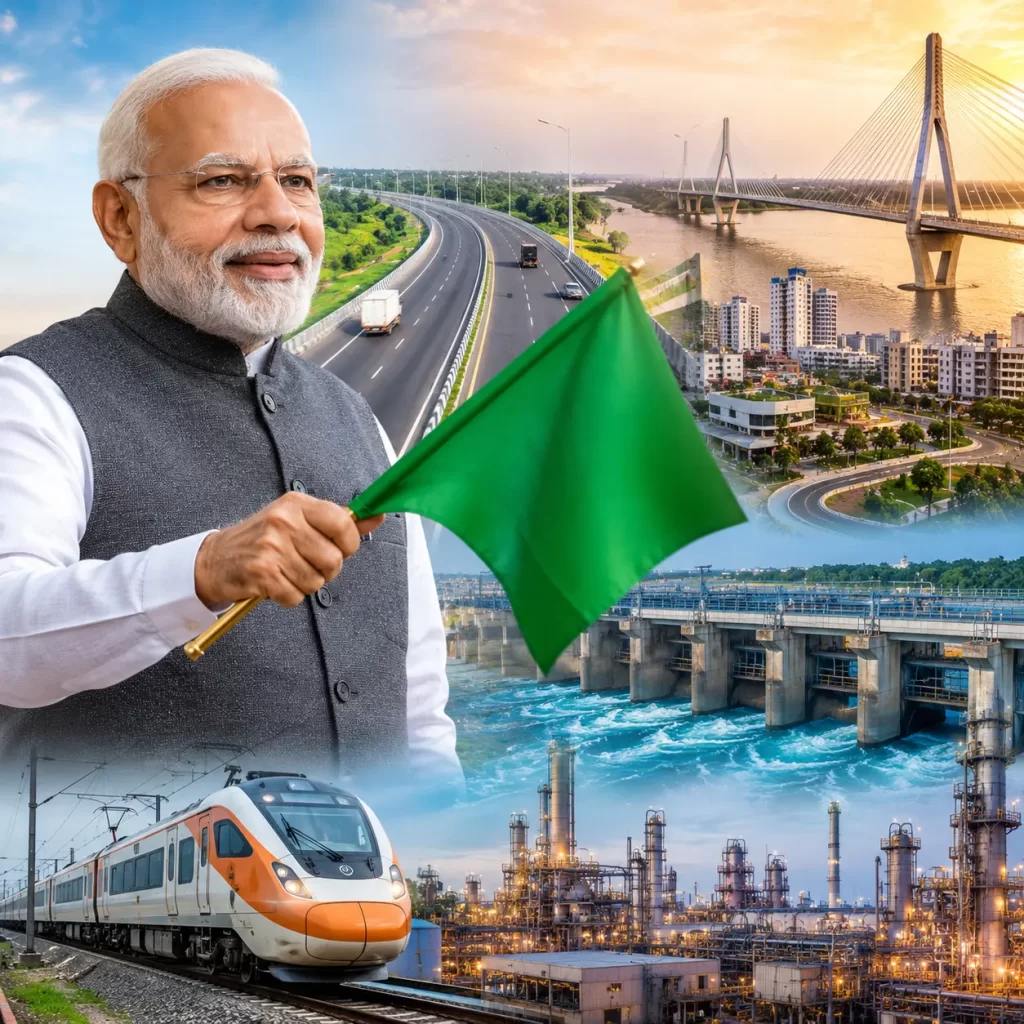
When Prime Minister Narendra Modi touched down in South Gujarat recently to inaugurate a sweeping package of development projects worth more than ₹18,700 crore, it wasn’t just another ribbon-cutting ceremony. For millions of people living across this industrially active but long-underserved stretch of western India, the announcement carried the kind of weight that actually changes daily life — better roads to reach work, cleaner water at home, and the quiet confidence that comes when your region finally makes it onto the national priority list.
So what exactly is happening in South Gujarat, and why does it matter beyond the headline numbers?
More Than Just Big Figures
It’s easy to get lost in crore figures. ₹18,700 crore sounds enormous — because it is — but the real story lies in where that money is going. The Modi Gujarat projects encompass four key sectors – transportation, urban development, water management and economic infrastructure. Each of these pillars addresses a pain point that residents and businesses in the region have endured for years.
And transportation upgrades, for instance, aren’t just about a smoother drive. Better road and rail connectivity directly reduces the cost of moving goods, which in turn makes local businesses more competitive. For a farmer trying to get produce to market before it spoils, or a small manufacturer shipping parts to Surat’s textile units, that difference is the gap between profit and loss.
South Gujarat’s Moment
South Gujarat has always been economically active. The region is home to Surat — one of India’s fastest-growing cities and the world’s diamond polishing capital — along with a dense network of chemical plants, textile clusters, and port-linked industries. Yet, for all its economic energy, infrastructure has often lagged behind the pace of growth.
The India infrastructure push announced through this initiative is designed to close that gap. Urban development components of the package are expected to ease the chronic pressure on cities like Surat and Vapi, where population growth has outpaced civic planning for decades. New water management systems promise to address what has long been a seasonal crisis — floods during monsoon, shortages in summer — by building more resilient supply and drainage networks.
Jobs, Investment, and the Bigger Picture
Officials have been clear that employment creation is central to this Gujarat investment drive. Large-scale infrastructure projects generate two kinds of jobs: the direct construction and engineering roles that kick in immediately, and the longer-term positions that emerge once the infrastructure itself becomes operational — logistics hubs filling with workers, industrial corridors attracting new factories, and service ecosystems building up around improved connectivity.
The PM Modi news around this launch also carries a broader economic signal. When the central government commits this kind of capital to a state, it functions as a confidence booster for private investors who often wait for public infrastructure before committing their own funds. A new highway that reduces travel time between an industrial zone and a port, for example, might unlock private warehousing or cold-chain investments that no government scheme could have directly funded.
Reading Between the Lines of South Gujarat Development
There’s a political dimension here too, which would be naive to ignore. Gujarat is Prime Minister Modi’s home state, and South Gujarat development has historically received slightly less attention than the northern industrial belt around Ahmedabad and Gandhinagar. Directing major investment southward is both a practical economic decision and a recognition that equitable regional growth matters — politically and socially.
But politics aside, the infrastructure need is genuine. Those who have driven through the traffic choked highways between Surat and Valsad or monitored the erratic water supply in smaller towns like Navsari or Bharuch know that this is not optics led development. The gaps are real and the investment, if done right, can make a difference.
What execution will look like Of course, the real test of any India infrastructure initiative is not the announcement but what happens in the months and years that follow. India has a long history of ambitious project launches that slow down in implementation due to land acquisition delays, contractor capacity issues or funding disbursement bottlenecks.
The projects unveiled as part of this package span multiple agencies — state and central — and will require tight coordination to stay on track. Urban development in particular tends to be complicated, involving municipal bodies, utility companies, and private landowners whose interests don’t always align neatly.
That said, Gujarat has a stronger-than-average track record among Indian states when it comes to infrastructure delivery. The state’s administrative machinery is relatively efficient, and its industry-friendly reputation means private stakeholders tend to cooperate more readily than in other parts of the country.
A Region on the Move
South Gujarat is at an interesting inflection point. The region’s natural advantages — proximity to major ports, a skilled labour force, established industrial clusters — have always been there. What’s been missing is the infrastructure layer that transforms latent potential into actual economic output.
If the ₹18,700 crore Gujarat investment is deployed effectively, the region could see a genuine step-change over the next five to seven years: faster movement of goods, more reliable utilities, expanded capacity for industrial growth, and improved quality of life for urban residents who have long dealt with the friction of under-resourced cities.
That’s a lot riding on project execution. But the foundations — both physical and financial — are now being laid. South Gujarat is watching closely. So is the rest of India.
Modi’s Big Bet on South Gujarat: What ₹18,700 Crore Really Means for the Region.