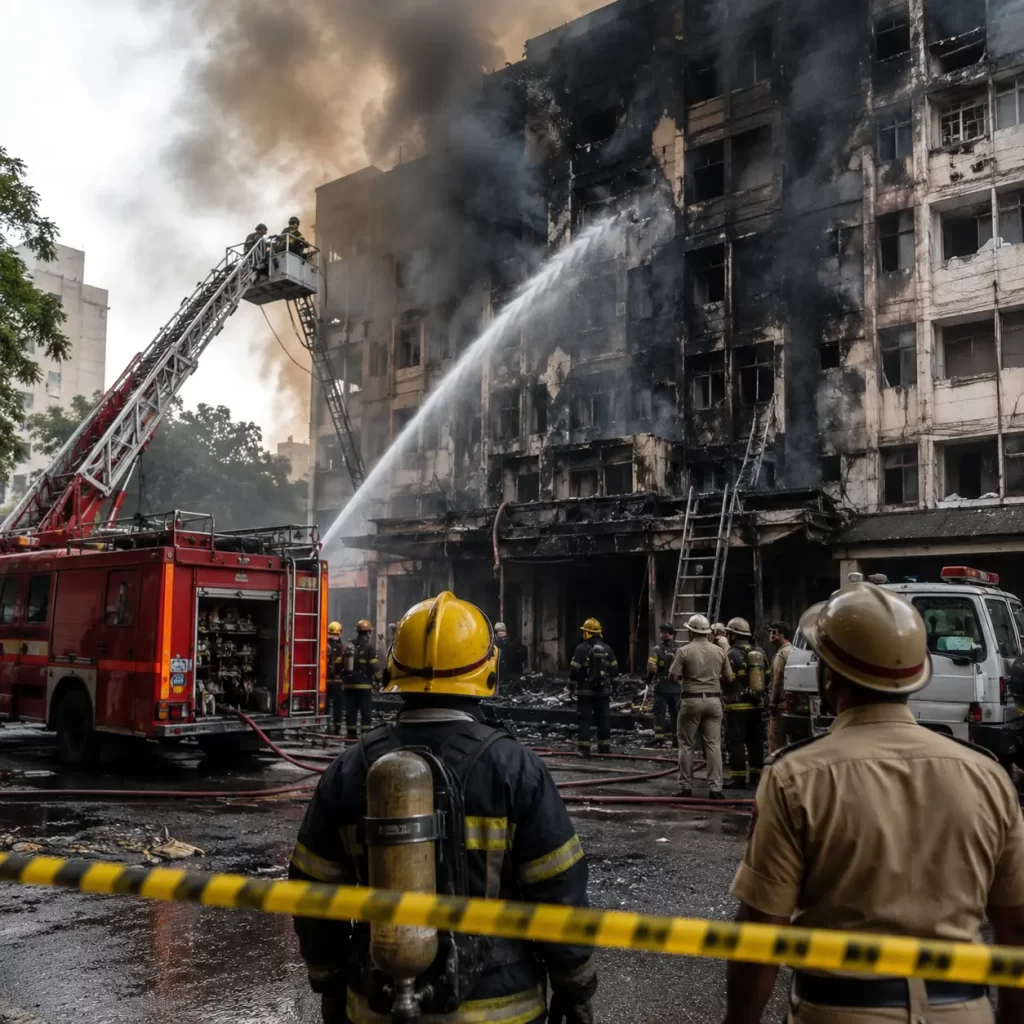
There are disasters that feel random — bolts from a clear sky that no one could have predicted. And then there are disasters that feel inevitable, the kind where the investigation that follows doesn’t so much uncover new information as confirm what everyone already suspected. The Delhi hotel fire that has gripped the nation in recent days falls squarely into the second category.
As authorities continue to piece together exactly what happened, the picture emerging is deeply uncomfortable. Not because the facts are surprising, but precisely because they aren’t.
What We Know So Far
Emergency services responded to the blaze and carried out rescue operations under intense pressure, pulling people from smoke-filled corridors and doing the difficult, dangerous work that first responders do when systems that were supposed to protect people have already failed. The human cost was significant. Behind every casualty figure is a family that sent someone off that day — to a work trip, a wedding, a business meeting — and received devastating news in return.
Police investigations are now examining two main threads: possible safety violations within the hotel itself, and the likelihood of an electrical fault as the fire’s origin. Neither possibility, if confirmed, will come as a shock to anyone familiar with how commercial buildings in Delhi — and across urban India — actually operate versus how they’re supposed to on paper.
A Familiar Tragedy With Familiar Roots
This is where the Delhi tragedy becomes harder to sit with. India breaking news cycles have carried stories like this before. Hotel fires, hospital fires, factory fires — each one triggers the same sequence: shock, grief, political statements, urgent inspections, promises of accountability. And then, slowly, the news cycle moves on, the inspections wind down, and the buildings that failed their occupants are quietly replaced in public memory by the next crisis.
The question this time, as it has been every time, is whether the cycle breaks.
Fire safety in India is not a mysterious or technically complex problem. The National Building Code is detailed. Fire safety regulations exist at both central and state levels. The rules covering commercial establishments — exit routes, sprinkler systems, fire extinguishers, electrical load limits, emergency lighting — are not vague or ambiguous. What has consistently failed is not the rule book. It’s the gap between the rule book and reality.
That gap is filled, typically, by a combination of factors: under-resourced inspection departments, the willingness of some officials to look past violations, the pressure on building owners to cut costs wherever possible, and a broader cultural assumption that the worst probably won’t happen. Until it does.
The Emergency Response Question
Credit where it is due: the emergency response to the Delhi hotel fire appears to have been swift. Fire brigades and police mobilised quickly, and rescue operations were conducted under genuinely difficult conditions. The bravery involved in entering a burning building to bring people out is not something to gloss over.
But emergency response, however good, is always the last line of defence — and the most expensive one, measured in human terms. A functioning smoke detector buys time. A clear fire exit saves lives before a single fire engine arrives. Sprinkler systems can contain a blaze while occupants escape. These systems aren’t glamorous, and they don’t make headlines when they work. They just quietly do their job, night after night, in buildings where someone took the regulations seriously.
The Delhi tragedy is, in a very real sense, a story about what happens when those unglamorous systems are either absent or non-functional.
What the Inspections Will — and Won’t — Tell Us
Officials have announced inspections across multiple commercial establishments in the wake of the fire, and this is the right instinct. If the political will holds for longer than a news cycle, these inspections could surface genuinely useful data about the scale of non-compliance across Delhi’s hospitality and commercial sectors.
But inspections work best when they’re part of a permanent, well-funded, and genuinely independent system — not a reactive burst of activity triggered by public outrage. The risk, as with previous such drives, is that buildings get a rush clean-up, inspectors visit, certificates are issued, and compliance quietly erodes again once the pressure lifts.
For fire safety India to meaningfully improve, the inspection system itself needs to change. That means adequate staffing of fire safety departments, digitised and publicly accessible compliance records, strict and consistently enforced penalties for violations, and protections that prevent the informal arrangements that allow unsafe buildings to operate with official-looking paperwork.
The Harder Conversation
There is a harder conversation sitting underneath all of this, one that tends to get avoided in the immediate aftermath of a tragedy like the Delhi hotel fire because it feels too abstract when people are still grieving.
India’s urban growth over the past two decades has been extraordinary. Cities like Delhi have expanded rapidly, absorbing millions of new residents and businesses, generating enormous economic activity, and building a physical infrastructure that has, in many places, outpaced the regulatory systems designed to keep it safe.
That mismatch — between the speed of urban growth and the pace of governance — is the context in which fires like this happen. Fixing it isn’t a matter of punishing one hotel owner or suspending one inspector. It requires sustained investment in the institutions that keep cities safe: funding, training, accountability, and the political will to prioritise unglamorous public safety work even when cameras aren’t watching.
The victims of this fire deserved better. So do the people in every other building across this city tonight, trusting — often without knowing it — that someone checked the exits.
The Delhi Hotel Fire That Should Never Have Happened.