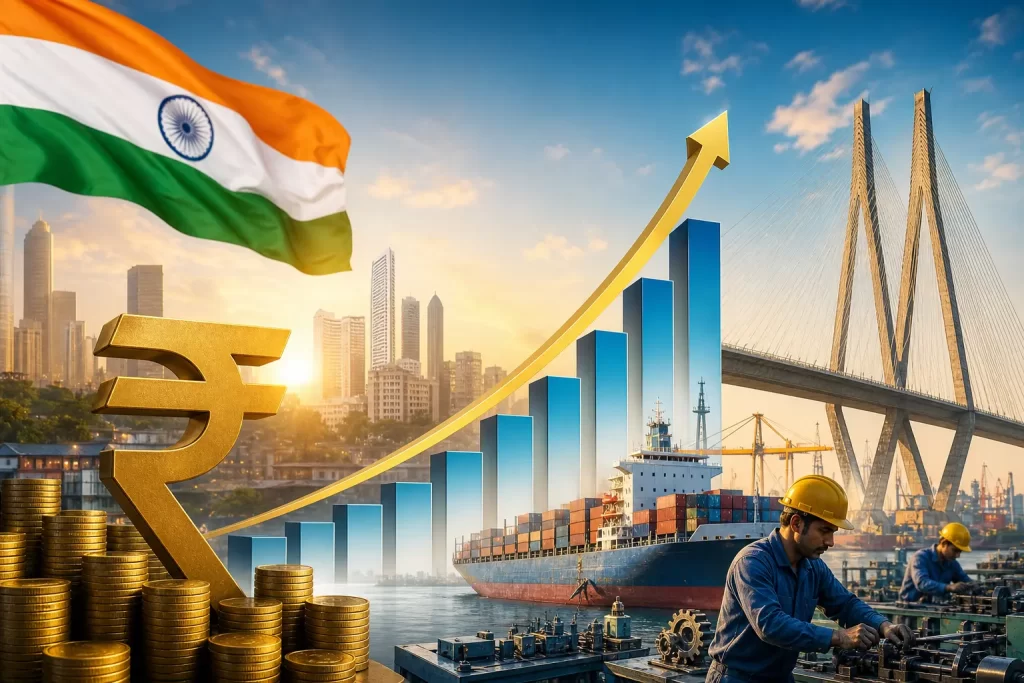
India’s FY26 GDP growth was not just resilient in a year of global economic volatility — it was a growth story, powered by strong domestic demand, infrastructure momentum and a manufacturing sector finally firing on all cylinders.
7.7% FY26 GDP growth rate
#1 Fastest growing major economy
₹350T+ Estimated GDP in rupees
4 Core growth pillars
Numbers rarely tell the full story of an economy. But sometimes a number comes along that is so clear, so unambiguous in what it signals, that it demands to be taken seriously on its own terms. One such number is India’s GDP growth of about 7.7% in FY26. In a year when the global economic outlook was clouded by stubborn inflation in the West, slowing demand in China, and geopolitical uncertainty reshaping trade routes, India grew at a pace that most developed and emerging economies could only look at with a mixture of admiration and curiosity.
This is not a story that arrived without warning. India’s economic expansion has been building across multiple fronts for several years — the result of deliberate policy choices, demographic advantage, and a digital infrastructure buildout that has quietly transformed how business is conducted across the country. FY26 is the year those threads came together visibly enough that even the most cautious economists have had to revise their language from “promising trajectory” to “demonstrated resilience.”
What actually drove the growth
Behind the headline India GDP 2026 figure lies a more textured picture. Domestic consumption — the engine that matters most in an economy of India’s size and population — remained robust through the fiscal year. Rising middle-class incomes, improved rural purchasing power, and a consumer goods sector that has been steadily formalizing drove spending in categories ranging from automobiles to electronics to financial services. This is not consumption that can be attributed to a single policy lever; it reflects a gradual and genuine improvement in household economic conditions across a wide geography.
Key Growth Drivers — FY26
Strong domestic demand and rising middle-class consumption
Record infrastructure investments under PM GatiShakti and NIP
Manufacturing expansion via PLI schemes across 14 sectors
Services sector growth led by IT exports and digital platforms
Infrastructure investment has been another pillar of the Indian economy growth story. Government capital expenditure on roads, railways, ports, airports, and urban transit has continued at a scale that would have seemed ambitious even a decade ago. The National Infrastructure Pipeline and the PM GatiShakti framework have provided the structural backbone to this spending, and the impact is seen not just in economic data but in the physical transformation of cities and corridors across the country. Infrastructure investment of this sort has a multiplier effect — it creates employment in construction, lowers logistics costs for businesses, and makes regions previously hard to access suddenly viable for industry.
Manufacturing finds its footing
Perhaps the most significant development in India’s FY26 economic expansion is what has happened in manufacturing. For years, the idea of India becoming a significant global manufacturing hub was talked about more as an aspiration than a reality — a contrast often drawn with China’s industrial capacity. The Production Linked Incentive schemes introduced across fourteen sectors have begun to shift that dynamic in measurable ways. Electronics manufacturing, pharmaceuticals, specialty chemicals, textiles, and components for the automotive and defence industries have all recorded output growth that shows up clearly in the data.
This matters beyond the quarterly GDP numbers. A stronger manufacturing base means more formal employment, more technology transfer, more export diversification, and a structural reduction in India’s dependence on services exports alone. The India business environment that is emerging from this shift is one where a wider range of industries can participate in growth — not just the technology and outsourcing sectors that have historically carried the headline.
“India’s growth in FY26 is not a lucky quarter. It is the compounding of years of investment in infrastructure, digitisation, and industrial capacity — and the numbers are finally saying so out loud.”
Services and the digital economy
India’s services sector, long the most reliable contributor to GDP, continued its expansion through FY26 with particular strength in information technology exports, business process management, financial services, and the domestic digital economy. The UPI payments ecosystem alone now processes transaction volumes that would be remarkable for any country, let alone one that was predominantly cash-based a decade ago. Digital transformation has not been a slogan in India — it has been infrastructure, and it is generating real economic output.
The IT and tech-enabled services industry, clustered in Bengaluru, Hyderabad, Pune, Chennai, and increasingly in Tier 2 cities, has navigated global demand fluctuations with greater resilience than many predicted. Indian firms have moved up the value chain — from pure outsourcing into consulting, AI services, and product development — and that transition is reflected in both revenue quality and employment grade.
Sustaining the momentum into 2026 and beyond
Strong growth numbers have a way of generating their own set of expectations, and India’s policymakers are aware that the work of sustaining FY26 GDP momentum is in many ways harder than achieving it. The government has signaled continued emphasis on industrial development, employment generation, and the deepening of digital public infrastructure as the pillars of its economic strategy for the remainder of 2026 and into the next fiscal year.
There are real challenges still. Inflation, especially in food prices, continues to bite household budgets at the lower end of the income spectrum. Global headwinds — from commodity price volatility to shifting trade policy — are not within India’s control. And the question of whether manufacturing growth can translate into the volume of quality jobs that a young and growing workforce needs remains one that economists watch closely.
But taken on the terms that economic data allows, FY26 has been a genuinely strong year for the Indian economy. The 7.7% growth figure is not a statistical artifact or a revision waiting to happen. It is the result of real activity, real investment, and real demand — and in a world that has been short on economic good news, that is worth acknowledging plainly.
India’s economy grew at 7.7% in the last quarter and it is still growing.