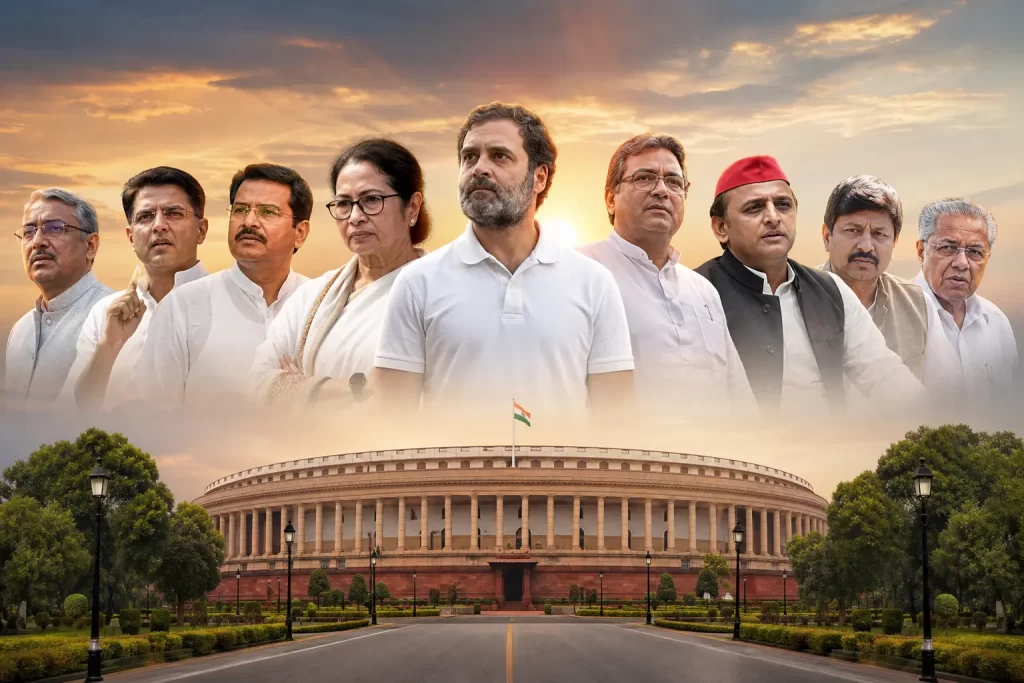
Across state capitals and party headquarters, India’s opposition alliances are quietly — and sometimes not so quietly — recalibrating. What emerges from these conversations could reshape the next chapter of Indian electoral politics.
Multiple State elections on the horizon
🤝 Fragile Coalition dynamics under review
🏛️Active Parliamentary debates intensifying
Indian politics has never moved in straight lines. It bends, doubles back, fractures along fault lines that weren’t visible a season ago, and occasionally surprises everyone — including the people doing the maneuvering. What is happening within the country’s opposition landscape in mid-2026 follows that tradition faithfully. Major regional parties are reassessing their alliances, their priorities, and in some cases their very identities — not in the quiet of a single backroom, but across a sprawling, decentralized process of negotiation that political observers are watching with close attention.The realignment under way is not a collapse. It is something more complicated and, arguably, more interesting: a moment of genuine strategic reckoning within opposition politics in India. After the electoral contests of recent years, the question of how parties with divergent ideologies, regional bases, and leadership ambitions can function as a coherent force against a well-organized ruling dispensation has become impossible to defer. The conversations now happening — about seat-sharing arrangements, chief ministerial candidates, policy platforms, and the basic grammar of coalition governance — are the result of that deferred question finally demanding an answer.
Leadership: the friction point no one wants to name
At the center of most opposition alliance discussions, in whatever form they take, is leadership.This is the issue that political news in India tends to circle around without always landing on directly — because naming it too plainly risks offending the very parties whose cooperation is needed. No large regional party that has built its own vote bank, its own organizational machinery, and its own narrative of governance will subordinate itself to another without clear negotiation of terms. That is not cynicism; it is the basic logic of coalition politics anywhere in the world.
What makes the Indian context particular is the sheer number of significant players. The opposition is not a binary — it is a constellation of parties, each with legitimate claims to representation and each with leaders who carry genuine public support in their home states.Finding a configuration in which those leaders can coexist, campaign together, and present a unified front to voters requires a quality of political craftsmanship that is in shorter supply than strategic ambition.
Key Pressure Points Within Opposition Alliances
Leadership hierarchy disputes between national and regional party heads
Seat-sharing formulas that disadvantage smaller coalition partners
Ideological distance between left-leaning and centrist alliance members
State-level coordination gaps undermining national messaging consistency
State-level coordination: where theory meets reality
National-level alliance declarations have a way of looking cleaner than the ground reality they attempt to describe. Two parties that agree on a joint framework at the level of Delhi press conferences may find themselves in direct competition when the specific boundaries of a Vidhan Sabha constituency come into play.This gap between stated alliance and operational reality has been one of the persistent weaknesses of opposition coordination in India — and it is precisely the gap that current discussions are trying to close, or at least narrow.
State-level coordination requires not just agreement at the top but organizational integration lower down — shared campaign resources, aligned candidate communication, and the difficult work of asking party workers who have spent years opposing each other locally to now stand on the same platform. This is the unglamorous, procedural work of coalition-building, and it rarely makes headlines. But it is where election strategy is either validated or quietly dismantled.”Coalitions in India are not built in press conferences. They are built — or broken — in the constituencies, one candidate conversation at a time.”
Policy priorities: the search for a shared language
Beyond the mechanics of alliance management lies a deeper question about what the opposition actually stands for. Government affairs analysts have noted that the ruling party has been effective, over successive election cycles, at controlling the terms of political debate — defining what issues matter, what the vocabulary of governance should be, and what aspirations voters are invited to hold. For any opposition alliance to compete seriously, it needs not just organizational coherence but a genuine policy agenda that speaks to the concerns of voters across diverse geographies and income levels.Employment, agrarian distress, price stability, and the quality of public services are the issues that consistently surface in survey data as the things ordinary Indian voters care most about. An opposition that can translate those concerns into a credible, specific programme — rather than a general critique of the incumbent — will be better positioned than one that relies primarily on anti-incumbency sentiment to generate momentum. The discussions currently under way within the opposition alliance space are, at their best, trying to build that programme. At their worst, they are substituting internal debate for the harder work of voter outreach.What political observers are watching
Among those who track Indian politics professionally, the consensus is that the outcome of the current realignment phase will matter enormously for the shape of upcoming electoral contests and parliamentary debates alike. A more cohesive opposition changes the calculus of governance — it forces harder engagement in Parliament, provides clearer accountability mechanisms, and gives voters a genuine choice rather than a fragmented alternative.
A fractured one, conversely, risks delivering the kind of divided field that benefits incumbents regardless of their actual performance record. That is a dynamic Indian voters have seen before. Whether the parties currently reassessing their strategies have internalized that lesson — and whether they can act on it collectively — is the question that makes this particular moment in Indian political news worth watching carefully.Realignments, by definition, are not endings. They are processes — messy, contingent, shaped by personalities as much as principles. The opposition’s current reckoning is no different. What it ultimately produces will say a great deal not just about the parties involved, but about the health and competitive vitality of Indian democracy itself.
The Opposition Is Rethinking Everything — and That Itself Is the Story.