There is a silent but discernible cadence to India’s foreign policy these days. While much of the world’s attention is fixed on flashpoint regions and great power rivalries, New Delhi has been doing something less dramatic but arguably more consequential — building bridges, one bilateral meeting at a time.
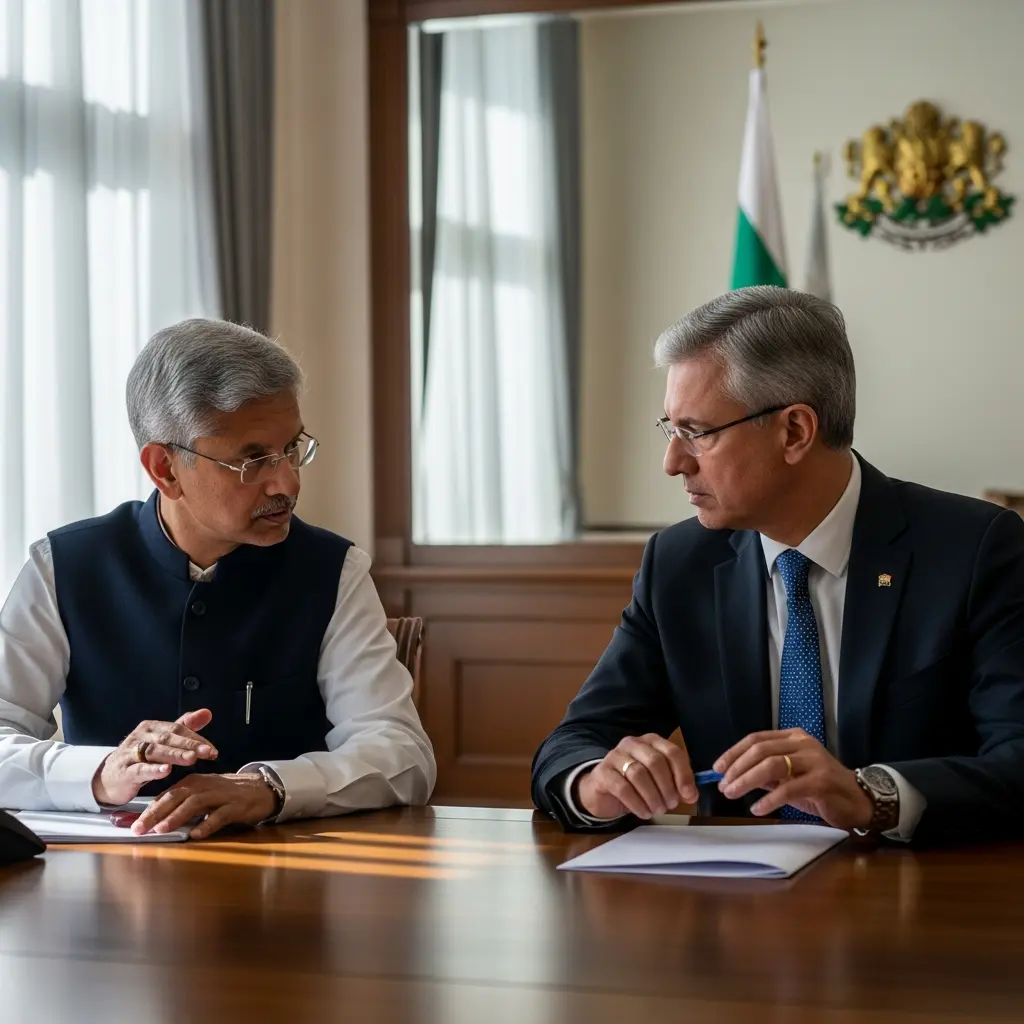
The latest stop on that journey was Sofia. External Affairs Minister Dr. S. Jaishankar had substantive discussions with Bulgarian leadership which laid the basis for a more purposeful and deeper relationship between the two countries. At first glance, an India-Bulgaria meeting might not set pulses racing in foreign policy circles. But look a little closer, and the visit starts to reveal quite a lot about where India is headed — and why.
More Than a Courtesy Call
Diplomatic visits can sometimes feel like choreographed rituals — warm handshakes, carefully worded joint statements, and little else. What happened in Sofia felt different. The conversations between Jaishankar and Bulgarian leadership were focused, practical, and forward-looking, covering the full range of what a modern bilateral relationship should address: strategic partnerships, trade opportunities, and collaboration in emerging sectors that will define the economies of tomorrow.
That last part is worth dwelling on. Emerging sectors — think technology, green energy, pharmaceuticals, digital infrastructure — are no longer peripheral talking points in diplomatic meetings. They are becoming the core of how countries build lasting partnerships. And India, with its rapidly expanding capabilities in each of these areas, is well-positioned to offer something real and valuable to European partners.
Bulgaria, for its part, is not just a small country on the eastern edge of the European Union. It is a member of one of the most powerful economic and political blocs in the world and a nation with its own strategic interests, industrial strengths and appetite for diversified partnerships. When India and Bulgaria talk trade and technology, it is a conversation with implications that extend well beyond Sofia.
Reading the Larger Pattern
The Jaishankar Bulgaria visit does not exist in isolation. It is one thread in a much larger tapestry that India has been weaving across the European continent over the past several years. India Europe relations have been experiencing a quiet but significant transformation, from a relationship defined largely in terms of trade statistics and diaspora ties to one increasingly defined in terms of shared strategic interests.
The context matters here. Europe spent decades operating within a set of assumptions about global order — stable supply chains, dependable energy sources, and the reliable presence of American security guarantees — that have been upended one by one. Russia’s war in Ukraine, the disruption of energy markets, the re-evaluation of dependencies on authoritarian regimes for critical goods: all of this has prompted European nations to look outward for new partners. And India keeps coming up as a natural answer.
India’s foreign policy, long characterized by strategic autonomy and a refusal to be boxed into any single alliance, turns out to be exactly what many European capitals are looking for in a partner right now. A large democracy with a growing economy, a skilled workforce, and a genuine interest in a stable, rules-based international order — that is a profile that resonates deeply in Brussels, Berlin, Paris, and increasingly, Sofia.
The Jaishankar Factor
It would be difficult to tell the story of India’s expanding diplomatic footprint without acknowledging the role of the man doing much of the legwork. Dr. S. Jaishankar has become one of the more distinctive and assertive voices in global diplomacy. He is known for plain speaking, strategic clarity, and a willingness to push back when India’s interests are mischaracterized or underestimated.
That approach travels well in Europe. European diplomats, who often operate in a world of careful hedging and diplomatic ambiguity, tend to appreciate interlocutors who say clearly what they mean and mean what they say. Jaishankar’s engagements across the continent have consistently left the impression of a country that knows what it wants and is confident enough to ask for it without apology.
His visit to Bulgaria fits squarely within that mold. The message delivered in Sofia was, at its core, the same message India has been delivering across European capitals: we are serious partners, we are here for the long term, and we want to build something that works for both sides.
Why Diversification Matters
One of the defining themes of India’s current foreign policy is diversification — of trade partners, of supply chains, of strategic relationships. The wisdom of that approach has been validated repeatedly by events of the past few years. Countries that relied too heavily on single partners for critical goods or energy found themselves dangerously exposed when those relationships turned complicated.
India’s push to deepen India Europe relations is partly a product of that same logic. Europe is a large market, a hub of technological innovation and a community of nations that share with India a commitment to democratic governance and open societies. Building up partnerships with European allies like the more modest but strategically placed countries like Bulgaria gives India more options, more resilience, more influence on the world stage.
Looking Ahead
As Dr. Jaishankar’s European engagements continue to accumulate, a picture is forming of an India that is confident, strategic, and increasingly indispensable in conversations about the shape of the international order. The diplomatic visit to Bulgaria may not make front-page news around the world. But in the careful, patient architecture of India’s long-term foreign policy, it is one more brick firmly laid.
Strategic partnerships are rarely built in a single meeting. They are built through repetition, through trust, through the slow accumulation of shared interests and shared experiences. India understands that — and it is showing up, meeting by meeting, to do the work.
Jaishankar’s visit to Bulgaria is part of a larger design for India’s expanding Europe engagement.