There are moments in sport that stop the world mid-sentence. This is one of them.
The 2026 FIFA World Cup is here. After years of buildup, qualification drama, record-breaking viewership predictions, and more pre-tournament speculation than any football fan could reasonably process, the greatest show on earth has officially begun. And it began exactly the way a World Cup opening should — with noise, history, and the unmistakable feeling that something very large and very wonderful is underway.
A Legendary Stage for a Historic Opening
The opening ceremony and match took place at the legendary Estadio Azteca in Mexico City — a ground that needs no introduction to anyone who has ever watched football. This is the stadium where Diego Maradona scored with his hand and then immediately scored with his feet in the most breathtaking five minutes in the sport’s history. Where Pelé lifted a World Cup. Where ghosts of the game seem to gather in the stands. Choosing the Azteca to host the first match of the 2026 FIFA tournament was not just logistically sensible. It was poetic.
South Africa and Mexico met in the opener — a reverse fixture of the 2010 World Cup opener, precisely 16 years after Siphiwe Tshabalala’s famous screamer united a nation. The symmetry was not lost on anyone. Two countries, two footballing cultures, and a shared piece of World Cup history reconnecting on the grandest stage of them all.
48 Teams, Three Nations, One Tournament
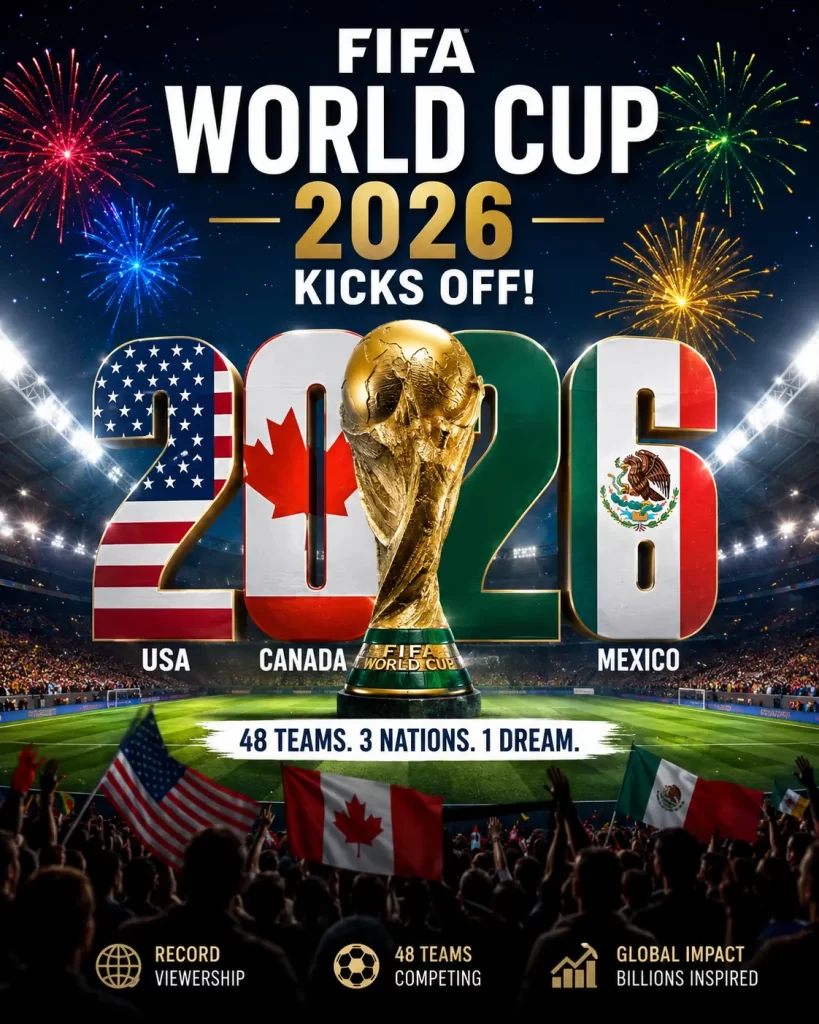
This is not just another World Cup. The 2026 FIFA World Cup is the first edition of the tournament featuring 48 teams, hosted jointly by the United States, Canada, and Mexico — spanning three nations for the very first time. The scale of what has been assembled here is genuinely difficult to wrap your head around.
The tournament features 104 matches across 16 magnificent venues. The expansion from 32 to 48 teams creates an additional round of knockout matches, meaning 32 teams will advance from the group stage rather than 16 — so not just group winners and runners-up, but also the eight best third-place finishers move forward. For fans of smaller footballing nations, this format change is not merely a structural tweak. It is a genuine invitation. Nations that might previously have traveled to a World Cup with little realistic hope of advancing beyond the group stage now have a credible path to the knockout rounds.
The 2026 World Cup is also the first tournament in which all six FIFA confederations have at least one guaranteed berth — a milestone that reflects a genuine broadening of the game’s global footprint.
The Host Nations and the Weight of Expectation
Of the three co-hosts, Mexico carries perhaps the most emotional burden on opening day. As hosts, Mexico did not have to qualify for the tournament and have not played a competitive fixture since July 2025, with a series of friendlies filling the gap. Their form coming in has been mixed but home advantage at the Azteca is a force that statistics alone cannot fully encapsulate. The Mexican crowd do not merely watch matches they participate in them, willing the ball into the net through pure collective intensity.
The United States, meanwhile, carries the weight of expectation that comes with being the world’s largest economy hosting one of the world’s biggest events. American interest in soccer has grown substantially over the past decade, and this tournament — played in NFL stadiums and basketball arenas converted for the occasion — has the potential to be a genuine watershed moment for the sport in the country.
Canada, hosting a World Cup for the first time in the modern era, brings its own story. A nation that only recently established itself as a genuine football force, Canada’s presence as both a host and a participating nation gives its fans a double reason to show up.
Stars, Stakes, and Soccer Updates to Follow
The football itself promises to be extraordinary. The 48 teams are split into 12 groups of four, with each team playing three group stage matches. Among the names to watch: Argentina arrive as defending champions, carrying the weight of Lionel Messi’s legacy even as a new generation steps forward. Brazil, with five World Cup titles to their name, will be desperate to end a long wait for a sixth. France, England, Germany, Spain — the traditional powerhouses are all present, all dangerous, and all with reasons to believe this could be their year.
The final will be held at MetLife Stadium in New York/New Jersey on July 19 — a venue that will host what is expected to be one of the most-watched sporting events in human history.
More Than a Football Tournament
It would be easy to talk about the FIFA World Cup 2026 purely in terms of goals, group standings, and knockout bracket projections. But that would miss the point of what a World Cup actually is.
For five weeks, the planet speaks a common language. Strangers in airports bond over results. Children stay up past their bedtimes in countries whose teams are playing on the other side of the world. Office conversations, family dinners, and late-night bar debates are all organized around the same fixture list.
The 2026 edition of this tournament is the biggest in history — more teams, more matches, more nations, more stories. The opening match at the Azteca was just the first sentence of a very long, very loud, and almost certainly very beautiful story.
The World Cup is here. Let the football do the talking.
The Wait Is Finally Over: FIFA World Cup 2026 Has Officially Kicked Off.