How India is Rewriting the Story of Women’s Empowerment The daughter of a farm labourer from a small district in Rajasthan, her world was defined by early mornings, hard work, and the quiet assumption that big decisions were made by others — usually men, usually older, usually from somewhere else.
Today, Sunita is an elected panch in her local gram panchayat. She oversees infrastructure projects, resolves community disputes, and signs off on welfare schemes. She is one of millions of Indian women whose lives have quietly, dramatically shifted — and her story sits right at the heart of what Prime Minister Narendra Modi is talking about when he speaks about Nari Shakti.
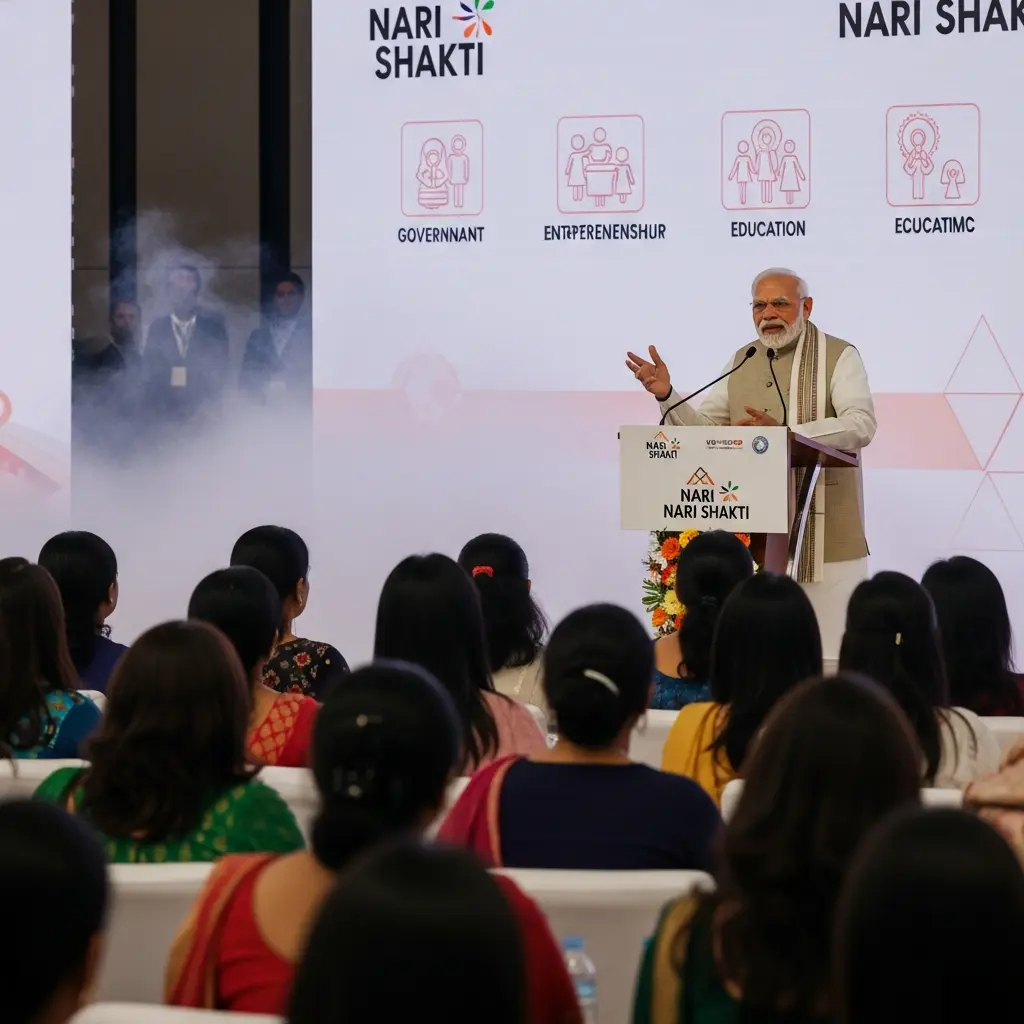
In a recent address, PM Modi highlighted the strides made under the NDA government in advancing women’s empowerment across India. He spoke of governance, entrepreneurship, education, and economic participation — not as aspirational targets, but as areas where measurable progress has already taken root. The message was clear: women-led growth is no longer a vision statement. It is, the government argues, increasingly India’s ground-level reality.
The Political Shift
One of the most structurally significant moments in India politics on this subject came in 2023, when Parliament passed the Women’s Reservation Bill — a landmark legislation guaranteeing 33 per cent seats for women in the Lok Sabha and state assemblies. It was a reform that had been debated, deferred, and defeated for nearly three decades. Under the NDA government, it finally crossed the line.
Implementation requires delimitation and will take time to fully materialise, but the constitutional commitment has been made. For women who have watched India’s Parliament function as an overwhelmingly male space for the bulk of its history, the significance of that commitment is not lost.
At the grassroots level, the transformation is already visible. Nearly 1.4 million women currently hold elected positions in panchayati raj institutions across India — local governance bodies that make real decisions about roads, water, sanitation, and welfare distribution in rural communities. When PM Modi speaks of women’s participation in governance, these are the faces behind the figure.
Financial Freedom on the Ground
Narendra Modi has consistently linked women’s empowerment with financial inclusion — and with good reason. For millions of Indian women, particularly in rural areas, the absence of a bank account, a formal identity, or access to credit was not just an inconvenience. It was a ceiling.
The Jan Dhan Yojana brought hundreds of millions of previously unbanked Indians into the banking fold, and women have made up a significant share of new account holders. Direct benefit transfers – government subsidies deposited directly into individual accounts – have reduced dependence on middlemen and given women greater control over household finances.
The MUDRA loan scheme, which provides collateral-free credit to small and micro enterprises, has become a quiet revolution in women’s entrepreneurship. A majority of MUDRA beneficiaries are women, and across India’s towns and villages, you can trace the scheme’s reach through thousands of small businesses — food stalls, boutiques, beauty parlours, agro-processing units — built by women who finally had access to capital.
The Self-Help Group network, which the NDA government has actively scaled, connects over 90 million women into community-based financial structures. These groups do more than pool savings. They build confidence, create networks, and generate the kind of economic agency that no single government scheme can manufacture alone.
Education and Health: The Long Game
One of the NDA government’s most sustained social campaigns has been the Beti Bachao, Beti Padhao initiative. Launched in response to deeply worrying trends in the child sex ratio and girls’ educational dropout rates, it has shown results — improving sex ratios at birth in several target districts and nudging school enrolment figures upward.
On health, the Ujjwala Yojana has delivered clean cooking gas connections to over 100 million households below the poverty line. Framed explicitly as a women’s welfare measure, it addresses something that public health researchers have documented for years — that indoor air pollution from biomass cooking disproportionately harms women and children. Cleaner kitchens mean healthier mothers and daughters.
Beyond the Numbers
Here is where any honest conversation about Nari Shakti must go — beyond the statistics and into the harder questions.
India’s female labour force participation rate, while showing recent improvement, remains well below the global average and far below what an economy of India’s scale and ambition should achieve. Gender-based violence continues to cast a shadow that policy announcements cannot quickly lift. In many communities, social norms around mobility, marriage, and autonomy still operate as invisible walls that even the most well-designed government scheme cannot fully dismantle.
PM Modi and the NDA government are right to take pride in what has moved. Real programmes have reached real women, opened real doors, and changed the texture of real lives. But political leaders who speak about empowerment most credibly are those who pair pride in progress with urgency about what remains.
India’s women — entrepreneurial, educated, politically awakening, and increasingly unwilling to be footnotes in their own country’s story — are not waiting for permission to lead. They never were. The task of governance, now and in every government that follows, is simply to ensure the path is clear.
Nari Shakti was never just a slogan. In the hands of women like Sunita Devi, it never needed to be.
Sunita Devi never thought she’d be sitting in a government office, making decisions for her village From Villages to Parliament: