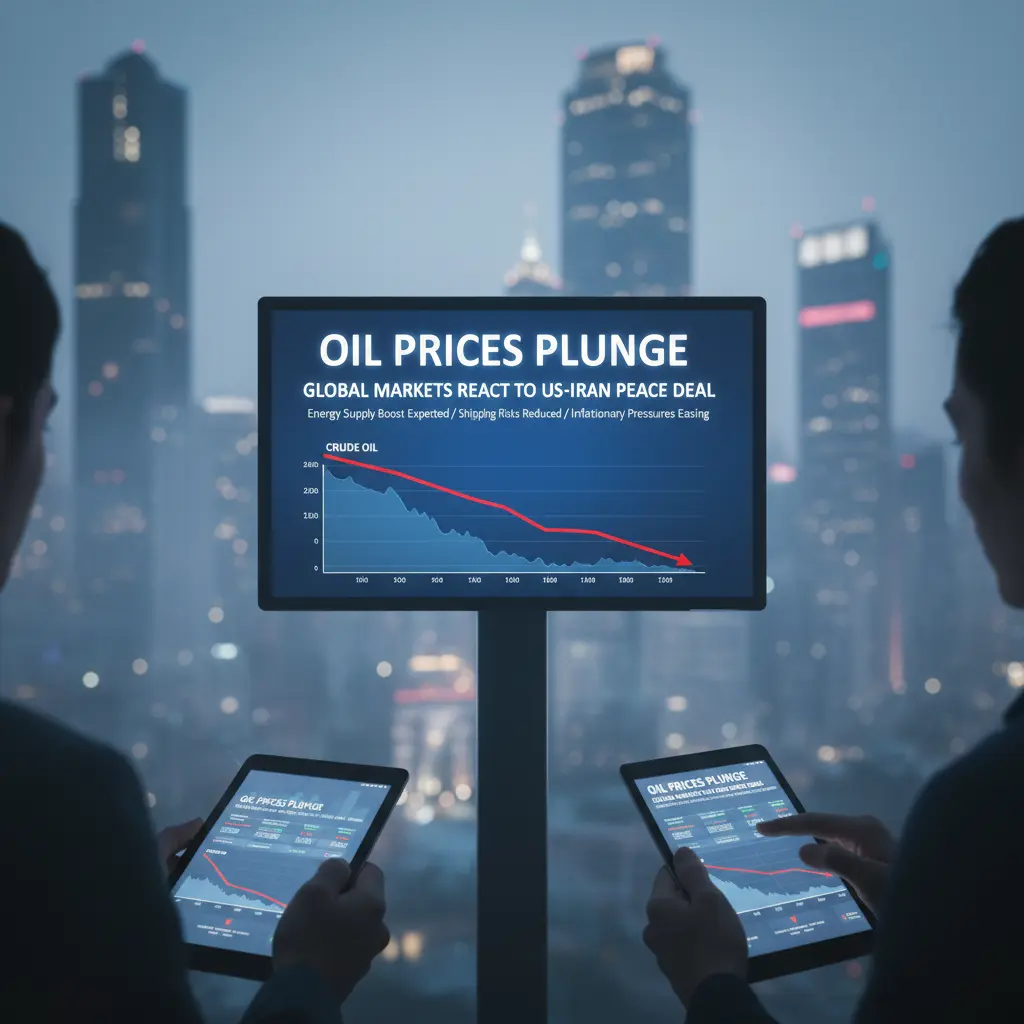
Markets have a way of reacting before the rest of the world has even finished reading the headline. So when reports began circulating of a peace agreement between the United States and Iran, energy traders didn’t wait for the fine print. Crude oil prices started falling almost immediately — a swift, decisive market signal that the deal, if it holds, could fundamentally shift the energy landscape for months to come.
But as with most things in geopolitics, the story behind the numbers is more complicated, more textured, and far more consequential than any single price movement can capture.
What the Market Heard — and Why It Reacted
To understand why oil prices fell, you have to understand what energy markets have been pricing in for years. The relationship between the United States and Iran has been one of the most persistent sources of geopolitical tension affecting global oil supply. Iran sits on some of the world’s largest proven oil reserves, but international sanctions — tightened and loosened in waves over the past two decades — have kept much of that supply constrained.
Beyond raw supply, the security of shipping routes through the Strait of Hormuz has long been a pressure point. Roughly a fifth of the world’s oil passes through that narrow stretch of water. Any threat to those routes — and there have been many over the years, from tanker seizures to drone incidents — sends a jolt through energy markets almost instantly. A peace agreement between Washington and Tehran doesn’t just promise more supply. It promises safer passage. Calmer waters, quite literally.
Investors and traders responded accordingly. When the risk premium that had been baked into crude oil prices began to unwind, prices declined. The global economy, already navigating a complicated mix of inflation pressures and uneven growth, got a rare piece of good news from an unexpected direction.
What Lower Oil Prices Could Mean for Ordinary People
The connection between crude oil prices and what people pay at the fuel pump or on their energy bills isn’t always immediate, and it’s never perfectly linear. But the direction of travel matters, and a sustained decline in oil prices would carry real benefits for millions of households and businesses around the world.
Inflationary pressure has been one of the defining economic stories of the past few years. Central banks raised interest rates aggressively to bring it under control, squeezing consumers and businesses in the process. Energy costs were a significant driver of that inflation — and they remain embedded in the price of almost everything, from food production and logistics to manufacturing and transport.
If lower crude oil prices translate into reduced fuel costs, even modestly, that creates breathing room. Disposable incomes stretch a little further. Businesses operating on thin margins get some relief. Central banks, which have been watching inflation data obsessively, may find their path toward easing monetary policy becomes slightly less fraught.
For economies in the developing world — where energy import costs represent a much larger share of national expenditure — the impact could be even more significant. A fall in global oil prices is one of those rare events that genuinely distributes benefits widely, even if unevenly.
The Caution That Remains
It would be a mistake, however, to treat this moment as a clean resolution to a complex problem. Energy markets themselves are signalling caution, and that caution is entirely justified.
A peace agreement is a beginning, not an end. The history of U.S.-Iran diplomacy is littered with moments that looked like breakthroughs and turned out to be the prelude to further complication. Implementation is where agreements are tested — by domestic political pressures on both sides, by the reactions of regional actors with their own interests, and by the slow, grinding work of rebuilding trust between parties that have spent years in active antagonism.
The Iranian economy has been shaped by decades of sanctions. Iranian oil supplies coming back online in global markets is not something that can be switched on overnight. Infrastructure takes investment. Contracts need to be negotiated. Verification mechanisms have to function. And all of this happens against a backdrop of ongoing regional tensions that don’t simply dissolve because two nations have signed a document.
Other OPEC+ members are also watching closely. Saudi Arabia, Russia, and the broader cartel have managed production levels carefully to maintain price stability. A significant increase in Iranian supply changes the calculus for everyone in that group. How they respond — whether through production adjustments or public positioning — will be one of the key variables shaping energy markets in the months ahead.
Reading the Global Economy’s New Map
What this moment illustrates, more than anything, is how deeply interconnected the global economy has become. A diplomatic development between two nations reverberates through fuel costs in Europe, inflation forecasts in Asia, and household budgets in Latin America. The energy market is not a regional story. It never really was, but the past few years have made that truth impossible to ignore.
The fall in crude oil prices following the Iran deal is, in one sense, a straightforward market reaction. Supply expectations improved. Risk perceptions shifted. Prices adjusted. But underneath that simple narrative is a reminder of just how much of everyday economic life runs on the stability — or instability — of the world’s energy systems.
Peace agreements, when they hold, tend to create more value than the optimists initially predict. When they fray, the costs tend to exceed what the pessimists anticipated. Right now, the world is in that delicate middle space — where hope is rational, but caution is equally so.
The price of oil moved. What moves next is the harder question.
Oil Prices Drop as U.S.-Iran Peace Deal Reshapes Energy Markets.