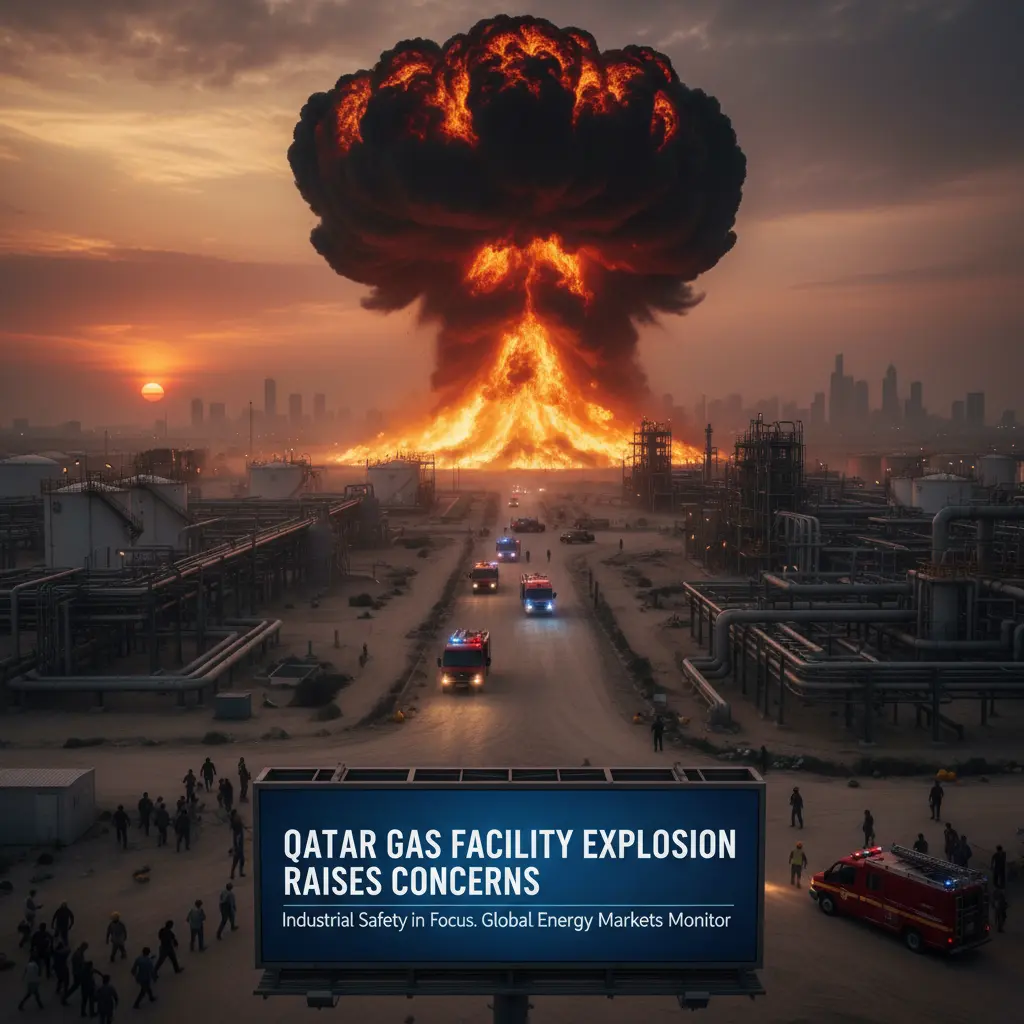
A major explosion tore through Qatar’s Ras Laffan Industrial City on Sunday evening, injuring dozens of workers and leaving more than a dozen others unaccounted for, in one of the most serious industrial incidents to hit the country’s energy sector in years. The blast struck the Barzan gas supply facility, a key part of the sprawling Ras Laffan complex north of Doha that sits at the heart of Qatar’s liquefied natural gas operations.
According to Qatar’s Ministry of Interior, the explosion injured 54 people, while 18 others remained missing as search and rescue teams combed through the site hours later. The Qatari International Search and Rescue Group was deployed to look for those still unaccounted for, and emergency crews managed to bring an accompanying fire under control. Authorities described the cause as a “technical malfunction” tied to an internal explosion, rather than any kind of external attack, and said there had been no dangerous gas leak that would put the wider public at risk.
What Happened, and Why the Timing Matters
State-run operator QatarEnergy said the incident occurred as workers were restarting operations at the Barzan facility, which produces close to 1.4 billion standard cubic feet of gas a day, gas that’s used domestically to generate electricity and to power Qatar’s desalination plants, the country’s main source of fresh water in an otherwise arid region. Qatar owns the vast majority of the plant, with a small minority stake held by ExxonMobil.
The timing here isn’t incidental. Qatar had scaled back gas production after a tense stretch in the Strait of Hormuz, a chokepoint that handles a huge share of the world’s energy shipments, when Iranian restrictions on the waterway made it difficult to move cargo out to international buyers. Ras Laffan itself had also reportedly come under direct attack earlier during the recent conflict, struck by Iran in retaliation for an Israeli strike on Tehran’s own gas field. As diplomatic talks between the US and Iran progressed and pressure on the strait began to ease, Qatar moved to bring its export operations back toward normal levels. It was during that restart process that Sunday’s blast occurred.
A Jolt for Global Energy Markets
Qatar isn’t just any gas producer. It ranks among the world’s largest exporters of liquefied natural gas, supplying countries across Asia and Europe that depend heavily on LNG shipments for power generation and heating. Any disruption at a facility this central to that supply chain tends to ripple outward fast, and energy markets were watching closely in the immediate aftermath for signs of how the explosion might affect output or shipping schedules.
For now, officials have stressed that the explosion involved a domestic gas supply unit rather than the export-focused trains that feed Qatar’s massive LNG shipments abroad, which may limit the immediate impact on international supply if the damage stays contained. Still, the explosion comes at an unusually fragile moment for global energy markets, with the broader Gulf region still working through the aftershocks of recent military conflict and ongoing negotiations over the Strait of Hormuz. Any uncertainty around Qatari output, even temporary, tends to put traders and importers on edge given how tightly balanced LNG supply has been in recent years.
Industrial Safety Back Under The Microscope This incident has refocused a familiar discussion about standards for industrial safety at critical energy infrastructure, especially facilities that are restarting in rapid succession after a shutdown or are under increased geopolitical tension, beyond the immediate human toll and market jitters. Restart operations at large industrial plants are considered some of the riskiest phases in the operating cycle of a facility, precisely because of the unpredictable behaviour of pressure systems, valves and machinery that have been idle before being brought back online.
Energy analysts have long pointed out that gas processing and LNG facilities by their very nature deal with highly flammable materials under significant pressure, meaning even a small technical fault can cascade into a serious incident. Qatar has generally maintained a strong safety reputation in the global energy industry but an explosion of this scale, with dozens injured and several people still missing, is likely to trigger calls for an independent and thorough investigation into exactly what went wrong during the restart sequence.
What Happens Next Authorities have yet to provide details of what technical fault caused the blast, and the full extent of damage to the Barzan facility is not yet known. For now the priority is to find the missing workers and treat the injured, with a cause-and-effect investigation likely to follow once the emergency response winds down.
The incident is particularly tricky for Qatar, which is trying to balance the urgency of restoring gas production to full capacity against the obvious risks of a rushed restart. For the rest of the world, it is a reminder of how interconnected global energy security has become, with a single explosion at one facility in one corner of the Gulf reverberating through markets, safety regulations and diplomatic discussions far beyond Qatar’s borders. As the investigation plays out, both the human cost and the bigger questions about industrial safety at critical energy sites are likely to remain in the spotlight for some time to come.
Qatar Gas Facility Explosion Raises Concerns Over Industrial Safety and Energy Supply.