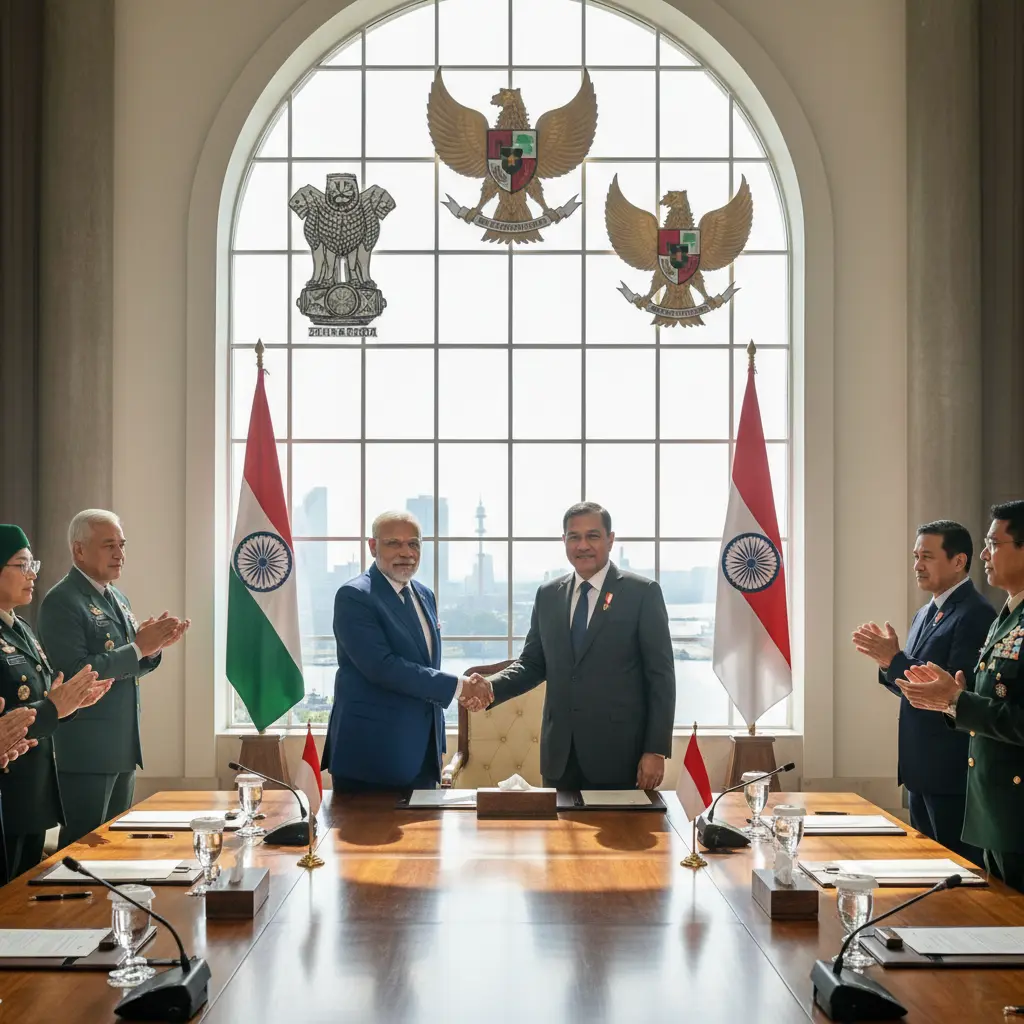
There’s something fitting about two of the world’s largest democracies choosing missiles and maritime cooperation as the centerpiece of a friendship upgrade. That’s exactly what happened in Jakarta this week, when Prime Minister Narendra Modi and Indonesian President Prabowo Subianto put pen to paper on a defence agreement that’s been in the works for months and is already being called the start of a “golden chapter” in India-Indonesia relations.
The headline item is a deal for India to supply BrahMos supersonic cruise missiles to Indonesia, along with Astra air-to-air missiles built by Bharat Dynamics. The package is reportedly worth around $630 million, and it makes Indonesia the third country to buy the BrahMos system, following earlier sales to the Philippines and Vietnam. For a missile that can be launched from land, sea, or air and is famously difficult to intercept because of its speed, that’s a meaningful vote of confidence in India’s defence manufacturing.
The timing wasn’t lost on anyone watching the region closely. The agreement was signed just a day after China test-launched a long-range ballistic missile, a reminder of how much of this deal is really about the broader contest for influence playing out across the Indo-Pacific. Southeast Asia’s largest economy picking up serious firepower from New Delhi rather than Beijing or Washington says something about where Jakarta wants to position itself as tensions simmer around the South China Sea and other maritime flashpoints.
Modi’s welcome in Jakarta was hard to miss. His plane was escorted into Indonesian airspace by fighter jets, and Prabowo personally greeted him at the airport, a gesture that underlined just how much weight Indonesia is putting on this relationship. At the Merdeka Palace, Prabowo called Modi’s visit a “historic milestone,” pointing out that two of the world’s biggest democracies working closely together brings real benefits to the wider region. Modi, for his part, described the ties between the two nations as having gained “new energy,” building on the Comprehensive Strategic Partnership the countries set up back in 2018.
But this trip was never just about hardware. Alongside the BrahMos and Astra deals, Indian and Indonesian officials signed off on roughly twenty separate agreements covering everything from maritime safety and critical minerals to healthcare, space exploration, and even election technology. One notable outcome was a joint venture between India’s Steel Authority and Indonesia’s Krakatau Steel to build a stainless-steel slab manufacturing facility, a project Indian officials say will create jobs and deepen industrial ties between the two economies. Also agreed were disaster management, health workforce collaboration and steel supply chain cooperation, giving the visit a far wider footprint than a simple arms sale.
Maritime security featured prominently in the talks too, and for good reason. India and Indonesia sit along some of the busiest shipping lanes connecting the Indian and Pacific Oceans, and both countries have a shared interest in keeping those routes secure and open. The two sides agreed on a maritime safety and security framework meant to formalize cooperation that has, until now, been fairly informal.
Indonesia didn’t let the visit pass without its own gesture of goodwill. Prabowo conferred the country’s highest civilian honor, the Bintang Adipurna, on Modi, a recognition Indian officials described as a testament to the Prime Minister’s efforts in deepening the two nations’ strategic partnership. It’s the kind of ceremonial touch that, while symbolic, tends to matter in diplomatic circles as a signal of genuine warmth rather than just transactional politics.
Modi’s Indo-Pacific tour doesn’t stop in Jakarta. He’s scheduled to travel next to Yogyakarta, where he may formally launch an India-backed restoration project at the Prambanan temple, one of Indonesia’s most treasured Hindu heritage sites. From there, Modi heads to Australia to meet Prime Minister Anthony Albanese, continuing a diplomatic sweep through the Indo-Pacific that’s clearly designed to strengthen India’s ties with key regional partners at a moment when the balance of power in the region feels increasingly up for grabs.
For India, the Indonesia deal fits into a bigger story about the country’s ambitions as a defence exporter. Officials have made no secret of wanting to expand BrahMos sales further, and reports suggest several other countries, including the UAE, have shown interest in acquiring the system. Landing Indonesia as a customer adds real credibility to that push, especially given Jakarta’s size and its influence within ASEAN.
Whether this “golden chapter” lives up to its billing will depend on how quickly these agreements move from paper to practice. But for now, the optics are clear: two major Indo-Pacific democracies, choosing to lean further into each other at a moment when the regional map is shifting fast.