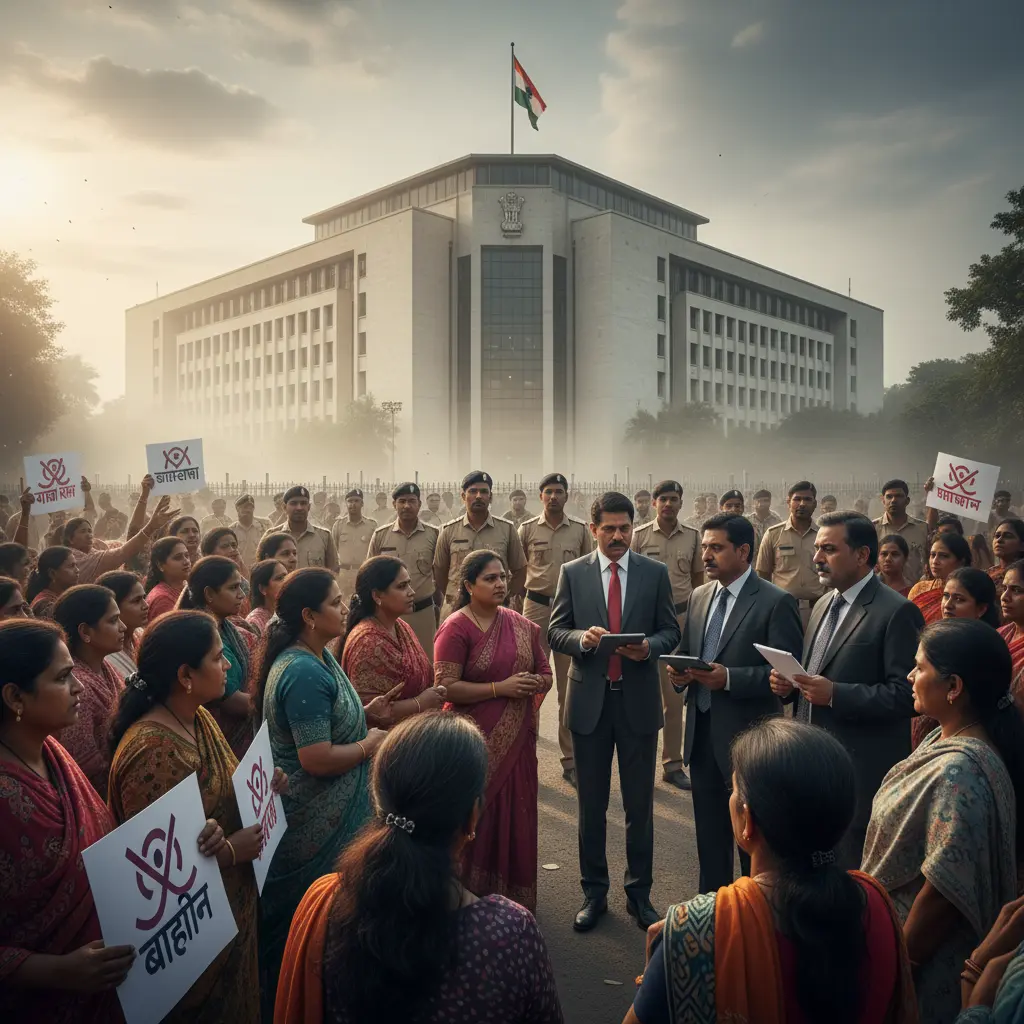
A months-long extensive verification exercise has led to the removal of more than 92 lakh women from the Maharashtra government’s flagship Mukhyamantri Majhi Ladki Bahin Yojana, one of the largest overhauls that the welfare scheme has seen since its launch. The development has rapidly become a hot-button issue in Maharashtra politics with the state government defending the move as a necessary transparency measure and opposition parties demanding a clearer account of the process.
The Extent of the Cut
For context, the scheme’s beneficiary base has come down from a high of about 2.43 crore women to about 1.5 crore now — a decline of nearly 38 per cent. That’s close to four out of every ten women who had originally been enrolled. Interestingly, the final figure of 92.44 lakh removals ended up considerably higher than the 80 lakh number the government had initially floated publicly, suggesting the verification exercise uncovered more irregularities than officials first expected.
Women and Child Development Minister Aditi Tatkare has said the verification drive was set in motion after the new government took charge, and that beneficiaries were given multiple opportunities to complete the mandatory eKYC authentication before any names were struck off.
Why So Many Were Removed
The breakdown of reasons behind the removals paints a fairly detailed picture of what went wrong with the scheme’s original rollout. The single biggest chunk — nearly 62 lakh beneficiaries, or about 67 percent of all removals — lost their spot simply for failing to complete the mandatory eKYC process, despite repeated deadline extensions and awareness campaigns.
Beyond that, the numbers get more specific:
- Around 16 lakh beneficiaries (17 percent) were found to belong to families exceeding the scheme’s annual income ceiling of Rs 2.5 lakh.
- Roughly 4.42 lakh beneficiaries came from households with a government employee, a category explicitly excluded from the scheme.
- Close to 3.6 lakh women were already receiving assistance under the overlapping Sanjay Gandhi Niradhar Yojana.
- Nearly 2.5 lakh cases involved more than two members of the same family drawing benefits simultaneously.
- About 1.8 lakh beneficiaries were above the scheme’s upper age limit of 65 years.
- Nearly 29,000 men were found to have improperly received payments meant exclusively for women.
- An additional 8,000 government employees were separately flagged during the process.
Officials have clarified that recovery proceedings will only be initiated against the male beneficiaries and government employees who wrongly received funds. Women removed for other reasons, such as income mismatches or eKYC lapses, will not be asked to return money already credited to their accounts — a distinction that’s likely aimed at avoiding further backlash against genuine applicants caught up in the state’s earlier verification gaps.
A Scheme Under Scrutiny Since Launch
The Ladki Bahin scheme was rolled out in June 2024 as the Mahayuti government’s flagship welfare programme in the run-up to the state Assembly elections, offering Rs 1,500 a month to eligible women aged 21 to 65 from economically weaker households. It’s widely credited with helping the alliance shore up support among women voters, and the campaign had even promised to eventually raise the monthly payout to Rs 2,100 — a commitment that hasn’t materialised yet.
But questions about how loosely the scheme was administered surfaced almost as soon as it rolled out. Reports of applications approved with minimal verification, men receiving payments meant for women, and beneficiaries who clearly exceeded income or age limits started piling up. That pressure eventually pushed the government into a phased verification process, starting with checks on families owning four-wheelers or using tractors, then widening into full-scale eKYC and bank account scrutiny.
The Fiscal Angle
There’s also a clear budgetary story running underneath this. The scheme’s expenditure was originally estimated at around Rs 45,000 crore annually before being scaled back, first to Rs 36,000 crore and now to Rs 26,500 crore for 2026-27. Officials estimate that the beneficiaries who’ve now been struck off had collectively drawn close to Rs 14,000 crore before being caught by the verification process at various stages.
Even with the sharp reduction in numbers, the Ladki Bahin scheme still accounts for around 3.4 percent of Maharashtra’s total estimated state expenditure for the year, underlining just how central it remains to the state’s welfare architecture despite the cuts.
Political Repercussions
Unsurprisingly, the scale of the removals has led to pointed questions from opposition parties, who are demanding greater clarity on how the verification process was run and why so many women who initially qualified are now being excluded. Some applicants have also voiced frustration at Aadhaar authentication failures and technical glitches that made it tougher to complete eKYC than it should have been, raising fears that not everyone removed from the list was necessarily ineligible.
The state government, on its part, argues that the exercise was necessary to protect public money and to ensure that welfare resources of Maharashtra reach the truly deserving beneficiaries and not get diluted on account of overlapping schemes, mismatch of income and outright misuse. It is probable that the question of whether this explanation will satisfy critics, or whether the controversy will only intensify as more women voice grievances, will remain a live thread in Maharashtra politics in the weeks to come, particularly given the scheme’s disproportionate influence on the state’s recent electoral outcomes.