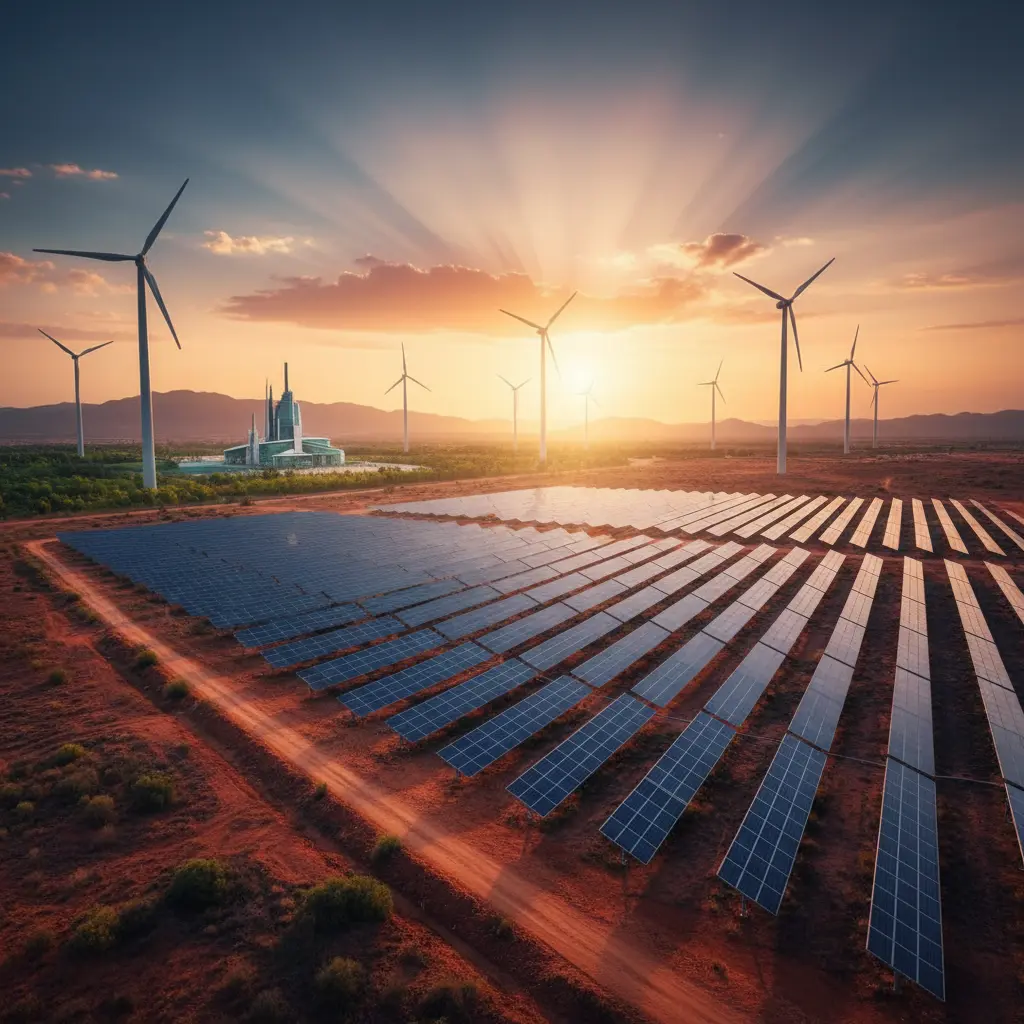
If you’ve been following India’s energy story over the past couple of years, you’ll know it’s no longer just about ambition — it’s about actual numbers showing up on the ground. India’s renewable energy sector just had its best year ever and the momentum shows no signs of slowing down. Solar parks are springing up everywhere, wind farms are growing, and the country’s climate pledges are beginning to feel less like distant promises and more like a plan that’s actually taking shape.
Solar installations alone were up more than 87 percent from the prior year, with wind capacity additions up nearly 46 percent.
Solar power remains the backbone of this growth and now makes up well over half of India’s total renewable capacity. By the close of March 2026, the total solar capacity has reached the 150 GW mark, a feat that would have seemed ambitious only a few years ago. Wind energy, meanwhile, is quietly having its best stretch too, with the highest-ever single-year capacity addition on record.
Why Solar Parks Are Doing So Much Heavy Lifting
A big part of this growth story comes down to the country’s network of large-scale solar parks, which have become central to how India scales up clean energy quickly. Ground-mounted, utility-scale projects have made up the bulk of new solar capacity, benefiting from years of government-backed bidding programs that gave developers the certainty they needed to commit serious capital.
But it’s not just massive utility-scale projects doing the work. Rooftop solar and distributed renewable energy — the kind of small-scale installations on homes, businesses, and farms — have also seen a real jump, contributing over a third of new solar capacity added in the past year. That diversification matters. It means the renewable energy push isn’t just a story of a few giant solar parks in Rajasthan or Gujarat; it’s becoming something that’s showing up in ordinary rooftops and community-level installations across the country.
Sustainability Meets Economic Development
Experts tracking this shift keep coming back to the same point: this isn’t purely an environmental story, it’s an economic one too. Cheaper solar and wind power is increasingly cost-competitive with traditional thermal generation, which means renewable energy isn’t just the responsible choice anymore — in many cases, it’s simply the cheaper one. That shift changes the calculus for utilities, investors, and state governments alike, all of whom have real financial incentives to keep building.
There’s also a manufacturing angle worth paying attention to. Combined with new systems to monitor imports of solar and wind equipment, the government appears to be playing a longer game — not just adding capacity, but trying to build an industry around it that creates jobs and keeps more of the economic value within the country.
Staying on Track for 2030
None of this growth is happening by accident. India has set a target of reaching 500 GW of non-fossil fuel capacity by 2030, a goal tied directly to its broader climate commitments under the Paris Agreement. Based on current trajectories, industry analysts expect India to add another 47 GW or so of combined solar and wind capacity in 2026 alone, with projections for FY2027 running even higher, somewhere in the range of 53 to 55 GW.
Getting there won’t be entirely smooth. Supply chain pressures, occasional geopolitical disruptions affecting equipment costs, and the sheer logistical challenge of building out transmission infrastructure to match new generation capacity all remain real hurdles. Land acquisition for large solar parks and wind farms continues to be a persistent bottleneck in several states, something officials have acknowledged for years without fully resolving.
What This Means Going Forward
Still, the broader trend is hard to argue with. Non-fossil fuel sources now account for just over half of India’s total installed power capacity, a genuine milestone in a country that, not too long ago, relied overwhelmingly on coal. The transition to green power is reshaping not just how India generates electricity, but also its ideas on energy security, industrial policy, and its role in international climate diplomacy.
For a country of India’s size and energy demand, sustainability at this scale was never going to be simple. But as solar installations hit records, wind sector growth remains steady and a manufacturing sector slowly catches up to demand, India’s renewable energy push feels less like a discrete campaign and more like a structural shift in how the country powers itself. At today’s pace, the next few years could see India’s climate ambitions get closer than ever to reality on the ground.