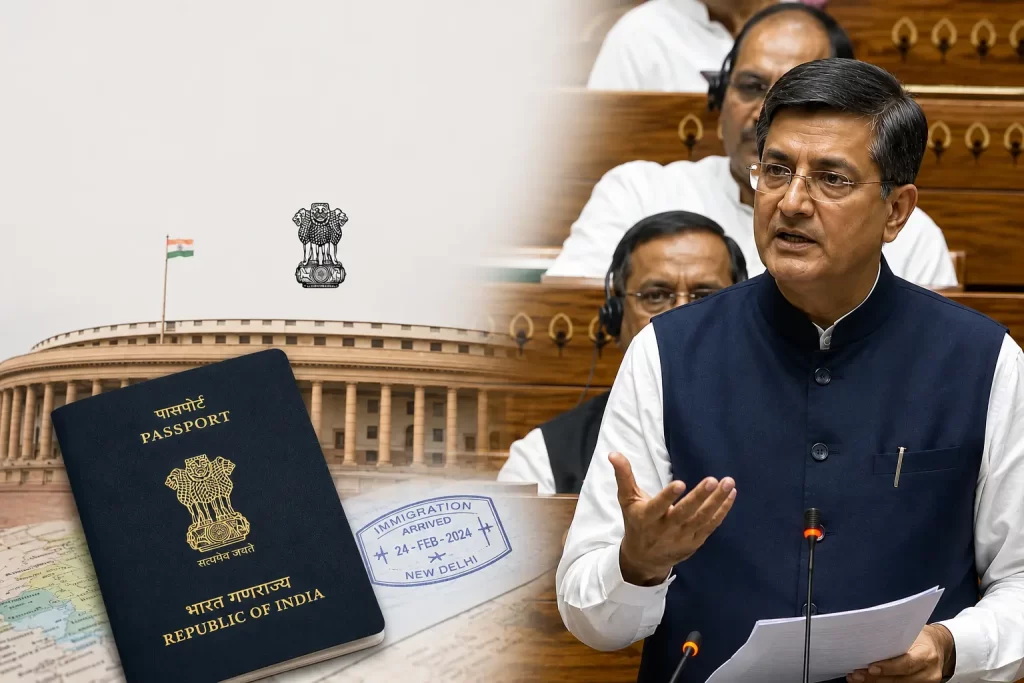
If there’s one document most Indians assume settles the citizenship question once and for all, it’s the passport. So when the Government of India put out a clarification stating that a passport is issued primarily to regulate international travel, and not to serve as a universal identity or citizenship document, it caught a lot of people off guard. The statement, which surfaced alongside questions raised in Parliament and during an official Passport Seva event, has quickly turned into one of the more talked-about pieces of government policy this year.
What Exactly Did the Government Say
The core of the clarification is fairly simple, even if it feels jarring at first. According to the Ministry of External Affairs, passports are issued to Indian citizens after due verification, but their legal purpose has always been to facilitate travel abroad and confirm identity to foreign governments. They were never designed, the government said, to be the final word on someone’s citizenship status within India.
To back this up, officials pointed to Section 20 of the Passports Act, 1967, which actually allows the government to issue a passport or travel document to a non-citizen if doing so is considered necessary in the public interest. That single provision undercuts the assumption that holding a passport automatically proves someone is an Indian citizen. Courts have said much the same thing over the years, including a 2013 Bombay High Court ruling that held a passport, by itself, cannot be treated as conclusive proof of citizenship.
The government was careful to stress that this isn’t a new rule or a policy shift. It’s simply a restatement of a legal position that has existed for well over a decade. Citizenship itself continues to be governed entirely by the Citizenship Act, 1955, not by any single identity card or travel document.
A Small Percentage, A Big Reveal
The other part of this story that’s drawn attention is the number itself. During the discussion, officials revealed that only around 10 percent of India’s population currently holds a passport. For a country of India’s size, that’s a strikingly small slice, even though it represents real progress compared to a decade ago, when the figure sat closer to 6 or 7 percent.
That gap matters because it changes how you think about passports in the national conversation. If barely one in ten Indians has one, then treating it as a stand-in for a universal ID card was always going to be a stretch. The government’s point, essentially, was that the passport was never meant to carry that kind of weight for the other 90 percent of the country who may never need one for travel but are still, quite obviously, citizens.
Passport issuance itself has grown substantially though. Annual processing has climbed to well over a crore applications a year, up sharply from a decade ago, aided by an expanding network of over 500 passport service centres across the country. The government has said it wants a facility in every Lok Sabha constituency by 2027, along with mobile outreach camps that have already helped hundreds of thousands of people in remote areas apply.
Why This Triggered a Political Debate
Naturally, a statement like this doesn’t stay confined to legal technicalities for long. Opposition leaders picked it up almost immediately, asking a fairly reasonable question: if a passport doesn’t prove citizenship, what does? Some pointed out that similar doubts have already been raised about Aadhaar and voter ID cards, neither of which is considered legal proof of citizenship either. That leaves India, at least for now, without one single document that automatically settles the matter for every citizen.
This concern isn’t purely academic. It ties into wider anxieties around electoral roll revisions and citizenship verification exercises that have played out in various states recently, where people have had to scramble to produce old records, land papers, or school certificates just to establish where they stand. Government supporters, meanwhile, have pushed back on the idea that anything has actually changed, arguing this is simply the law being restated the way courts have consistently interpreted it for years.
Former officials have weighed in too, noting that while the government’s legal position is technically accurate, the way it was communicated added to public confusion rather than easing it. There’s a real difference between saying a passport isn’t conclusive proof of citizenship and explaining, in the same breath, that it’s still issued only after citizenship has been verified.
Where This Leaves Digital Identity Policy
This whole episode has also reopened a broader conversation about India’s digital identity architecture. Aadhaar, PAN, voter ID, and passports each serve very different legal purposes, yet in daily life people often reach for whichever one is on hand to prove who they are. The passport clarification has made that patchwork more visible, and it’s likely to feed into ongoing discussions about whether India eventually needs a more unified approach to citizenship documentation, separate from the various identity cards currently in circulation.
For now, nothing changes for ordinary applicants. The process of applying for or renewing a passport remains exactly the same, and the document still works exactly as it always has for travel and identification abroad. What’s shifted is public understanding, not the underlying rule itself. Whether that’s a reassuring outcome or an uncomfortable one probably depends on which side of the debate you’re standing on. Either way, the passport conversation seems far from over.