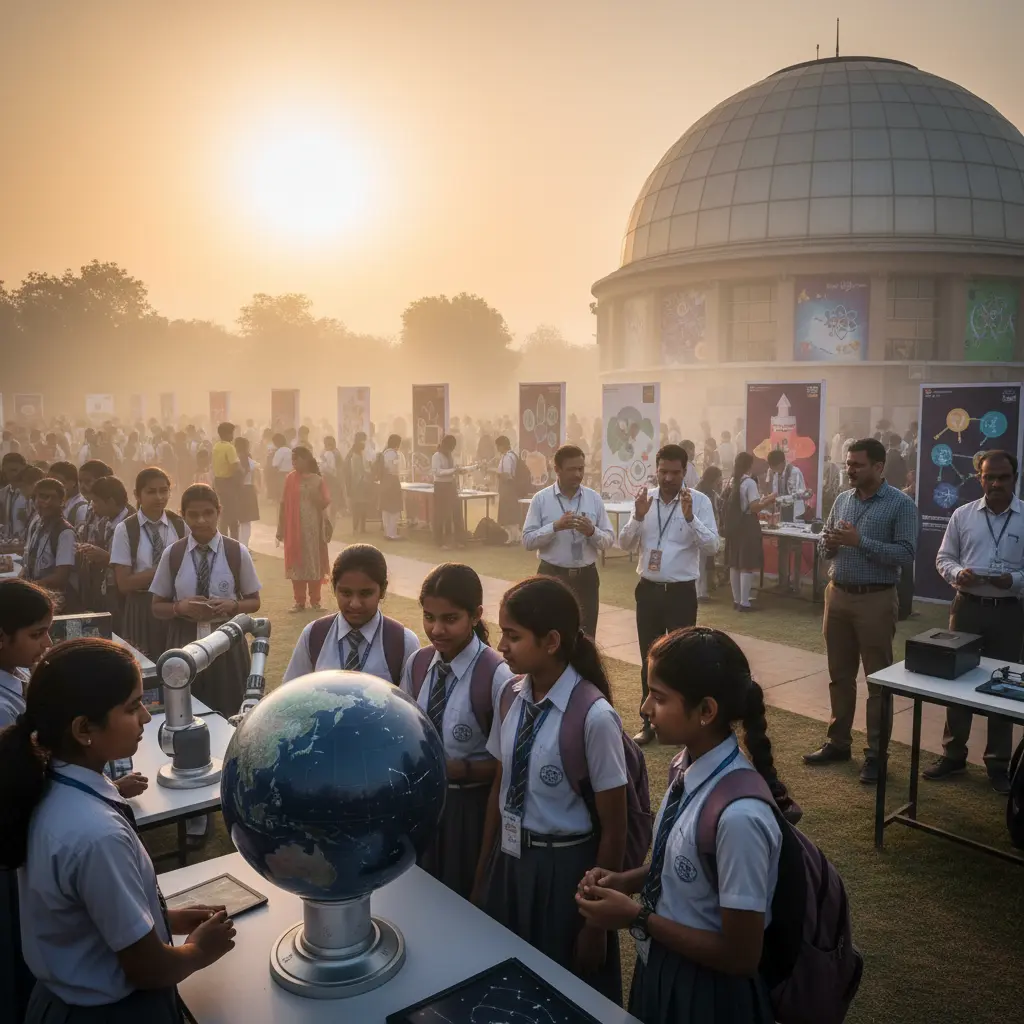
There’s a particular kind of energy in the air whenever a school auditorium fills up with students clutching handmade project boards, or a university hall buzzes with researchers debating the finer points of a new experiment. Across India, that energy is showing up more often than ever. Science conferences, exhibitions, and youth-focused research events have become a regular fixture on the academic calendar, and they’re quietly doing something important: reshaping how young people in this country relate to science.
It’s easy to underestimate how much a single event can shift a student’s outlook. A teenager who spends an afternoon listening to a scientist explain their research, or who gets to present their own project to a panel of judges, often walks away seeing science differently. It stops being a subject confined to textbooks and exam papers and starts looking like something they could actually do. That shift, small as it seems, is exactly what’s driving the growing emphasis on science conference culture in education India today.
Part of what makes these events effective is that they don’t just target one type of audience. Walk into any major science conference, national or regional, and you’ll usually find a mix of school students, undergraduates, PhD scholars, and working researchers all sharing the same physical space. That mix matters more than it might seem. A student who might never get direct access to a senior scientist in their day-to-day academic life suddenly gets to ask questions, hear how research actually gets done, and see firsthand that the people producing India’s scientific output are, in the end, just people who started out curious.
This growing culture of participation is also tightly linked to how India is thinking about innovation more broadly. The country has spent the last decade pushing hard to build a stronger research ecosystem, one where fresh ideas don’t stay trapped in isolated labs but actually move toward real-world application. Science conferences play a quiet but essential role in that pipeline. They’re often where early-stage research gets its first real audience, where industry professionals scout for promising ideas worth funding, and where interdisciplinary collaborations, the kind that produce genuinely useful innovation, first take shape over a shared cup of chai between sessions.
Students, in particular, benefit in ways that aren’t always obvious from the outside. Presenting a project, even a modest one, forces a student to think like a researcher: define a question, defend a method, handle tough feedback, and communicate complex ideas to people who don’t already share their assumptions. Those are skills that don’t come naturally from classroom learning alone. Many students describe their first conference experience as a turning point, the moment they stopped thinking of themselves as someone who merely studies science and started thinking of themselves as someone capable of contributing to it.
Educators, too, have leaned into this shift. Increasingly, schools and colleges are looking at conference participation not as an optional extracurricular, but as a meaningful part of a student’s academic development. Teachers who once only drilled students for exams are now actively encouraging students to submit papers, to build projects, and to take part in research events, knowing that early exposure to real scientific inquiry does more for long-term learning than another semester of rote memorization ever could.
There’s also a broader national interest at play here. The aspirations for self-reliance in science and technology of India hinge critically on the development of a steady pipeline of young researchers who are at ease engaging with cutting-edge ideas from an early age. Conferences that bring students face-to-face with working scientists effectively shorten the distance between classroom learning and frontier research, giving the next generation a running start rather than making them wait until postgraduate study to encounter serious scientific work.
None of this suggests the system is without gaps. Access to these opportunities still varies significantly depending on which city, school, or institution a student happens to belong to, and rural and smaller-town students often have fewer chances to attend major events compared to their urban counterparts. Cost, travel, and awareness all remain real barriers. But the direction of travel is encouraging. More universities are hosting their own research symposiums, more state-level science fairs are popping up, and more national events are actively building in student-focused tracks rather than treating young people as passive observers.
What ties all of this together is a simple, steady idea: that scientific temperament isn’t something that arrives fully formed in university labs, it’s something built gradually, through curiosity, exposure, and the chance to stand in a room full of people who take research seriously. Every conference that opens its doors to students, every science fair that lets a ninth-grader present alongside a postdoctoral researcher, adds another brick to that foundation.
As India continues to invest in its research ecosystem, the quiet, ongoing work of scientific events across the country deserves real credit. They don’t always make headlines, but they do something headlines rarely capture: turning curious students into the researchers, innovators and scientists India will depend on in the coming decades.