
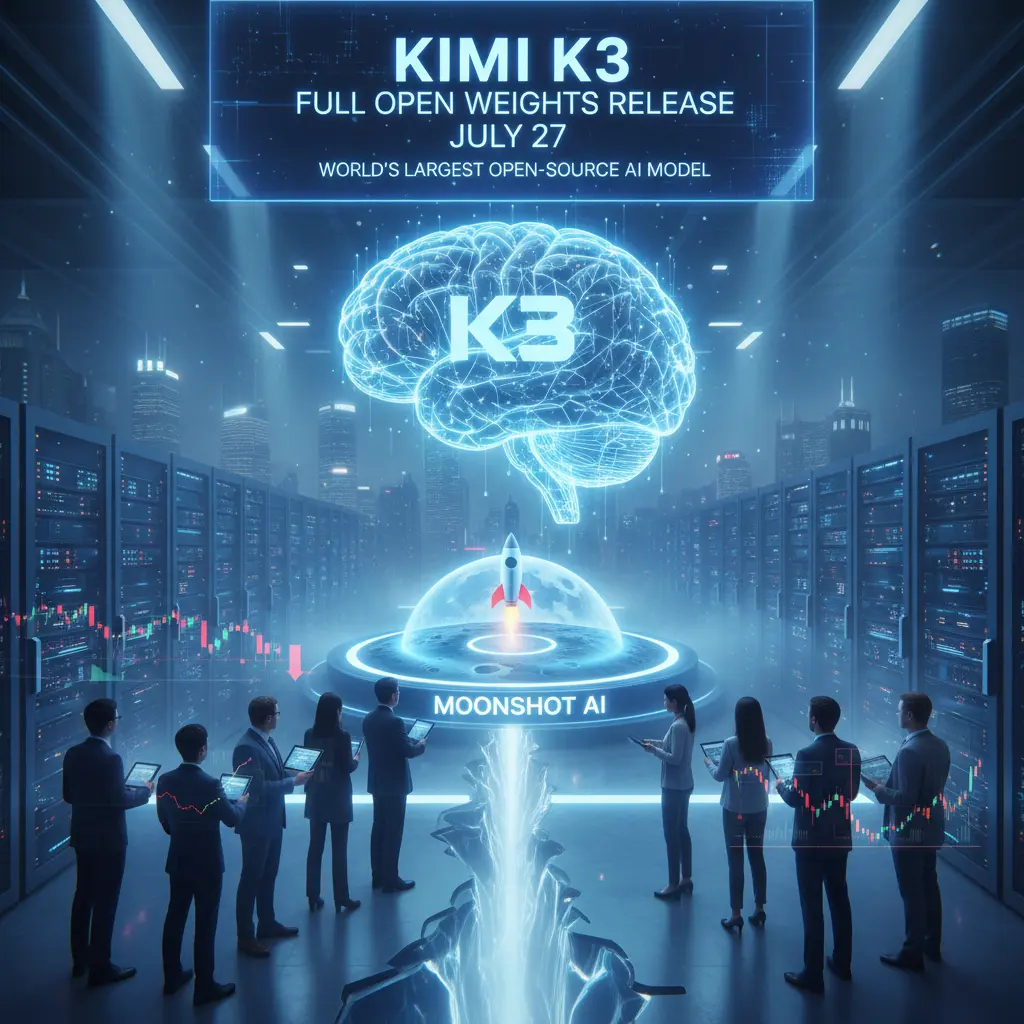
Moonshot AI Set to Release Kimi K3’s Full Open Weights Today, Capping a Two-Week Sprint That Rattled the AI Industry.

Today marks the day much of the AI world has had circled on its calendar: Moonshot AI, the Beijing-based startup, is scheduled to publish the complete open weights of Kimi K3, its 2.8-trillion-parameter model that the company describes as the largest open-source AI system ever built. The release caps a whirlwind two weeks that started with the model's benchmark-topping debut on July 16 and has, in the time since, sent shockwaves through both the AI industry and financial markets. For anyone tracking the Kimi K3 open weights story, today's release is the second half of a two-step launch. Moonshot first made the model available through its API and consumer apps on July 16, letting developers and researchers test its capabilities without handing over the underlying architecture. That held the model at arm's length from the open-source community for eleven days — enough time for benchmark numbers to circulate and for the industry to start forming an opinion. Now, with the full weights due out, anyone with the hardware to run it will be able to download, inspect, fine-tune, and self-host the model directly. The scale of Kimi K3 is what's driven most of the conversation around this Moonshot AI model. At 2.8 trillion total parameters, it dwarfs other recent open-source Chinese releases — roughly 75 percent larger than DeepSeek's V4 Pro, which sits at around 1.6 trillion parameters. But the headline number is a bit misleading on its own. Kimi K3 uses a mixture-of-experts design, meaning it only activates a small fraction of its total parameters for any given task — 16 of 896 experts per token, which works out to roughly 50 billion parameters of active compute at any one time. That architecture, paired with what Moonshot calls Kimi Delta Attention and a technique it calls Attention Residuals, lets the model behave like something far larger than its actual per-token compute cost would suggest. TECHi On the benchmark side, the numbers have been enough to put Kimi K3 in serious conversation with the leading closed-source labs. The model has landed close to the top of several independent leaderboards, and in blind developer testing on Arena's Frontend Code Arena, it actually took the top spot outright. It hasn't overtaken everything — Anthropic's and OpenAI's most capable systems still generally edge it out on broader intelligence indexes — but for an open-weight model to land within striking distance of the closed frontier at all is being treated as a milestone in its own right. Not everyone has taken Moonshot's benchmark claims fully at face value, though; some independent testing has flagged a notably elevated hallucination rate on K3 compared with its predecessor, a detail that didn't appear in Moonshot's own published charts. The reaction across the AI benchmark race has been just as notable as the model itself. When Kimi K3 first launched, shares of rival Chinese AI firms took a hard hit — Z.ai's stock reportedly dropped nearly 30% in Hong Kong trading, while MiniMax Group fell around 16%. The sell-off wasn't confined to Moonshot's direct competitors either; broader Asian semiconductor names and even Nvidia saw pressure, as investors weighed whether a highly capable, comparatively cheap open-weight model might chip away at the assumption that frontier AI requires enormous, sustained spending on high-end compute. Some analysts have compared the mood to the "DeepSeek moment" from early last year, when a similar Chinese release rattled US tech valuations, though others have pushed back on the comparison as overblown. The timing of today's open-source AI China release also lands amid a more complicated geopolitical backdrop. Chinese regulators have reportedly been weighing new export controls that could restrict how freely Chinese AI labs release model weights to the rest of the world, with discussions apparently still unresolved as of late last week. That backdrop has added a layer of urgency to today's release: once the weights are out and downloaded across the globe, they're effectively impossible to pull back, regardless of what rules Beijing eventually settles on. On the US side, the release has also fed into an ongoing debate in Washington over whether American companies should be permitted to build on Chinese open-source models at all. For developers and enterprises, today's release effectively creates a new decision point. Until now, using Kimi K3 meant routing requests through Moonshot's hosted API — and, by extension, through infrastructure that may fall under China's National Intelligence Law. With the weights public, organizations will have the option to self-host the model on their own infrastructure instead, though doing so isn't trivial: even in a compressed weight format, the full model reportedly requires somewhere in the neighborhood of 1.4 terabytes of storage, putting genuine self-hosting within reach mainly of organizations running substantial multi-node GPU clusters. Whatever happens with today's rollout, it's already reframing how the industry talks about the AI benchmark race. A model built with a fraction of the resources available to the largest US labs, now sitting within reach of the closed frontier and handing its full weights to the public, is exactly the kind of development that keeps both AI researchers and stock analysts checking their screens today.


Today marks the day much of the AI world has had circled on its calendar: Moonshot AI, the Beijing-based startup, is scheduled to publish the complete open weights of Kimi K3, its 2.8-trillion-parameter model that the company describes as the largest open-source AI system ever built. The release caps a whirlwind two weeks that started with the model’s benchmark-topping debut on July 16 and has, in the time since, sent shockwaves through both the AI industry and financial markets.

For anyone tracking the Kimi K3 open weights story, today’s release is the second half of a two-step launch. Moonshot first made the model available through its API and consumer apps on July 16, letting developers and researchers test its capabilities without handing over the underlying architecture. That held the model at arm’s length from the open-source community for eleven days — enough time for benchmark numbers to circulate and for the industry to start forming an opinion. Now, with the full weights due out, anyone with the hardware to run it will be able to download, inspect, fine-tune, and self-host the model directly.

The scale of Kimi K3 is what’s driven most of the conversation around this Moonshot AI model. At 2.8 trillion total parameters, it dwarfs other recent open-source Chinese releases — roughly 75 percent larger than DeepSeek’s V4 Pro, which sits at around 1.6 trillion parameters. But the headline number is a bit misleading on its own. Kimi K3 uses a mixture-of-experts design, meaning it only activates a small fraction of its total parameters for any given task — 16 of 896 experts per token, which works out to roughly 50 billion parameters of active compute at any one time. That architecture, paired with what Moonshot calls Kimi Delta Attention and a technique it calls Attention Residuals, lets the model behave like something far larger than its actual per-token compute cost would suggest. TECHi

On the benchmark side, the numbers have been enough to put Kimi K3 in serious conversation with the leading closed-source labs. The model has landed close to the top of several independent leaderboards, and in blind developer testing on Arena’s Frontend Code Arena, it actually took the top spot outright. It hasn’t overtaken everything — Anthropic’s and OpenAI’s most capable systems still generally edge it out on broader intelligence indexes — but for an open-weight model to land within striking distance of the closed frontier at all is being treated as a milestone in its own right. Not everyone has taken Moonshot’s benchmark claims fully at face value, though; some independent testing has flagged a notably elevated hallucination rate on K3 compared with its predecessor, a detail that didn’t appear in Moonshot’s own published charts.

The reaction across the AI benchmark race has been just as notable as the model itself. When Kimi K3 first launched, shares of rival Chinese AI firms took a hard hit — Z.ai‘s stock reportedly dropped nearly 30% in Hong Kong trading, while MiniMax Group fell around 16%. The sell-off wasn’t confined to Moonshot’s direct competitors either; broader Asian semiconductor names and even Nvidia saw pressure, as investors weighed whether a highly capable, comparatively cheap open-weight model might chip away at the assumption that frontier AI requires enormous, sustained spending on high-end compute. Some analysts have compared the mood to the “DeepSeek moment” from early last year, when a similar Chinese release rattled US tech valuations, though others have pushed back on the comparison as overblown.

The timing of today’s open-source AI China release also lands amid a more complicated geopolitical backdrop. Chinese regulators have reportedly been weighing new export controls that could restrict how freely Chinese AI labs release model weights to the rest of the world, with discussions apparently still unresolved as of late last week. That backdrop has added a layer of urgency to today’s release: once the weights are out and downloaded across the globe, they’re effectively impossible to pull back, regardless of what rules Beijing eventually settles on. On the US side, the release has also fed into an ongoing debate in Washington over whether American companies should be permitted to build on Chinese open-source models at all.

For developers and enterprises, today’s release effectively creates a new decision point. Until now, using Kimi K3 meant routing requests through Moonshot’s hosted API — and, by extension, through infrastructure that may fall under China’s National Intelligence Law. With the weights public, organizations will have the option to self-host the model on their own infrastructure instead, though doing so isn’t trivial: even in a compressed weight format, the full model reportedly requires somewhere in the neighborhood of 1.4 terabytes of storage, putting genuine self-hosting within reach mainly of organizations running substantial multi-node GPU clusters.

Whatever happens with today’s rollout, it’s already reframing how the industry talks about the AI benchmark race. A model built with a fraction of the resources available to the largest US labs, now sitting within reach of the closed frontier and handing its full weights to the public, is exactly the kind of development that keeps both AI researchers and stock analysts checking their screens today.

Leave a Comment

Your email address will not be published. Required fields are marked *

Scroll to Top
“5 Best Forts Near Pune to Visit on Shivjayanti 2026” 7 facts about Dhanteras