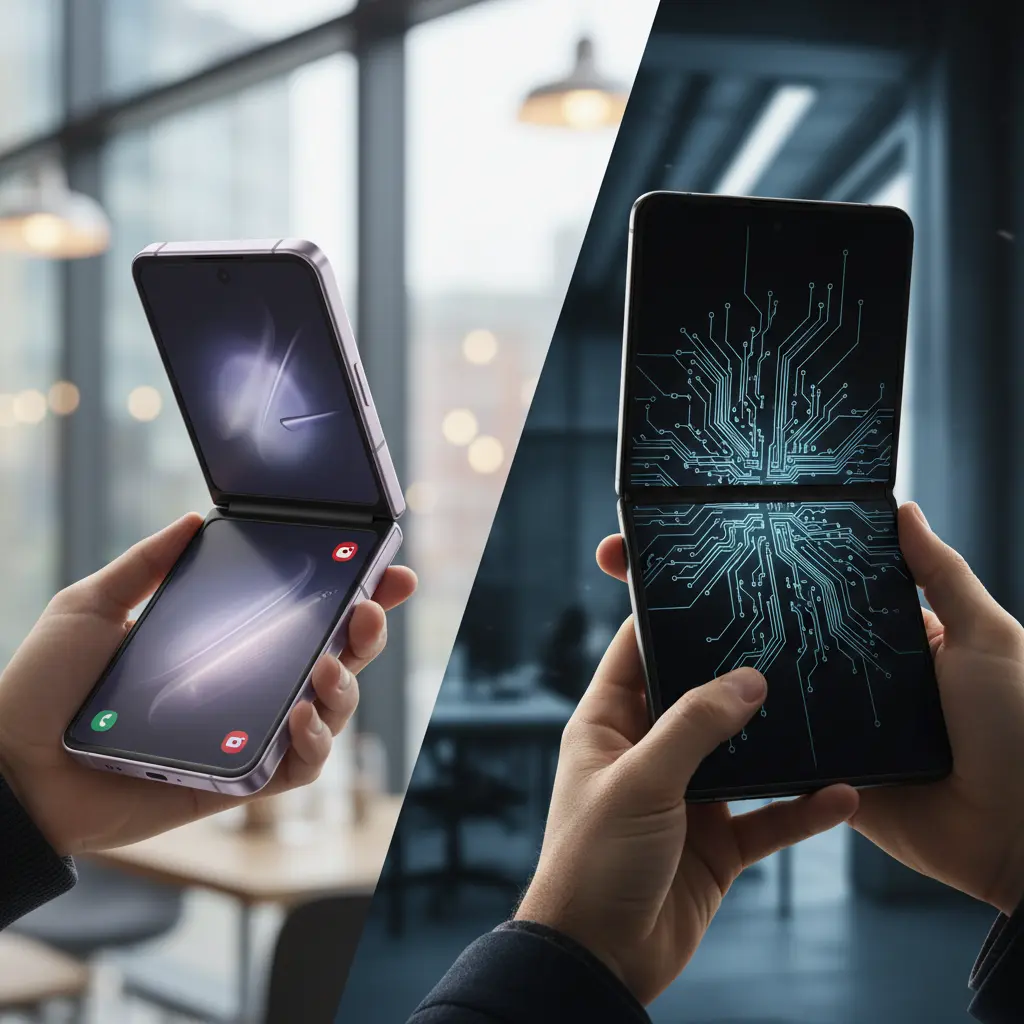
Samsung has never been shy about tinkering with its foldable phones every year, but this time the change is bigger than a spec bump. At its Galaxy Unpacked event in London, the company didn’t just refresh the Fold — it split it into two distinct phones, alongside a redesigned Flip, new smartwatches, and its first real swing at smart eyewear. For a company that’s spent years being the default name in foldables, this launch feels like Samsung finally admitting that “one Fold to rule them all” wasn’t working anymore.
Two Folds, Two Very Different Philosophies
The headline act is the Samsung Galaxy Z Fold 8, and for the first time, there isn’t just one version of it. Samsung introduced a standard Fold 8 alongside a Fold 8 Ultra, and the two aren’t simply different price tiers of the same idea — they’re built around opposite priorities.
The Fold 8 takes the biggest design swing. Instead of sticking with the familiar tall, narrow shape Samsung’s foldables have carried for years, it adopts a shorter, wider silhouette — something closer to a stubby passport when closed, and a genuinely tablet-like widescreen when opened flat. It’s a layout clearly aimed at people who want their foldable to feel more like a mini tablet for streaming, browsing, and multitasking rather than a taller version of a regular phone.
The Fold 8 Ultra, on the other hand, plays it more traditionally. It carries forward the tall, book-style design that’s defined the Fold series since the Fold 7, but pushes the hardware further than any Fold before it — a bigger 8-inch open display, a stronger camera system led by a new 50MP ultra-wide sensor, and Samsung’s largest Fold battery to date, jumping to 5,000mAh thanks to a new silicon-carbon design that packs more energy into a smaller footprint. Both phones also get Samsung’s new Flex Titanium hinge, reinforced with a titanium alloy film meant to make the crease-prone screen sturdier while keeping the device thinner overall.
It’s a smart bit of segmentation, honestly. Rather than forcing every foldable buyer into a single form factor, Samsung is letting people choose between “wide and tablet-like” or “tall and camera-focused” — a genuine acknowledgment that not everyone wants the same thing out of a folding phone.
The Flip Gets Quieter, Smarter Updates
The Galaxy Z Flip 8 didn’t get a dramatic redesign, but it did get meaningfully thinner — about 13% slimmer than its predecessor — along with a reworked cover screen interface that makes the outer display more useful for quick tasks without opening the phone. It’s a subtler update, but for a device whose whole appeal is pocketability, shaving off bulk matters more than flashy new features.
Galaxy Watches and a Real Step Into Smart Eyewear
Foldables weren’t the only story at this year’s event. Samsung also rolled out the Galaxy Watch 9 and Galaxy Watch Ultra 2, continuing its push into health-focused wearables. The Watch 9 keeps last year’s design largely intact but leans hard into software, adding features like a Fitness Index that blends heart rate, step count, and activity time into more actionable recommendations. The Watch Ultra 2, meanwhile, holds its position as Samsung’s toughest, thinnest rugged smartwatch, now with hydration guidance built in for people tracking workouts more seriously.
Perhaps the most forward-looking announcement, though, was Samsung’s new smart eyewear, built on Google’s Android XR platform. This marks Samsung’s clearest attempt yet to plant a flag in the smart glasses space, an area Google and its hardware partners have been circling for a while as the next frontier beyond phones and watches. Details are still emerging on exactly how deep the AI integration runs, but pairing Android XR smartglasses with an ecosystem that already includes Galaxy phones, watches, and tablets signals Samsung wants a foothold in wearable computing before rivals lock the category down.
Why This Launch Matters Beyond the Spec Sheet
Samsung isn’t operating in a vacuum here. The premium foldable segment has gotten noticeably more competitive, with Chinese manufacturers pushing thinner designs and bigger batteries, and rumors swirling about a foldable iPhone potentially entering the fray. Splitting the Fold line into two form factors looks like a direct response to that pressure — a way of covering more ground and giving Samsung an answer regardless of which direction competitors go.
AI is the other thread running through everything here, from the watches’ smarter health insights to the broader push toward wearable, screen-optional computing represented by the smart glasses. Samsung clearly wants its entire device ecosystem, not just its phones, to feel AI-native going forward.
The new Fold 8 and Fold 8 Ultra are available for preorder now, with shipping starting in early August. Whether buyers gravitate toward the wider, tablet-style Fold 8 or the more familiar, camera-heavy Ultra will say a lot about where Samsung takes its foldable lineup next year — and whether “one size fits all” is truly a thing of the past.