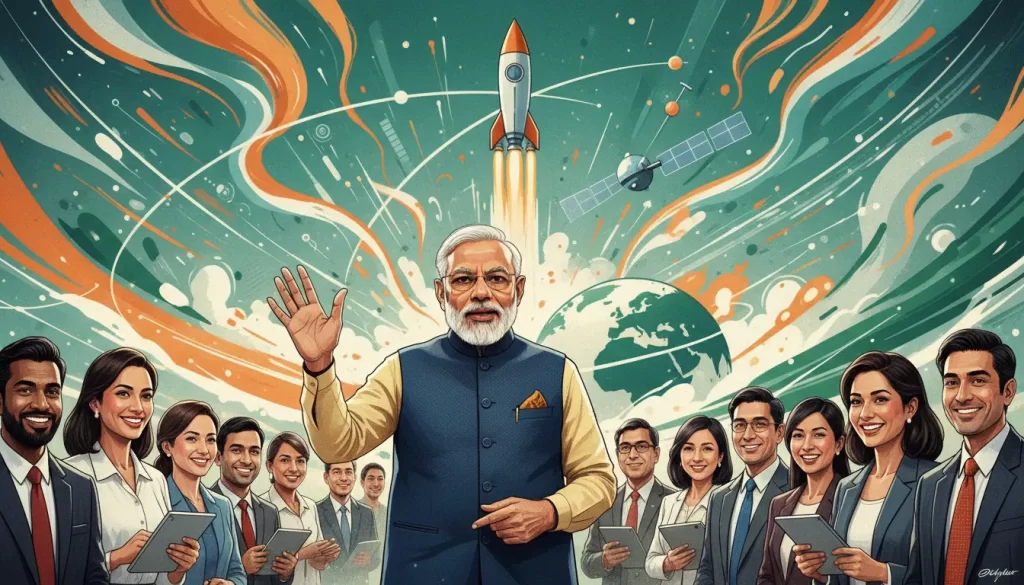
Every year on August 23, India pauses to celebrate National Space Day, marking the anniversary of Chandrayaan-3’s historic soft landing near the Moon’s south pole in 2023. This year’s celebration carried an extra dose of optimism, as Prime Minister Narendra Modi used the occasion to deliver a message that was equal parts pride and ambition: India’s space sector, he said, has become a “magnet” for global investors.
Speaking on Sunday, PM Modi extended greetings to scientists and citizens across the country, reflecting on how far India’s space story has traveled in just a few years. He pointed out that the private space sector in particular has begun drawing serious international attention, a shift he linked directly to a series of policy reforms that opened the field beyond government control. “Today, India’s space sector has become a magnet for global investors,” he said, describing this moment as part of a larger cycle of change that he had first spoken about in Ayodhya.
A Nation Betting Big on Viksit Bharat 2047
Much of PM Modi’s speech was framed around the government’s long-term vision of Viksit Bharat 2047 — the goal of transforming India into a fully developed nation by the year marking a century of independence. He directly linked this vision to the growth of the space sector, space technology is not simply a matter of scientific prestige, but a real pillar of national development. The PM said the country’s capacity to build out sectors such as space — where India has a competitive advantage in cost, talent and ambition — will be key to India’s chances of becoming a developed nation by 2047.
This is not just words. In the last few years, India’s space policy has undergone one of the most momentous changes since the establishment of ISRO. The sector, which was hitherto monopolized by the government, has now been thrown open to private players, spawning a slew of startups working on everything from launch vehicles, satellites, propulsion systems, earth observation to space debris management. That policy shift is widely seen as the single biggest reason for the current surge of interest from investors.
Gen Z Engineers are Leading the Way One of the more striking features of PM Modi’s message was his compliment to India’s Gen Z scientists and engineers. This new generation of coders, designers and researchers is the driving force behind the country’s new technologies, he said, crediting their energy and technical skill for keeping India competitive on the world stage. It’s a generation that grew up watching ISRO’s missions unfold live, and for many of them, the successful touchdown of Chandrayaan-3 was not only a national milestone but a career-defining moment that influenced what they wanted to do in their lives.
PM Modi has made a similar point on other occasions this year, telling founders of private space startups that ISRO’s credibility and India’s growing talent pool could work together like a magnet, pulling in not just capital but skilled professionals from around the world. He has spoken about wanting to build what he calls an “aura” around India’s space sector, one where global professionals feel that if they want a serious career in this field, India is the place to be.
ISRO’s Role in Inspiring the Next Generation
Throughout his address, PM Modi kept returning to ISRO’s role as the inspirational backbone of India’s space journey. “The achievements of ISRO have had a ripple effect far beyond the scientific community, shaping the ambitions of children who now dream of becoming scientists themselves,” he said. This line is not just sentimental padding, but a real strategic bet by the government that a strong pipeline of homegrown talent, inspired by ISRO’s successes, will be the key to keeping India’s space ambitions aloft in the decades to come.
The figures support some of that optimism. India’s private space sector has exploded from a handful of experimental ventures to several hundred startups working across launch vehicles, satellite manufacturing, and advanced propulsion. Companies like Skyroot Aerospace have already achieved milestones such as launching India’s first privately developed rocket, and there is growing talk within the industry of scaling up to monthly, and eventually weekly, private launches in the coming years.
What This Means Going Forward
PM Modi’s remarks on National Space Day aren’t happening in a vacuum. They come at a time when India is trying to assert itself as a serious global player in the commercial space race, fighting for the kind of investment and talent that has traditionally flowed to the United States, Europe and China. Describing the sector as a “magnet” is as much a message to investors and returning Indian professionals abroad as it is a celebration of past achievements.
To keep up this momentum, India will need to maintain policy consistency, invest in infrastructure and let private companies compete on the global stage. But for now, the message from the country’s leadership is clear: space is no longer just ISRO’s story. It’s becoming a national project that’s tapping young engineers, an ambitious government roadmap and a growing appetite among global investors to be part of what India is building next.
PM Modi Calls India’s Space Sector a “Magnet” for Global Investors.