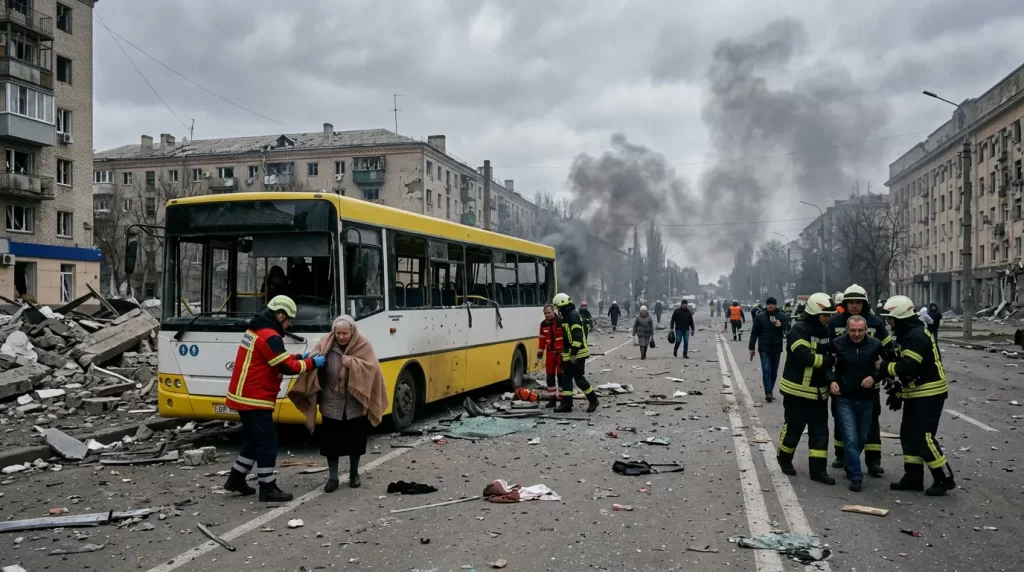
Another morning in Ukraine began the way far too many have: with sirens, shattered glass and families trying to work out who was still alive. New Russian attacks have killed civilians across the country, and the worst of the reporting centers on Kramatorsk, where buses were struck in an assault that has left a heavy human toll. The Russia Ukraine war has dragged on for years, and each fresh round of Ukraine civilian deaths shows how little distance there is between the front line and ordinary life.
What We Know About the Kramatorsk Attack
Al Jazeera reported that at least 33 people were killed after buses were attacked in Kramatorsk. That figure is the highest circulating so far, but it is not the only one. Other morning bulletins put the death toll at at least 20, while others cited at least 25 civilian deaths.
Differences like these are common in the first hours after a major strike. Emergency crews are still pulling people from the wreckage, hospitals are still counting the wounded, and officials are still reconciling lists of the dead and missing. One outlet may be working from an early statement while another has a later update. None of this means someone is lying. It means the situation is moving faster than the paperwork.
The most honest summary is this: civilians were killed, buses were hit, and the final number is not yet settled. Rescue work was still under way when these reports came in, so the count may rise. Independent confirmation of the full figures was still awaited. Readers following the Kramatorsk attack should treat every number as provisional until authorities and independent observers confirm it.
Why Buses Matter
Buses are not military hardware. They carry people to work, to hospitals, to markets, and in some cases away from danger altogether. When a bus is hit, the victims are usually commuters, older residents, parents and workers, people with no role in the fighting.
Kramatorsk, in Ukraine’s eastern Donetsk region, has lived under the shadow of this war for a long time. The city sits within reach of the front, and its residents have heard these sounds before. In April 2022, a missile strike on its railway station killed dozens of people who were trying to flee. For many locals, the latest attack will not feel like a new event. It will feel like an old wound being opened again.
Under international humanitarian law, deliberately targeting civilians or civilian vehicles is prohibited. Russia has repeatedly denied intentionally targeting civilians, even as strikes on residential areas, transport hubs and public spaces continue to produce large numbers of casualties. Investigators and human rights groups will likely examine this latest incident closely, as they have with earlier ones.
Kyiv Shelters Underground
The violence was not limited to the east. In the capital, residents sheltered in a metro station during an air-raid alert. Anyone who has followed the war will recognize the scene: people sitting on platforms with blankets and bags, children in coats, phones in hand scrolling for news, strangers sharing quiet space far below the street.
The Kyiv metro became a shelter in the first days of the full-scale invasion, and it never stopped being one. For many families, going underground at the first alert is as routine as locking the front door. But routine should not be confused with comfort. Parents who have done this for years still describe the same exhaustion, the broken sleep, the constant calculation of whether to stay home or run for cover.
The Kyiv air raid on this occasion was a reminder that no part of the country feels fully safe. Strikes in the east and alerts in the capital are connected by the same reality: a population living with uncertainty, day and night.
The Human Cost Behind the Numbers
It is easy to get lost in the arithmetic of a tragedy like this. Thirty-three, twenty-five, twenty. The numbers change from one bulletin to the next, and each one hides a set of ordinary lives: someone who was heading to a shift, someone who was visiting a relative, someone who simply needed to get across town.
Behind every figure are families waiting for news, neighbors checking on each other and medical staff working long hours with limited supplies. Local hospitals in frontline cities are already stretched, and a mass-casualty event puts enormous pressure on doctors, nurses and volunteers. Communities in Donetsk and beyond have shown remarkable resilience, but resilience is not the same as being unharmed. People can endure and still be worn down.
What Comes Next
In the coming hours and days, several things are likely to happen. Officials will release updated casualty figures. Rescue teams will finish searching damaged sites. Investigators will try to establish exactly what struck the buses and how. Governments and international bodies are expected to issue statements, and some will call for accountability.
Whether any of that brings real change is another question. The pattern of the past few years suggests that condemnation comes quickly, while meaningful protection for civilians remains hard to deliver. For people in Kramatorsk and across the region, the practical concerns are simpler: getting treatment for the injured, burying the dead and finding a way to feel safe again, however briefly.
Staying Informed
For anyone searching for Ukraine news today, the key point is to be careful with early numbers. During breaking news events, be suspicious of unconfirmed reports on social media and wait for confirmation from multiple reliable sources. Death tolls often rise as rescue efforts continue, and early reports can be incomplete or contradictory.
What is already clear, without any dispute, is that civilians have paid the price once again. The Kramatorsk attack and the alarms in Kyiv are part of a larger story that has not ended. Until it does, the pattern will keep repeating: the sirens, the shelters, the search through rubble and the long wait for the final count.
Russian Strikes Kill Civilians in Ukraine as Buses Are Hit in Kramatorsk.