
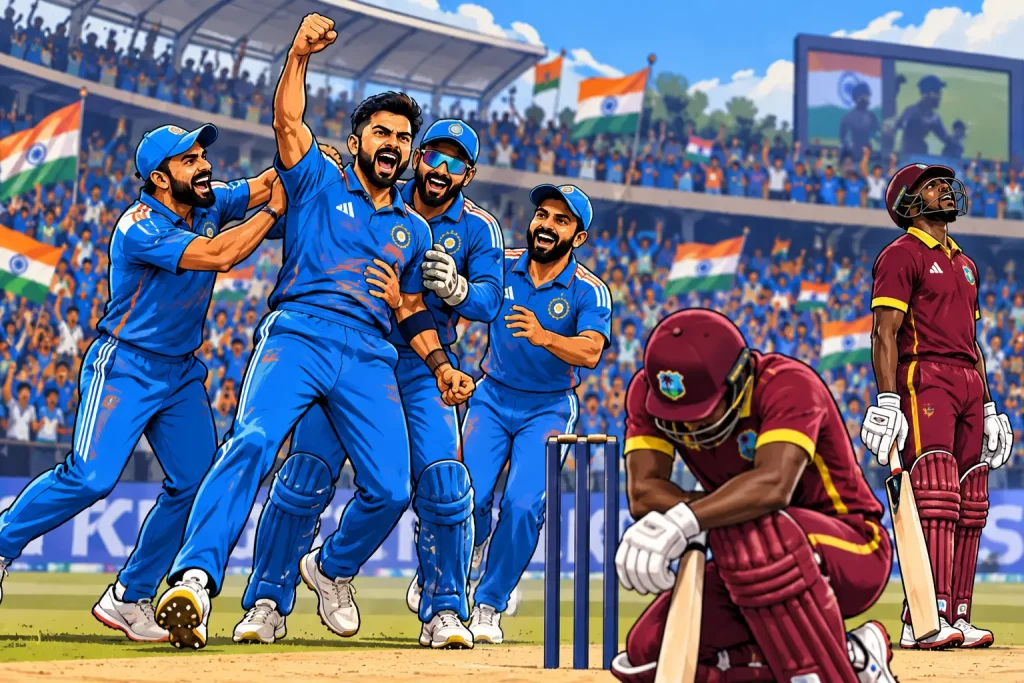
Cricket has a habit of making a comfortable evening feel like a hostage situation. India had 223 on the board in Indore, a total that should have been enough to relax on, and yet the final over was still a nervous one. When the dust settled, India had won the third T20I by 14 runs and moved ahead 2-1 in the five-match series.
A big total, but a messy finish
India were bowled out for 223, and it happened off the very last ball. That detail says something about the innings. They pushed hard right to the end, took risks when the clock was running out, and eventually ran out of wickets just as they ran out of deliveries. It was an aggressive approach, and in a format where 200 is no longer a guarantee, it was probably the right one.
West Indies then answered in the way this series has taught us to expect. They finished on 209/7, only 14 short, after a furious late charge that had the Indore crowd on its feet and, one imagines, a few Indian fans covering their eyes. Whenever the equation tightened, you could feel the tension in the stands. Hitting out is what these West Indies batters do best, and they nearly turned a lost cause into a heist.
The series so far
It helps to remember how this contest has unfolded, because it has been anything but predictable. India opened the series with an eight-wicket win in Lucknow, where Shreyas Iyer finished unbeaten on 102. That was a statement innings, calm and complete, the kind that shapes a captain’s early authority over a series.
Then came Ranchi, where the script flipped. West Indies chased down 250, a target that would have scared most teams away from even trying. They went at it without fear, and they got there. It was a reminder that this touring side can hurt anyone if its big hitters get going.
Indore, then, was the tiebreaker of sorts, and India did enough. Not comfortably, not elegantly in every phase, but enough.
What the numbers suggest
A 14-run margin on a night where both teams scored over 200 tells you the bowlers had a tough time. Neither attack could fully control the scoring, and both sides leaked runs at moments when they could least afford it. For India, that is a point worth thinking about. A team that wins by 14 after scoring 223 will want to look hard at its death bowling and its fielding. A couple of dropped chances or loose overs can turn a win into a defeat, and West Indies came uncomfortably close to proving it.
Still, there is something to be said for winning ugly. Good teams find a way to cross the line when things are not perfect. Over a long bilateral series, those are the wins that tend to matter most, particularly when the batting group is as aggressive and deep as India’s.
Iyer’s leadership under the spotlight
Shreyas Iyer has the job of leading this side, and the series has already given him plenty to think about. He has delivered with the bat in Lucknow, he has watched a 250 target get chased down in Ranchi, and he has had to manage a tense finish in Indore. A captain learns more from nights like the last one than from easy victories.
How he uses his bowlers in the closing overs, and how he sets his field when the batter is swinging for the stands, will be talked about in the days ahead. Captaincy in T20 cricket is largely a matter of nerve, and a 2-1 lead is a decent early sign that his decisions are mostly working.
The batting engine
Even in a game decided by a handful of runs, the India vs West Indies T20I conversation keeps returning to how fearless the Indian top order has become. Players like Abhishek Sharma have helped set the tone for this team: attack early, take the powerplay seriously, and make the opposition chase a mountain. When that approach comes off, scoreboards balloon quickly. When it does not, wickets fall in clusters, and a total like 223, bowled out off the last ball, shows both sides of that coin.
It is a thrilling way to watch cricket, even if it can be stressful for anyone who likes their matches calm. Fans of this India side have largely accepted the bargain. They would rather see a team swing and occasionally miss than play it safe and finish with 160.
What happens in Hyderabad
The series now moves to Hyderabad for the fourth T20I on Wednesday, and the stakes are simple. A win would give Iyer’s side an unassailable lead in the five-match series, which means they would clinch it with a game to spare. That kind of situation can be both a blessing and a trap. A team that is one win away from a series victory sometimes plays freely and sometimes tightens up, and which version shows up is hard to predict.
For West Indies, the equation is just as clear. They have to win to stay alive, and a side with nothing to lose is a dangerous one. Their batters have already shown in Ranchi and Indore that they can chase big totals, so nobody in the Indian camp will be treating the IND vs WI 4th T20 as a formality.
A series worth watching
What makes this series enjoyable is that neither side is playing it safe. There have been centuries, huge chases, a 250 target conquered, and a finish in Indore where the winning margin was smaller than the number of runs in a single big over. For neutral fans, that is a good deal. For anyone with a stake in the result, it is a lot more nerve-wracking.
India lead 2-1 and have the momentum going into Hyderabad. West Indies have the firepower to spoil it. If the first three matches are any guide, whoever wins the fourth T20I will have earned it the hard way, and the final few overs will probably decide it again.