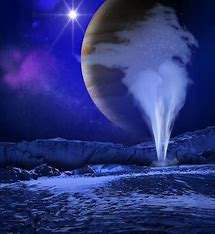
NASA scientists have uncovered fresh evidence suggesting that Jupiter’s moon Europa could be venting material from a vast ocean beneath its icy surface—raising new hopes in the ongoing search for alien life.
Recent studies using data from the Hubble Space Telescope and upcoming mission insights from the Europa Clipper have revealed that Europa’s fractured surface may be acting as a window into the subsurface ocean lying miles beneath. Researchers have detected signs of salts and organic compounds in regions where the moon’s icy crust appears most disturbed.
Europa has long been of interest to planetary scientists because of its potential to host liquid water beneath its frozen exterior. Now, findings indicate that the fractured regions—especially areas called “chaotic terrains”—may result from the upward movement of warmer water or slushy ice, forcing its way through cracks in the moon’s surface.
Surface Clues Suggest Subsurface Activity
Spectral analysis of Europa’s surface shows hydrated salts and other substances that likely originated from its internal ocean. These materials are concentrated in zones where the crust is visibly disrupted, pointing to geological activity beneath.
“These regions could be acting like conduits,” said Dr. Elena Rivera, a geophysicist affiliated with the Europa Clipper mission. “What we’re seeing may be the result of material from the ocean below making its way to the surface through fractures in the ice.”
Thermal imaging supports this theory, as slightly elevated temperatures have been recorded in these same areas. Scientists believe tidal forces caused by Europa’s orbit around Jupiter are responsible for generating internal heat, keeping its ocean in a liquid state.
Organics Found Near Fractures
Perhaps the most exciting aspect of the discovery is the identification of organic molecules—compounds that contain carbon and are essential for life as we know it. While the presence of these molecules does not confirm life, it adds to growing evidence that Europa’s environment may be suitable for sustaining microbial organisms.
Conditions on Europa are often compared to deep-sea hydrothermal environments on Earth, where life thrives without sunlight. If similar energy sources exist beneath Europa’s crust, it’s possible that simple life forms could survive there as well.
Next Steps: Europa Clipper Mission
NASA’s Europa Clipper, set to launch in 2025, will carry sophisticated instruments designed to investigate Europa’s surface and subsurface features. The spacecraft will conduct multiple flybys to map the moon’s composition, measure ice thickness, and detect signs of geological activity.
Additionally, the European Space Agency’s JUICE mission will complement NASA’s efforts by exploring Europa and other icy moons in the Jovian system.
Conclusion: A Step Closer to Answering Life’s Big Question
Although no direct evidence of life has yet been found, the discovery of oceanic material possibly leaking through Europa’s icy shell significantly strengthens its status as one of the most promising locations for life beyond Earth. The findings not only enhance our understanding of Europa but also broaden the scope of astrobiology across our solar system.
As missions like Europa Clipper prepare to explore this intriguing moon more deeply, scientists are optimistic that the answers to one of humanity’s oldest questions—Are we alone?—might lie beneath Europa’s fractured surface.