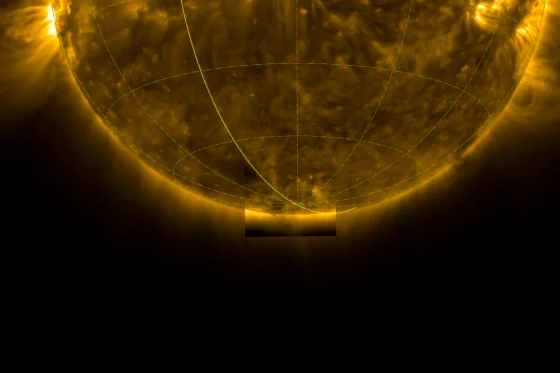
Paris, June 12, 2025 — In a major milestone for solar research, the European Space Agency’s (ESA) Solar Orbiter has captured the first-ever close-up images of the Sun’s south pole. The breakthrough promises to enhance scientific understanding of solar activity and improve predictions of space weather events that can impact Earth.
The images, released by ESA on Monday, were taken during the Solar Orbiter’s recent close approach to the Sun. The spacecraft, launched in February 2020 in partnership with NASA, used its advanced imaging systems to photograph the Sun’s southern region, which has remained largely unexplored until now.
“These are the most detailed images we have ever seen of the Sun’s south pole,” said Daniel Müller, ESA’s Solar Orbiter project scientist. “This data is crucial for understanding the Sun’s magnetic field and the dynamics behind solar activity.”
Pioneering Solar Observation
Unlike previous solar missions that primarily focused on the Sun’s equator, the Solar Orbiter was specifically designed to gradually tilt its orbit, enabling unique polar views. The recent flyby, which brought the spacecraft within 42 million kilometers of the Sun, allowed it to record high-resolution data using instruments like the Extreme Ultraviolet Imager (EUI) and Polarimetric and Helioseismic Imager (PHI).
Scientists believe the Sun’s poles play a key role in generating the solar magnetic field and driving the 11-year solar cycle, which influences the frequency of solar storms, flares, and coronal mass ejections (CMEs).
Impact on Space Weather Forecasting
Understanding solar pole activity is critical for forecasting space weather — a field of growing importance due to the global reliance on satellites, navigation systems, and power infrastructure. Solar storms can disrupt communications, damage spacecraft, and affect power grids on Earth.
“With the Sun currently nearing the peak of Solar Cycle 25, these images arrive at a pivotal time,” said ESA Director of Science Carole Mundell. “This new data can improve our ability to predict space weather and protect technological systems on Earth.”
A Technological Achievement
Capturing images so close to the Sun is a complex task. The Solar Orbiter is equipped with a specially designed heat shield and instruments capable of withstanding extreme temperatures and radiation. Its success is seen as a demonstration of European engineering and international cooperation.
The mission also represents a joint effort with NASA, which provided key components and scientific support. ESA officials highlighted the importance of this collaboration in advancing heliophysics — the study of the Sun and its interactions with the solar system.
Continued Mission Ahead
Over the coming years, the Solar Orbiter will continue adjusting its orbit to allow for even better views of both solar poles. Scientists are hopeful that this mission will answer key questions about the solar dynamo — the process that governs the Sun’s magnetic field and its periodic reversals.
As the world becomes increasingly dependent on space-based technologies, the need for accurate space weather forecasting grows. The newly captured images of the Sun’s south pole mark a critical step in meeting that challenge, opening a new chapter in the study of our closest star.