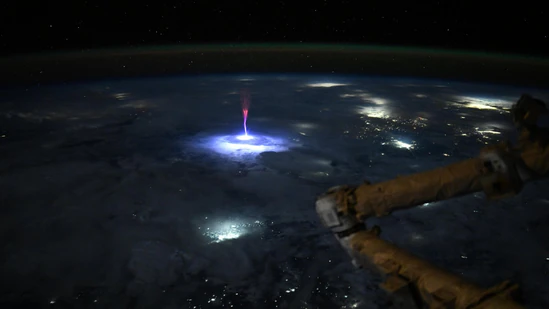
4 July, 2025-A NASA astronaut aboard the International Space Station (ISS) has captured a striking image of a rare upper-atmospheric lightning event known as a “sprite,” offering a rare glimpse of this fleeting natural phenomenon. Sprites are brief, luminous flashes that occur far above thunderstorms and are part of a group of atmospheric phenomena known as Transient Luminous Events (TLEs).
These electrical discharges occur in the mesosphere, usually between 50 and 90 kilometers above the Earth’s surface. Unlike traditional lightning, sprites travel upward from storm clouds and typically appear as bright, red-orange bursts shaped like jellyfish or tendrils. Due to their altitude and rapid appearance—lasting only a few milliseconds—they are exceptionally difficult to observe from the ground.
The recently captured image shows a vivid red glow radiating through the upper layers of Earth’s atmosphere, with the deep blackness of space in the background. Shared through NASA’s official platforms, the image has sparked widespread interest among both scientists and the public, highlighting the visual wonder and scientific intrigue of such phenomena.
NASA officials emphasized the importance of these observations from space, noting that the vantage point aboard the ISS allows researchers to study sprites with minimal atmospheric distortion. “Photographing sprites from orbit provides invaluable data, helping us better understand the interactions between thunderstorms and the upper atmosphere,” the agency stated.
Sprites typically form above large thunderstorm systems and are triggered by extremely powerful lightning strikes. Because they are brief and emit light mostly in the red spectrum, they are rarely seen by the human eye from the ground. Observations from space not only make detection easier but also offer new insights into how these events are structured and how they evolve.
The captured sprite also contributes to ongoing scientific studies focused on the different types of TLEs, which include blue jets, halos, and elves. Each of these phenomena plays a role in the Earth’s complex electrical environment, and their study could help researchers better understand how energy moves between the Earth’s surface and the ionosphere.
Experts believe that increased documentation of such events can also inform atmospheric modeling and improve our understanding of how upper-atmosphere discharges may affect radio communications, GPS systems, and even satellite operations.
Public response to the image has been equally enthusiastic, with many describing it as a stunning example of nature’s hidden beauty. For the astronaut who captured it, the moment was a rare opportunity to witness Earth’s atmospheric activity from a unique perspective.
As research into space weather and atmospheric science continues, images like this not only enhance our scientific knowledge but also deepen our appreciation for the dynamic and awe-inspiring planet we inhabit.