
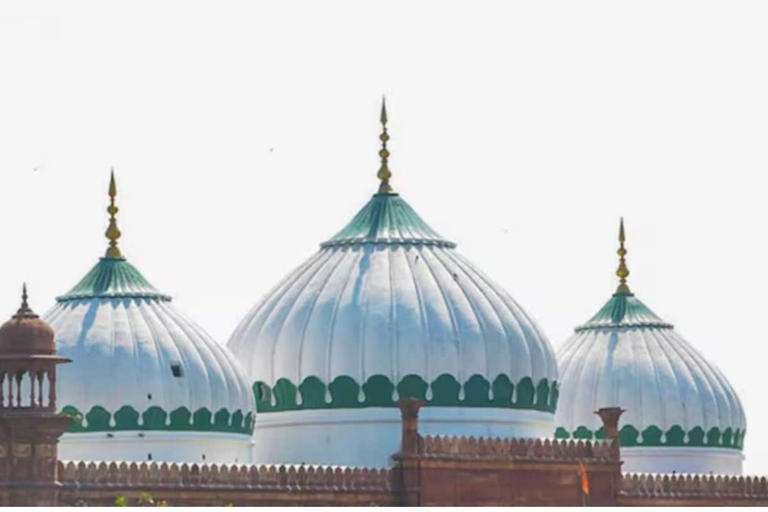
In a significant development in the Krishna Janmabhoomi-Shahi Eidgah legal battle, the Allahabad High Court has rejected a plea that sought to label the Shahi Eidgah mosque in Mathura as a “disputed structure.” The court’s decision is expected to influence the course of the ongoing civil suits linked to the sensitive religious site.
The plea was part of the larger legal proceedings in the Krishna Janmabhoomi case, where petitioners have challenged the presence of the Shahi Eidgah mosque adjacent to the Shri Krishna Janmabhoomi temple in Mathura. The petitioners argue that the mosque was allegedly constructed on the birthplace of Lord Krishna and should therefore be recognized as part of the temple land.
The court, while dismissing the application, held that labelling the Shahi Eidgah mosque as a “disputed structure” at this stage was premature and legally unwarranted. Justice Mayank Kumar Jain, who presided over the case, emphasized that the dispute must be adjudicated based on factual evidence and legal proceedings, not through speculative terminology.
The rejected plea had requested the court to officially record the Eidgah as a disputed property under litigation, which could have had implications on security, archaeological surveys, and potential demolition risks. The High Court ruled that such a declaration could not be made in the interim, and that any such categorization must be based on conclusive findings during trial.
The Krishna Janmabhoomi dispute, much like the Ayodhya Ram Janmabhoomi-Babri Masjid issue, has stirred political and religious sentiments across the country. However, unlike Ayodhya, the Mathura dispute is still in its early stages of litigation and lacks a Supreme Court verdict.
The court’s latest decision comes amidst heightened scrutiny of religious sites across India. In recent years, similar disputes have emerged in Varanasi (Gyanvapi mosque case) and other locations where historical religious structures of different faiths coexist.
Legal experts view the High Court’s order as a reaffirmation of judicial restraint and procedural correctness. “The court rightly refused to jump to conclusions before the matter has been fully heard,” said constitutional lawyer Ramesh Gupta. “It sends a message that sensitive disputes must be resolved through evidence, not assumptions.”
The Shri Krishna Janmabhoomi Mukti Dal, which is pursuing the case, has stated that it will continue to seek legal remedies to reclaim what it describes as temple land encroached upon centuries ago. Meanwhile, representatives from the Eidgah mosque maintain that the structure is lawful and that a compromise agreement made in 1968 between temple and mosque representatives remains valid.

